
Litigation Funding Battle Over Litigation Control

April 26th, 2023|Categories: Complex Business Litigation, Corporate Compliance, HB Risk Notes|Tags: , , |

Sysco and Burford Capital Butting Heads Over Litigation Control. Food giant claims funder is interfering with antitrust litigation. Funder says its client is settling for too little.  Public dustups over litigation funding are rare. Leading litigation funder Burford Capital LLC and food distribution giant Sysco Corp. are locking horns over the control and use of litigation funds. Burford says Sysco is settling Burford-funded antitrust litigation for amounts that deny the financial company optimal return on its investment. Sysco says the funder has overstepped its bounds and interfered with Sysco’s litigation oversight. Sysco received $140 million from Burford in part to fund price-fixing lawsuits against poultry, pork and beef producers – complex multidistrict litigation involving hundreds of plaintiffs, dozens of defendants, and related criminal suits brought by the Department of Justice (DOJ). So far, settlements of private antitrust litigation have reached into the hundreds of millions, and DOJ has levied more than $100 million in fines. Burford, which gets a share of any settlements in the antitrust litigation, says Sysco is settling for too little. Sysco has sued companies associated with Burford – Glaz LLC, Posen Investments LP, and Kenosha Investments LP – claiming they are meddling in Sysco’s settlement efforts. Glaz, Posen, and Kenosha are all companies which have Burford Capital Limited as the only direct or [...]


Alleged Hair Product Injuries Impact Women of Color

April 26th, 2023|Categories: Class Actions, Complex Business Litigation, Environmental Torts, Mass Torts|Tags: , , , |

L’Oréal Among Defendants in Litigation Over Hair Products. Dozens of hair straightener cases allege higher incidence of cancers and other diseases. Plaintiffs in dry shampoo litigation say products contain benzene.  Seven companies control the U.S. hair product industry. L’Oréal has been hit hard in recent hair care litigation related to straighteners, relaxants, and dry shampoos. L’Oréal was named a defendant in nearly sixty complaints alleging that straightening products manufactured by the beauty giant have caused cancer in its consumers. L’Oréal has also been named a defendant in a proposed class-action for its Redken dry shampoo that allegedly contains the carcinogen benzene. Other large industry players such as Johnson and Johnson and Unilever have also been accused of selling dry shampoos with dangerous levels of benzene. Straighteners and Relaxers Litigation Dozens of cases have been consolidated in multidistrict litigation against L’Oréal for its potentially cancerous hair straighteners and relaxers. Mitchell v. L’Oréal USA Inc. is a typical case.  It was filed by Missourian Jennifer Mitchell, a black woman, after her diagnosis of uterine cancer which she claims was caused by endocrine disrupting chemicals (EDCs) in L’Oréal’s hair straighteners and relaxers. Jennifer Mitchell was diagnosed with her cancer on August 10, 2018. “Ms. Mitchell was first exposed to EDCs and/or phthalate-based products around 2000, at or around the age [...]

Pixel Litigation the Latest Craze in Privacy Law

April 7th, 2023|Categories: Complex Business Litigation, HB Risk Notes, Technology Law|Tags: , , , , |

Meta, Google Face Barrage of Pixel Lawsuits in Digital Privacy War META PLATFORMS INC. AND GOOGLE  are currently facing nearly 70 lawsuits involving large companies and some hospital systems or individual health care providers utilizing Pixel tracking tools embedded on their websites and applications. Sensitive private data such as financial information gathered from filing tax returns online or patient healthcare information stored on patient portals is being actively tracked and sent to Meta and Google for both analytical and advertising purposes. Tracking pixels are a 1x1 Pixel graphic that serves as a snippet of code used for tracking user behavior, site conversions, web traffic, and other metrics generated from a site’s server. In 2018, Meta told Congress that there were more than 2 million Pixels across the web, which at the time, was one of the largest data-harvesting operations most internet users had ever seen. Meta makes their Pixel code freely available to anyone and any business – thus the amount of Pixel tracking has exponentially grown since Meta testified before Congress. The analytical information that companies gleam from Pixel tracking is paying off and is featured on everything from fast food companies such as Chick-Fil-A, media companies like iHeart Radio, and even tax-filing websites such as Tax Slayer or TaxAct. Pixel Tax Data On November 22, 2022, [...]

Toxic Train Wreck Sparks Litigation

April 7th, 2023|Categories: Complex Business Litigation, Environmental Torts, HB Risk Notes|Tags: , , , |

Legal News: Ohio AG Sues Norfolk Southern Over East Palestine Train Spill. Legal News On March 14, 2023, Ohio filed a lawsuit against Norfolk Southern Railway Company, a multi-billion dollar entity, in the U.S. District Court for the Northern District of Ohio. The lawsuit stems from the East Palestine train derailment (the “Derailment”), which took place on February 3, 2023. The lawsuit seeks to “recover response costs, redress damages to natural resources, and receive an order for injunctive relief, civil penalties, and damages.”  The Derailment  The Derailment of train 32N occurred at approximately 9 PM in East Palestine, Ohio—roughly fifty miles northwest of Pittsburgh, Pennsylvania. The accident is believed to have been caused by the overheating and failure of at least one wheel bearing. Twenty of the derailed cars contained hazardous materials, including vinyl chloride, butyl acrylate, ethylhexyl, acrylate, and ethylene glycol monobutyl ether.  Chief among the substance concerns was vinyl chloride, which emits toxic substances when it burns. The Environmental Protection Agency (EPA) states that it was notified of the Derailment about two hours after it occurred, and personnel were on site five hours after the accident. The surrounding downwind area was evacuated. Reports were made of health and safety hazards to people and animals in the affected region. Three days after the crash, emergency responders intitiated a controlled [...]

Reimagining the Administration of Justice with Qudsiya Naqui of Pew Charitable Trust

February 27th, 2023|Categories: ELP, Emerging Litigation & Risk, HB Tort Notes, Law Firm Operations, Technology Law|Tags: , , , , |

Before COVID-19 came to America in early 2020, “going to court” literally meant putting on your shoes and walking into a courthouse, typically a large building with courtrooms inside, and people in robes and business suits and, in some cases, more restrictive attire.  Stoked by necessity, courts sprinted toward solutions for keeping the wheels of justice spinning while also keeping everyone away from each other. Until then it didn’t seem possible that attorneys could or would appear before judges via digital screens, like George Jetson getting yelled at by Mr. Spacely over some hilarious mishap at the sprocket factory. Pew Charitable Trust concluded an in-depth study of the courts with the 2021 release of a report,  “How Courts Embraced Technology, Met the Pandemic Challenge, and Revolutionized Their Operations.” After examining emergency orders from all 50 states and Washington, D.C., and court approaches to virtual hearings, e-filing, and digital notarization, the researchers wrote that it was a time for "reimagining how to administer justice.” Was the adoption of technology effective? Were there any hiccups? Was technology widely embraced? Were the effects of new efficiencies enjoyed evenly across the socio-economic spectrum? Do we think courts will continue to reimagine how they administer justice without the crushing pressure of widespread disease? Listen to my interview with Qudsiya Naqui who leads Pew’s research at the intersection of technology [...]

Litigation’s Role in Gun Safety Advocacy: An Interview With Adam Skaggs of Giffords

October 14th, 2022|Categories: Emerging Litigation & Risk, News|Tags: , , , , |

Read the article We’re closing in on 400 million guns in America, weapons that have been used to kill 1.5 million Americans between 1968 and 2017. Can litigation be an effective tool in curbing this loss of life? In 2020 alone there were more than 45,000 gun deaths. The beyond tragic and senseless mass shootings at schools has become all too routine. Most Americans want stricter gun laws which they believe will reduce the senseless killing in our country, which leads the world in both the number of privately owned firearms and gun-related deaths. The Supreme Court, of course, didn't take public opinion into account when it struck down a more than century old New York City ban on concealed firearms. Politicians do, however, pay close attention to polls. At the federal level, President Joe Biden signed a bipartisan law designed to make Americans safer in our gun-toting nation. Hailed as a "great start" and a rare but welcome exercise in reaching across the aisle, the law will result in safer citizens, but didn't include much of what gun advocates say is really needed to effect meaningful change. In California, Governor Gavin Newsom signed a new law that gives citizens incentives to pursue gun manufacturers and dealers who sell illegal firearms. In New York, Democratic leaders, undaunted by the [...]

Federal Judge, Two Attorneys Honored for Excellence in Ethics in Complex Litigation

September 28th, 2022|Categories: Class Actions, Complex Business Litigation, HB Tort Notes, News|Tags: , , |

For Immediate Release U.S. Appellate Judge, Two Attorneys Honored for Ethics in Complex Litigation First-ever awards for ethics in complex litigation excellence will be presented Oct. 22, 2022. Nominations were evaluated by a committee comprising a federal judge, scholars, and litigators. Committee selected a current judge on the Ninth Circuit U.S. Court of Appeals, a plaintiff’s attorney, and a defense attorney. SAN FRANCISCO – Sept. 28, 2022 – Nominated for their contributions to ethics in class actions and complex litigation, the first-ever recipients of the Awards for Excellence in Ethics in Complex Litigation are: jurist, scholar, and teacher, the Honorable William Fletcher; preeminent plaintiff’s attorney Elizabeth J. Cabraser; and distinguished employment defense attorney Fred W. Alvarez. The awards will be presented at the inaugural Complex Litigation Ethics Conference on Oct. 22, 2022, held at the UC Hastings College of the Law in association with the college’s Center for Litigation and Courts. Program co-chairs Joshua P. Davis and Scott Dodson – both professors at UC Hastings – have assembled an exemplary faculty of leading jurists, litigators, and other subject matter experts. “In developing this program we wanted not only to educate litigators and stimulate discussion on the important and evolving ethical aspects of this practice, but also to honor those who have demonstrated leadership, scholarship, and dedication in promoting ethical [...]

Covid Insurance Coverage Decisions with Guest Marshall Gilinsky. Are Policyholders Catching Up?

September 22nd, 2022|Categories: ELP, Emerging Litigation & Risk, News|Tags: , , , , |

According to the online Covid Coverage Litigation Tracker (CCLT) run by Penn Law there have been more than 2,300 insurance coverage cases filed over denial of claims relating to Covid-19. Restaurants and bars were hardest hit by the pandemic and so led the way in seeking – and being denied – coverage, too. They are also leading the way in suing their insurers. The top five insurers in the defense position are Chubb Limited at #5, then #4 Lloyds of London, #3 Cincinnati Financial, and #2 Zurich.  And in the #1 position facing the most coverage suits is Hartford.  The insurance industry started off strong when this litigation began, winning the vast majority of the coverage suits. And they continue to do well, scoring with the argument that many of the claims do not involve actual property damage. Government closures don’t cause property damage, they argue. Courts have largely been siding with the carriers – but not all. Policyholders, a tenacious bunch, appear to be chipping away at the body of law in this suddenly expanding category. A recent case involving a New Orleans restaurant against Lloyd’s was penciled into the win column for carriers by a trial court , but an appeals court erased it and wrote the policyholder a narrow 3-2 victory. The appeals court said the language [...]

EMR Audit Trail—What Is It? Why Do They Matter? What Should You Look For? by Haley K. Grieco and Brooke E. Reddin

September 20th, 2022|Categories: Emerging Litigation & Risk, HB Tort Notes, Journal, Mass Torts, New Featured Post for Home Page, News|Tags: , , , , |

The Authors Haley K. Grieco (hgrieco@hallboothsmith.com) is a partner in the Paramus, New Jersey, office of Hall Booth Smith, where she defends physicians, hospitals, and other healthcare providers in a wide range of medical malpractice litigation. Brooke E. Reddin (breddin@hallboothsmith.com) is an associate with the firm, where she focuses her practice on healthcare, medical malpractice, and aging services litigation. Interviews with leading attorneys and other subject matter experts on new twists in the law and how the law is responding to new twists in the world. EMR Audit Trail—What Is It? Why Do They Matter? What Should You Look For? "As the healthcare industry becomes increasingly digitized, it is imperative that attorneys appreciate the impact it may have on their clients and their practice. In medical malpractice matters, discovery requests for metadata—specifically, the production of the EMR audit trail—has steadily increased over the past few years." Abstract: Maintaining electronic medical records, or EMRs, is now a nearly universal best practice among medical providers from small physician practices to large hospital networks. Unlike handwritten or typed records, these digital documents carry with them much more data than meets the eye. In this article, the authors—two medical malpractice attorneys— discuss what attorneys need to know about EMRs in the litigation context and [...]

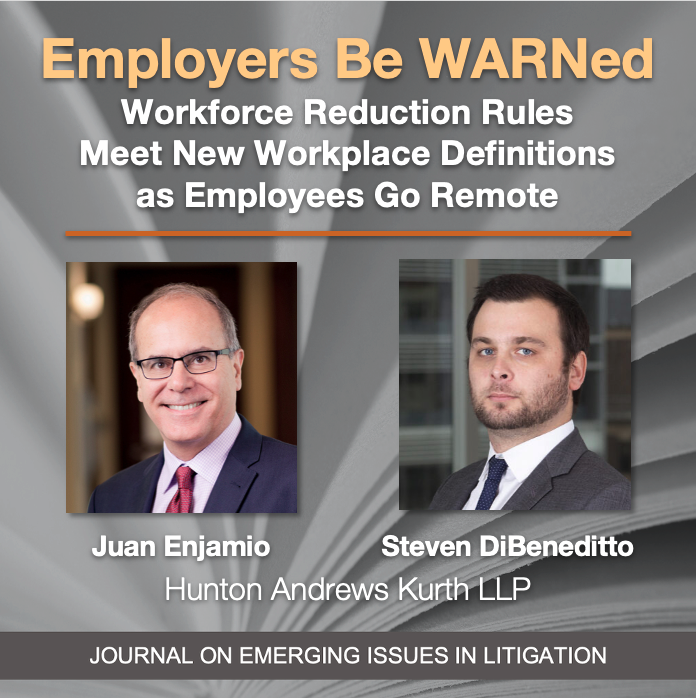
Employers Be WARNed: Workforce Reduction Rules Meet New Workplace Definitions as Employees Go Remote by Juan Enjamio and Steven DiBeneditto

September 6th, 2022|Categories: Emerging Litigation & Risk, Employment, Journal, New Featured Post for Home Page, News|Tags: , , , , |

The Authors: Juan C. Enjamio (jenjamio@huntonak.com) is managing parter of the Miami office of Hunton Andrews Kurth where he dedicates his practice to complex domestic and international employment law matters. Steven J. DiBeneditto Jr. (sdibeneditto@huntonak.com) is a Washington, DC-based associate in the firm’s employment and labor group. Interviews with leading attorneys and other subject matter experts on new twists in the law and how the law is responding to new twists in the world. Employers Be WARNed Workforce Reduction Rules Meet New Workplace Definitions as Employees Go Remote "Numerous courts have opined that a “home base” is a place in which the employee has some sort of physical connection. But this connection must be more than a “notional” base, whereby the employee has a menial relationship." Introduction A common sentiment during the Covid-19 pandemic was that a different society would emerge from its ashes. While overstated in many cases, one segment of society that appears to have changed for good is the white collar workplace. Indeed, after enjoying the flexibility of working from home for more than 2 years, many white collar workers are demanding that a remote work option remain a permanent fixture at their place of employment. And with seemingly no negotiating leverage due to worker shortages across the [...]

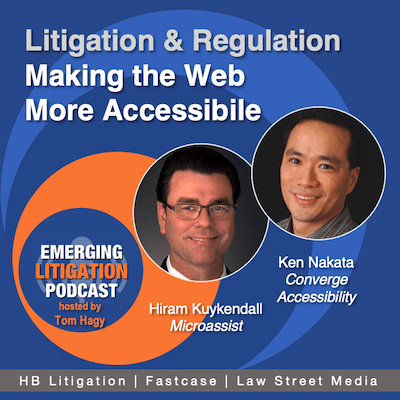
The Role of Litigation and Regulation in Making the Web More Accessible with Guests Ken Nakata and Hiram Kuykendall

September 2nd, 2022|Categories: ELP, Emerging Litigation & Risk, News, Technology Law|Tags: , , |

According to the International Agency for the Prevention of Blindness there are 43 million people around the world living with blindness, and 300 million living with moderate to severe visual impairment. Put those statistics next to these: There are nearly 2 billion websites, and 550,000 created every day. Shouldn’t sight-impaired people have the same access to these sites as sighted people? Of course they should. There is good news. After previously announcing guidance, the DOJ says new regulations are on the way under Title II of the Americans with Disabilities Act, which describes the obligations for state and local governments. My guests say there are many reasons to be excited about this. My guests say there are many reasons to be excited about this. Ken Nakata is Co-Founder and Principal at Converge Accessibility, whose solutions help make sure websites and other technologies are accessible to people with disabilities. Ken is former Senior Trial Attorney with the DOJ Disability Rights Section where he developed nationwide ADA policies for the internet. Joining Ken is Hiram Kuykendall, Chief Technology Officer at Microassist, an Austin-based learning and development consulting. Hiram is a technical leader with hands-on experience in instructional design and digital accessibility. This podcast is the audio companion to the Journal on Emerging Issues in Litigation. The Journal is a collaborative project between HB Litigation Conferences and the Fastcase legal research family, which includes Full Court Press, Law [...]

Lien Resolution: Government & Private Plans Get Aggressive (Against Attorneys)

August 19th, 2022|Categories: CLE OnDemand, Featured On-Demand, Insurance, Mass Torts|Tags: , , , , |

Includes Nearly 75 minutes of insights from experienced professionals. CLE credit: 1+ (subject to bar rules). For CLE questions: CLE@LitigationConference.com The complete Power Point presentation. Continued access to the complete recording for later use. Answers to your questions via email to the presenters or write to HB and we will be sure to contact the speakers. What can you do to settle personal injury suits cleanly and avoid costly litigation and penalties? What recent cases can inform you about protecting your settlements and, as attorneys, yourselves, from post-settlement federal lawsuits? How can your firm set itself up to meet government expectations? What role might experts play in navigating these pitfalls? Medicare Advantage (42 USC § 1395w-22) Federal Medical Care Recovery Act (FMCRA) (42 USC § 2651) Armed Forces Act (10 USC §1095) Veterans’ Benefits (38 USC §1729) Third-Party Collection Rules (32 CFR 537.24; 38 CFR 17.101, etc.) Set-Asides under the Medicare Secondary Payer Act (42 USC § 1395y(b)(2)] On Demand Registration Lien Resolution Government & Private Plans Get Aggressive (Against Attorneys!) On Demand | Recorded September 2020 It is increasingly common these days. Personal injury attorneys settle a case, only to find themselves sued by a U.S. Attorney for failing to reimburse Medicare for conditional payments as required by the [...]

Go to Top