7th Circuit: Is Each Transmission of Biometric Data a BIPA Violation? | By Jennifer M. Oliver | MoginRubin LLP

January 13th, 2022|Categories: Complex Business Litigation, Emerging Litigation & Risk, Employment, HB Risk Notes, New Featured Post for Home Page, News, Technology Law|Tags: , , , |

7th Circuit: Is Each Transmission of Biometric Data a BIPA Violation? By Jennifer M. Oliver The outcome of this case will have a dramatic impact on statutory damages. The Seventh Circuit U.S. Court of Appeals has certified a question to the Illinois Supreme Court over the accrual of claims under the Illinois Biometric Information Privacy Act (BIPA). The question, posed by the court in Cothron v. White Castle Systems, Inc., reads: “Do section 15(b) and 15(d) claims accrue each time a private entity scans a person’s biometric identifier and each time a private entity transmits such a scan to a third party, respectively, or only upon the first scan and first transmission?” The case was brought by an employee of the White Castle hamburger chain, which requires fingerprint scans for employees to access computer systems. The plaintiff charged that sharing her fingerprints with a third party vendor violated the law. Cothron v. White Castle Sys., No. 20-3202, 2021 U.S. App. LEXIS 37593 (7th Cir. Dec. 20, 2021). An accrual rule based on each collection, opponents to such a finding argue, would pose potentially existential damages — especially in the class action context — since BIPA provides for statutory damages of $1,000 or $5,000 per violation. Parties disagree on whether BIPA damages are mandatory or discretionary, however. Should [...]

The New Lloyd’s Market Association War, Cyber War and Cyber Operation Exclusions for Cyber Insurance Policies | By Vincent J. Vitkowsky | Gfeller Laurie LLP

January 7th, 2022|Categories: Complex Business Litigation, HB Risk Notes, Insurance, New Featured Post for Home Page, News|Tags: , , , |

The Author Vince Vitkowsky is a partner in Gfeller Laurie LLP, resident in New York. He focuses on cyber risks, liabilities, insurance, and litigation. Vince assists insurers and reinsurers in product development, and in all aspects of coverage evaluation and dispute resolution in many lines of business, including cyber, CGL, property, and professional liability. He also assists in complex claim evaluations, and if necessary, the defense of insureds in complex matters. Vince is also a member of the Editorial Advisory Board for the Journal on Emerging Issues in Litigation. Contact: vvitkowsky@gllawgroup.com More from Vince and his colleagues. The New LMA War, Cyber War and Cyber Operation Exclusions for Cyber Insurance Policies By Vincent J. Vitkowsky On November 25, 2021, the Lloyd’s Market Association released four War, Cyber War and Cyber Operation Exclusions (“Exclusions”). The LMA Cyber Business Panel spent well over two years drafting the Exclusions, which are models for use in standalone cyber insurance policies.  Lloyd’s has agreed that they meet the requirement that all insurance and reinsurance policies written at Lloyd’s must, except in very limited circumstances, contain a clause which excludes all losses caused by war.  The Exclusions address some difficult issues troubling the cyber insurance market for several years, following cyberattacks by nation-states (“states”) and threat actors associated [...]

The Rise of Robojudges with Josh Davis

December 15th, 2021|Categories: Complex Business Litigation, ELP, HB Tort Notes, News, Technology Law|Tags: , |

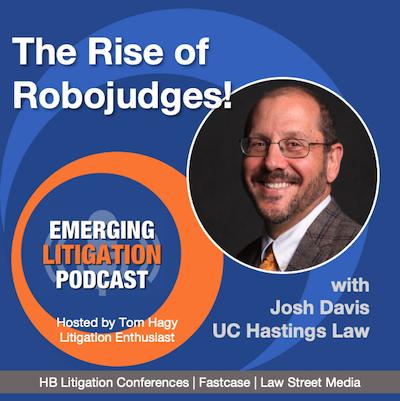
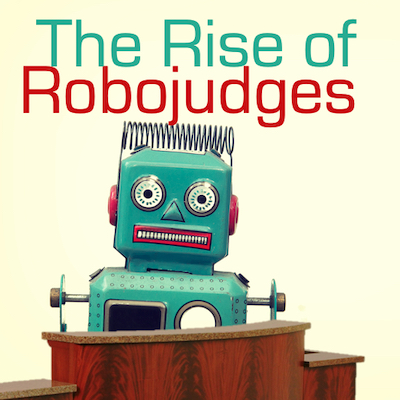
The Rise of Robojudges with Joshua Davis The good news for all of us, not the least of which are the robe and wig industries,  is that we still have time. Artificial intelligence is advancing rapidly, but it's still not able to think like a learned jurist. We can say it will have flaws, but so do our human deciders. So it will be a tradeoff, right? What are the risks? What are the upsides? Will robojudges be able to absorb infinitely more information quickly? Will they hand down decisions free from the influence of bias? Wouldn't it be great to eliminate conflicts of interest?  Joining me to discuss this not-so-out-there concept is Joshua P. Davis, a nationally recognized expert on legal ethics, class actions, and artificial intelligence in the law. He is Research Professor of Law at the University of California Hastings College of Law, and Shareholder and Manager of Berger & Montague, P.C.'s new San Francisco Bay Area Office. For more than 20 years Josh was a tenured Professor of Law at the University of San Francisco Law School, where he also served as the Director of the Center for Law and Ethics. Josh is authoring two books, one titled Unnatural Law, dealing with AI and the law, and a second on the important issue of class action ethics.  Finally, [...]

Broken Privilege and IoT with Kathryn Rattigan

December 10th, 2021|Categories: Complex Business Litigation, ELP, Emerging Litigation & Risk, News, Technology Law|Tags: , , , |

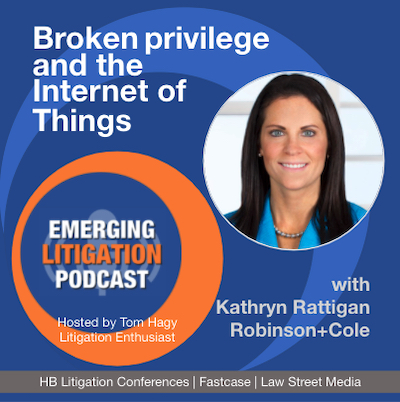
Broken Privilege and IoT with Kathryn Rattigan Joining me to discuss this emerging area of law is Kathryn M. Rattigan, a member of the Business Litigation Group, the Data Privacy + Cybersecurity Team, and the Drone Compliance Team in the Rhode Island office of Robinson Cole. Kathryn provides clients guidance regarding privacy and data protection in connection with mobile devices, data storage technologies, mobile apps, and location-based services. She  assists with the development of website and mobile app privacy policies and  terms and conditions. Kathryn is a frequent contributor to the excellent Robinson Cole Data Privacy + Cybersecurity Insider blog.  She holds a J.D. from the Roger Williams University School of Law and a B.A. (magna cum laude) from Stonehill College. This podcast is the audio companion to the Journal on Emerging Issues in Litigation, a collaborative project between HB Litigation Conferences and the Fastcase legal research family, which includes Full Court Press, Law Street Media, Docket Alarm and, most recently, Judicata. If you have comments or wish to participate in one our projects, or want to tell me how insightful and informative Kathryn is, please drop me a note at Editor@LitigationConferences.com. Finally, yes, "skeevy" is a word. And the law is not settled as to whether Shiloh has privacy rights. Tom Hagy Host of the Emerging Litigation Podcast There are now billions and billions of interconnected devices [...]

Public Justice Shares Inside Look at Roundup Trial and Appeal in First Episode of “Justice Pod”

November 8th, 2021|Categories: Complex Business Litigation, Environmental Torts, HB Tort Notes, Mass Torts, News|Tags: , , , |

Public Justice Discusses Hardeman v. Monsanto in First Episode of Justice Pod That is according to a post written by Leslie Brueckner, Senior Attorney with Public Justice following the May 2021 Ninth Circuit U.S. Court of Appeals ruling against Monsanto, and for Edwin Hardeman, a California resident who developed non-Hodgkin’s lymphoma after decades of exposure to Roundup. The jury awarded Hardeman $5,267.634.10 in compensatory damages, and $75 million in punitive damages. The district court reduced the punitive damages award to $20 million.  In this inaugural episode of Justice Pod: Conversations with Public Justice Change Makers, Leslie, is joined by David J. Wool, an attorney with the Wagstaff Law Firm.  Wool and Jennifer A. Moore of the Moore Law Group, were on the trial team led by highly-regarded mass tort plaintiff attorney Aimee Wagstaff.  Public Justice’s Brueckner served as co-lead appellate counsel along with Wool before the Ninth Circuit. Listen to what they felt inspired the jury to return such a substantial award, how Monsanto attempted to defend its actions, what the evidence revealed, and what it was like in the courtroom with the Hardeman family when the foreman read the verdict. I hope you find the episode inspiring and informative! Susan Gombert Host of Justice Pod: Conversations with Public Justice Change Makers Listen Now! Monsanto Co. has “stopped at nothing to deny the [...]

Putting an AI App to Work to Protect IP with Jan-Diederik Lindemans and Judith Bussé

November 1st, 2021|Categories: ELP, Emerging Litigation & Risk, Intellectual Property, News, Technology Law|Tags: , , , |

Putting an AI App to Work to Protect IP with Jan-Diederik Lindemans and Judith Bussé They are Crowell & Moring partner Jan-Diederik Lindemans and Judith Bussé, both part of the firm’s Technology & Intellectual Property Department in Brussels. And, working with Neotalogic, they developed an interactive app that takes you through a set of attorney-crafted questions that, depending on your answers, take you to other questions. The app applies a layer of artificial intelligence to enhance the information gathering process. Listen to what these innovators had to say about the Crowell & Moring IP Check-Up application, and take it for a test drive yourself.  Or, here is a quick video of someone using the app. This podcast is the audio companion to the Journal on Emerging Issues in Litigation*, a collaborative project between HB Litigation Conferences and the legal news folks at Law Street Media, and the Fastcase legal research family, which includes Docket Alarm and Judicata. If you have comments or wish to participate in one our projects, or want to tell me how insightful our guests are, please drop me a note at Editor@LitigationConferences.com. Tom Hagy Host of the Emerging Litigation Podcast * Highly regarded insurance and reinsurance industry attorney Laura Foggan of Crowell & Moring's Washington, DC, office is on the Editorial Advisory Board. Thanks to Laura for connecting me with J.D. and Judith.  An organization’s intellectual property is [...]

Biotech Patent Wars: If at First You Don’t Succeed . . . University of California v. The Broad Institute

October 26th, 2021|Categories: Complex Business Litigation, HB Risk Notes, Intellectual Property, Journal, News|Tags: , , |

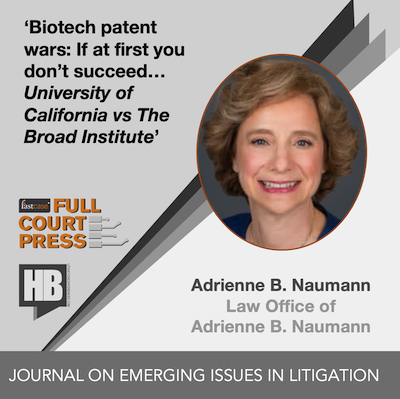
Biotech Patent Wars: If at First You Don’t Succeed . . . University of California v. The Broad Institute Abstract This case discussed in this article is about two methods of editing DNA: one that has infinitely more lucrative applications because it can edit human DNA (plus all animals and plants), another that works in cell-free environments. Whether inventions are separate or part of the same innovation is an important factor in patent interference disputes; if there are two patentably distinct inventions there cannot be interference. One party in this case lost its argument that there was only one invention at issue, but returned with a second interference claim, arguing that it was the first inventor to constructively reduce to practice the animal and plant DNA editor. In this article, the author examines the nuances and intricacies of the patent process in the world of biology, and how patent lawyers must possess a level of knowledge in disciplines related to the inventions they seek to protect. This is necessary, for example, in understanding whether an invention is a significant improvement over prior innovations. The author also shares the importance of confidentiality especially when potentially groundbreaking (and lucrative) inventions are in development. Author Adrienne B. Naumann (adriennebnaumann@uchicago.edu) practices intellectual property law at the Law Office of Adrienne B. Naumann in [...]

To Pay or Not to Pay: Does Your Insurance Policy Cover Ransomware Losses? | By Pamela Hans | Anderson Kill

October 26th, 2021|Categories: Emerging Litigation & Risk, HB Risk Notes, Insurance, Journal, News, Technology Law|Tags: , , , , |

To Pay or Not to Pay: Does Your Insurance Policy Cover Ransomware Losses? Abstract Ransomware attacks are a rapidly growing threat against organizations. Paying ransom demands is a risky proposition and may even lead to sanctions against the targeted company. Either way, the damage to a company’s operation and integrity can be cripplingly severe. Should a company suffer losses from cyber extortion, its insurance company will be one of the resources it turns to for relief. But with cyber coverage increasingly out of reach for some, policyholders may find coverage in more traditional coverages. In this article, the author evaluates the potential for coverage under several policy types, and underscores the importance of understanding policy language, the relevant law, and the potential regulatory ramifications of meeting ransom demands. Author Pamela D. Hans (phans@andersonkill.com) is the managing shareholder of Anderson Kill’s Philadelphia office. Her practice concentrates on insurance coverage exclusively on behalf of policyholders. Pam is also a member of the firm’s COVID Task Group and Cyber Recovery Group. About The Journal on Emerging Issues in Litigation is a co-production of HB, Fastcase, and Law Street Media. You can also hear the complementary (and complimentary) Emerging Litigation Podcast wherever podcasts appear. For questions, contact Tom Hagy, Editor in Chief, at Editor@LitigationConferences.com.

Wildfire Litigation and Recovery with Ed Diab

October 19th, 2021|Categories: ELP, Environmental Torts, HB Tort Notes, Mass Torts, News|Tags: , , , |

Wildfire Litigation and Recovery with Ed Diab I had the pleasure of interviewing Ed Diab, co-founder of Dixon Diab & Chambers in San Diego, about his firm’s role in the litigation, what the claims are, what defenses they encounter, settlements they have secured, what evidentiary hurdles plaintiffs face, and  more.  They’ve been successful. Since 2018, Dixon Diab & Chambers has recovered more $1.4 billion in settlements. And there is more to come. The firm represents more than 40 public entities – including some of the largest cities and counties in California – as well as thousands of individuals and families. Ed leads the firm’s mass tort practice which, in addition to wildfire litigation, represents people who allege injuries from defective drugs and medical devices. This podcast is the audio companion to the Journal on Emerging Issues in Litigation, a collaborative project between HB Litigation Conferences and the legal news folks at Law Street Media. If you have comments or wish to participate in one our projects, or want to tell me how insightful our guests are, please drop me a note at Editor@LitigationConferences.com. Thanks to Ed Diab for speaking with me about this fascinating and frightening subject, and to Baron & Budd's Scott Summy for introducing us.  For my part, I am sure my suggestion that they install smoke detectors all over the forest is complete [...]

Gamification of Stock Trading with Brad Rustin

October 14th, 2021|Categories: Complex Business Litigation, ELP, Emerging Litigation & Risk, News, Technology Law|Tags: , , , |

Gamification of Stock Trading with Brad Rustin "What's the deal?" you ask? Find out! Listen to my interview with FinTech attorney Brad Rustin, a partner with Nelson Mullins. In addition to chairing the firm’s Financial Services Regulatory Practice, Brad counsels  financial institutions in regulatory matters, including strategic agreements, product development, and operational compliance. A large portion of his work is on bank and non-bank partnerships involving white-label deployments, FinTech partnerships, or payments, digital assets, cryptocurrency, and lending partnerships. Brad is a Certified Anti-Money Laundering Specialist (CAMS) by ACAMS and a Certified Regulatory Compliance Manager (CRCM) by the American Bankers Association. He received his JD, magna cum laude, from the University of South Carolina School of Law and his BA in Political Science and History, cum laude, from Furman University. And now, he is not only a guest on the Emerging Litigation Podcast, but the FinTech advisor on the  Editorial Advisory Board of the Journal on Emerging Issues in Litigation. This podcast is the audio companion to the Journal on Emerging Issues in Litigation, a collaborative project between HB Litigation Conferences and the legal news folks at Law Street Media, and the Fastcase legal research family, which includes Docket Alarm and Judicata. If you have comments or wish to participate in one our projects, or want to tell me how insightful and informative our guests are, please drop me a note at Editor@LitigationConferences.com. [...]

A Special Episode: A lovable litigator with Danny Karon

October 8th, 2021|Categories: Class Actions, ELP, Emerging Litigation & Risk, HB Tort Notes, Law Firm Operations, News|Tags: , , |

A Special Episode: A lovable litigator with Danny Karon For  30 years attorney Daniel R. Karon has successfully represented plaintiffs and defendants in class-action and individual lawsuits. He's also chair of one of the leading class action conferences for lawyers, judges and law professors: the American Bar Association National Institute on Class Actions. He's passionate about educating up-and-coming lawyers. He teaches and writes extensively, and has been featured on podcasts and television news shows.   While practicing law (handling some intensely serious matters), Danny became acutely aware of "a societal bias against access to justice where people who need justice the most often get it the least." One response to that was to launch Your Lovable Lawyer, a multi-media website whose goal is to "make  justice more accessible to people who don’t know, can’t find, or can’t pay for lawyers." He endeavors to provide actionable insights regarding common legal problems. He refers to his "lovable" concept as "legal wellness," and encourages regular folks to take a proactive approach to legal matters and potential conflicts.  This podcast is the audio companion to the Journal on Emerging Issues in Litigation, a collaborative project between HB Litigation Conferences and the Fastcase legal research family, which includes Full Court Press, Law Street Media, Docket Alarm and, most recently, Judicata. If you have comments or wish to participate in one our projects, or want [...]

Digital Payments in Class Administration

September 9th, 2021|Categories: Class Actions, Complex Business Litigation, HB Risk Notes, Technology Law|Tags: , , |

Epiq presents DIGITAL PAYMENTS Best Practices for Efficiency in Class Actions Recorded: Sept. 23, 2020 75 minutes CLE credit: 1+ Registration includes recording, materials, and answers to your questions. TAKE IT NOW! Epiq presents a CLE-eligible webinar Digital Payments Best Practices for Efficiency in Class Actions Recorded Live | Sept. 23, 2020 produced by HB Litigation Conferences Modern life increasingly relies on digital solutions. Nothing has made that more apparent than the novel coronavirus pandemic. In terms of class action settlement payments, the impetus has never been greater to transition to the e-payment realm for security, convenience, cost-reduction, and improved fund disbursement. Class counsel and claims administrators have experimented for years with pre-paid debit cards, automated clearing house (ACH) deposits, and wire transfers, while others have tested judicial appetites for registered-user payment systems like PayPal and Venmo. However, digital payment schemes with multiple options -- the primary of which is direct deposit -- seem to be emerging as the favored solution. Though class action notice is increasingly being digitized, aided by the 2018 amendments to Federal Rule of Civil Procedure, particularly Rule 23(c)(2)(B), which permits notice by electronic means like emails and digital and social media, payment itself has lagged behind. Even with these challenges, electronic payment distribution is now a viable option. Courts are [...]

Go to Top