

Emerging Litigation Podcast

The Long and Brawny Arm of the Foreign Corrupt Practices Act with Mark Bini and Tom Suddath
Hey! Corporate corruption costs $5 trillion a year! In this episode two former prosecutors talk about the Foreign Corrupt Practices Act, the government’s leading weapon in its global war on corporate crime. They also talk about the new statute on the block, the Foreign Extortion Prevention Act, and the many complexities of this fascinating area of the law. Check out our interview with Reed Smith attorneys Mark Bini and Tom Suddath. They know this area of the law inside and out.

False Claims Act, Health Care Whistleblowers, and Whistling in the Wind with Justin Lugar
In this episode, we discuss How whistleblower cases come about, the benefits of rewarding whistleblowers, how things are done differently outside the U.S., what’s driving the acceleration of this area of law, and best practices when your company is served with guest Justin Lugar of WoodsRogers. Drawing on his background as both public servant and private practitioner, Justin walks through these issues and others.

President Biden’s Critical Infrastructure Cyber Memo and CrowdStrike’s Whoopsie Daisy with Elizabeth Burgin Waller
In this episode, we discuss our nation's critical infrastructure in the context of cybersecurity, addressing President Biden's recent National Security Memorandum on Critical Infrastructure Security and Resilience and its implications for sectors like energy, water, and transportation, with guest Elizabeth Burgin Waller of WoodsRogers. Beth also comments on a recent global system glitch that underscores the vulnerability of the networks behind many of our most critical services. We're talking CrowdStrike and Microsoft Windows.
A Shameless Plug for Our Content Services
Your content marketing is everything you’ve ever dreamed of. Right?
 Sara is marketing director at a boutique law firm. When we asked her how their blog was going, she made a sad face. But then, we made Sara smile.*
Critical Legal Content was founded by Tom Hagy, former Editor & Publisher of Mealey’s Litigation Reports and VP at LexisNexis, founder of HB, current litigation podcaster and editor-in-chief. CLC’s mission is to help smaller firms and service providers not only create content — blogs, articles, papers, webinars, podcasts (like the stuff on this site) — but also to get it out there. How? Via social media, this website, your website, and potential via our podcast and journal which we publish in collaboration with vLex Fastcase and Law Street Media. The goal is to attract readers and dizzy them with your brilliance.
*Inspired by actual events.
Create content like a real legal publisher.
Emerging Litigation Journal

Resolving Business Disputes Without Burning Bridges Featuring Judge Alan Fine on the Emerging Litigation Podcast
In this episode of the Emerging Litigation Podcast, retired Judge Alan Fine of Private Resolutions explores how businesses can resolve disputes without destroying valuable relationships. Drawing on decades of experience on the bench and in commercial litigation, Judge Fine explains the pros and cons of mediation, arbitration, and “private judging,” which allows parties to choose their own judge and resolve matters quickly and confidentially. He shares how aligning your dispute resolution strategy with business objectives—rather than emotions—can preserve partnerships, save time, and achieve fair results.

Insurance Coverage Litigation’s Modern Mayhem with Jeremy Moseley on the Emerging Litigation Podcast
Insurance coverage litigation isn’t what it used to be. In this episode of the Emerging Litigation Podcast, Jeremy Moseley of Spencer Fane unpacks how automation, AI, climate change, and “social inflation” are reshaping risks and fueling high-stakes disputes. From thermonuclear verdicts to dangerous policy gaps, Jeremy offers sharp, practical insights into what insurers, policyholders, and lawyers should expect next.

Federal Courts Issue Contrasting Rulings on AI Training and Copyrighted Books Fair Use
Federal courts in California just issued conflicting rulings on whether training AI models with copyrighted books qualifies as fair use. In Bartz v. Anthropic, the court protected training on lawfully purchased works but rejected the use of pirated copies. In contrast, Kadrey v. Meta allowed AI training on pirated books, calling it “highly transformative.” Tom Hagy explains that with more than 50 similar lawsuits pending, these decisions underscore the legal uncertainty facing tech companies, publishers, and creators—and could reshape the future of AI development and copyright law.
HB Webinars on CeriFi LegalEdge
Rule 23(c)(4) Issue Certification: Reconciling the Conflict With the Predominance Requirement
Rule 23(c)(4) Issue Certification: Reconciling the Conflict with the 23(b)(3) Predominance Requirement Proposed class actions seeking monetary damages are often difficult to certify because common issues do not predominate over individualized issues as required by Rule 23(b)(3). Rule 23(c)(4) provides that "[w]hen appropriate, an action may be brought or maintained as a class action with respect to particular issues."Although Rule 23(c)(4) has been part of the rule since the landmark 1966 amendments, it was often overlooked until the Supreme Court's decision in Wal-Mart v. Dukes. Plaintiffs now routinely seek limited issue certification for purported common issues, such as liability, arguing that questions of injury, reliance, or causation should be left for individual cases. When approved, this approach increases defendants' exposure by permitting certification in some cases that would otherwise fail the Rule 23(b)(3) standards.The federal circuits are now in a three-way split on how issue certification should be treated under Rule 23(b)(3)'s predominance requirement. While the Fifth Circuit has taken the textual view in Castano v. American Tobacco Co. that permits issue certification only if the class first qualifies under Rule 23(b)(3), the Ninth, Sixth, Second, and Seventh Circuits have adopted the opposite view that Rule 23(c)(4) certification does not require predominance. The Third Circuit has clarified and heightened the test in Russell v. Educ. Comm’n for Foreign Med. Graduates, 20-2128 (3d Cir. Sept. 24, 2021), but offers both sides plenty to consider. The remaining circuits are uncommitted, leaving the district courts to address the matter.Listen as our panel of experienced class action litigators analyzes the varying circuit court positions on Rule 23(c)(4) issue classes and the implications of practitioners' decisions when pursuing or opposing class certification. Outline The emergence of issue classes under Rule 23(c)(4) What is an issue class? How are they being strategically used? Where are the grey areas? Key court decisions on issue class certification Textual and historical analysis of Rule 23(c)(4) Strategies for defending [...]
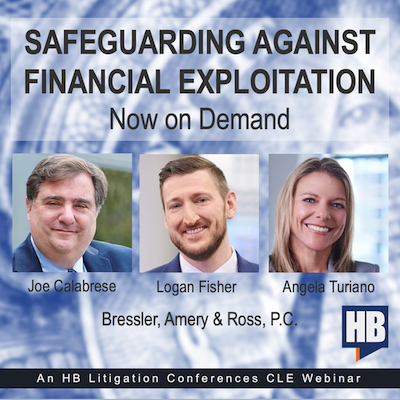
Safeguarding Against Financial Exploitation
An on-demand CLE-eligible webinar Safeguarding Against Financial Exploitation America’s senior population is growing. Nearly one in five U.S. residents will be 65 or older in 2030. Which means the average age of U.S. investors is climbing too. With that comes the risk that they will be exploited by people with access – or gain access through nefarious methods – to their investment portfolio. Seniors and vulnerable persons lose billions of dollars each year. Remarkably, 90% of the people to take advantage of senior investors are members of their own family. Attorneys who represent senior clients need to know the signs of vulnerability, red flags that their clients are being exploited, what laws apply, and rules lawyers must follow in these matters. Questions our speakers answer: What is senior / vulnerable investor exploitation? Who is protected by state and federal laws? How prevalent is senior financial exploitation? What do the numbers tell us? What is the pace of financial abuse SAR filings by securities firms? What are the most popular scams? What is diminished capacity? What are the red flags indicating possible exploitation? What are the laws, rules, and regulations governing law firms? What are some best practices for law firms? How can firms best protect their senior clients? On Demand CLE Webinar What You Get PowerPoint and supplemental materials. Complete recording for later review. Answers to your questions via email. Invitation to contact speakers. 1.5 CLE credits (for licensed attorneys). CLE assistance.* *Subject to state bar rules. For licensed attorneys. Register Meet the Speakers Joseph Calabrese Bressler, Amery & Ross, P.C. A 1991 Graduate of St. John’s University Law School, Mr. Calabrese brings 30 years of practice and 18 years of Securities Litigation/Regulatory experience to his role as principal in the New York office [...]







Epiq Class Action Settlement Efficiency
Epiq presents a CLE-eligible webinar Wait Wait ... Don't Settle! Essential elements of effective class action settlements. When it comes to complex class action litigation, once the hard work is done – litigation and settlement – more hard work begins – administering it. But is the deal really ready? After years of arduous proceedings, discovery, motions, appeals, hearings, negotiations, and more, the scope and structure of your settlement has been drafted. Everyone is in agreement. The hard work of the courts, the attorneys, the legal teams, and the litigants is complete. Now it's time to administer the settlement. Send out notices. Cut the checks. Get people paid. Boom! Sit back and relax. Get a claims administrator to take it from there. But wait … you find out that the terms of the agreement, the promises made, the budget established, and the deadlines calendared are not only inefficient, they are completely unworkable. Now the settlement is in jeopardy. The clients are frustrated. The court is frustrated. And you have a headache. That is a situation you, as a class action attorney, never want to find yourself in. The best way to avoid this quagmire is for attorneys to work with a professional and experienced claims administrator before you agree on settlement terms, someone who has been to this rodeo many, many times before. If you want smooth execution of your claims program, they must be on your team as you pull the pieces of the settlement together, not afterwards. Join us for a complimentary CLE webinar on Thursday, April 8, 2021, for a practical discussion based on Seven Elements of Effectively Settling Class Actions led by a class action litigator turned class action settlement expert, who will moderate a discussion with two highly regarded class action attorneys who have been involved in a number of high-profile complex cases. On [...]
Content Partners