
The Light and Dark Sides of Auto-GPT

August 2nd, 2023|Categories: Corporate Compliance, ELP, Technology Law|Tags: , , , , |

Businesses must understand how Auto-GPT technologies use data, the potential for biased results, and how to responsibly leverage these powerful technologies. Listen to my interview with Jason I. Epstein, Partner at Nelson Mullins Riley & Scarborough, as we explore this emerging field.

The Plight of the Indirect Purchaser

June 30th, 2023|Categories: Class Actions, Complex Business Litigation, ELP|Tags: , , , |

Consumers and businesses -- indirect purchasers of products whose prices are fixed by those who supply the maker of your purchase may not collect damages in states that -- surprisingly, do not have antitrust laws that give them standing. But what about federal law? Why do some states provide for damages and others do not? Are there alternatives? 

Does the European Union Commission’s Proposal on AI Liability Act as a Game Changer for Fault-Based Liability Regimes in the EU?

June 22nd, 2023|Categories: HB Risk Notes|Tags: , , , , |

Guest Writer Does the European Union Commission’s Proposal on AI Liability Act as a Game Changer for Fault-Based Liability Regimes in the EU? By Nils Lölfing Abstract: In this article, the author discusses increasing risks that artificial intelligence system providers, developers, and users will face from a liability directive proposed by the European Union Commission. The AI Liability Directive proposed by the European Union Commission puts additional liability risks on providers, developers and users of specifically high-risk artificial intelligence (AI)  systems. If enacted, it could become a game changer for fault-based liability regimes in the European Union, as it introduces a presumption of causality to prove fault and a right of access to evidence from companies and suppliers regarding high-risk AI systems. This will help victims enforce non-contractual civil law claims for damages caused by an AI system. What this is about and how it increases the liability risk exposure of actors in the AI systems supply chain will be discussed in this article. Background On September 28, 2022, the EU Commission published its  proposal for a Directive to establish new fault-based liability  rules for AI systems (AI Liability Directive), along with a reform for the existing rules on the strict liability of manufacturers for defective products. The current article focuses on [...]

The Blueprint for an “AI Bill of Rights”

June 22nd, 2023|Categories: Corporate Compliance, Technology Law|Tags: , , , , |

Authors Peter Schildkraut is a co-leader of the firm's Technology, Media & Telecommunications industry team and provides strategic counsel on artificial intelligence, spectrum use, broadband, and other TMT regulatory matters. Mr. Schildkraut helps clients navigate the ever-changing opportunities and challenges of technology, policy, and law to achieve their business objectives at the US Federal Communications Commission (FCC) and elsewhere. He is the author of "AI Regulation: What You Need To Know To Stay Ahead of the Curve. James W. Kim is a nationally recognized expert in procurement law that regularly advises companies that do business with the US government, with a focus on professional services organizations and the life sciences industry. He is a regular speaker and author on procurement and drug pricing matters and his work is regularly featured in nationally-distributed industry print and digital media. Mr. Kim provides clients with strategic counsel related to US government funding and US market access, including assistance with more than $5 billion in procurement and grant awards and regulatory counsel related to more than $40 billion in successful M&A transactions. Marne Marotta works with clients facing complex challenges to develop and implement dynamic government relations strategies. Drawing from her experience in the Senate and the executive branch, she provides clients with strategic guidance and counseling, devises and implements comprehensive advocacy campaigns, [...]

The Rise of Multi-Claimant Litigation in England and How Companies Can Manage Potential Exposure

June 21st, 2023|Categories: Complex Business Litigation, Environmental Torts, HB Tort Notes, Journal, Mass Torts, New Featured Post for Home Page, News|Tags: , , , |

The Authors Sheila L. Birnbaum Mark S. Cheffo Dorothy Cory-Wright Evan Flowers Jacqueline Harrington Will Sachse Stephen Surgeoner Rachel Leary Caroline Power Julie Witham Interviews with leading attorneys and other subject matter experts on new twists in the law and how the law is responding to new twists in the world. The Rise of Multi-Claimant Litigation in England and How Companies Can Manage Potential Exposure "With the growth in US/English partnerships for bringing multi-claimant actions in England, there may be an increased interest in leveraging US discovery for copycat English claims. The larger mass torts become in the United States, the more likely they are to feed into related multi-claimant actions in England." Abstract: Recent court decisions have signaled the English courts’ willingness to embrace multi-claimant litigation and to broaden the types of questions decided on a collective basis. These developments have led UK-based plaintiffs’ lawyers to expand mass tort filings, including doing so in partnership with US plaintiffs’ lawyers who are actively advertising in England. This article provides an overview of multi-claimant litigation in England, highlights some of the factors that may lead to its increase, and discusses steps that companies operating in the English market can take now to manage potential exposure. Three primary [...]

Law Firm Technology Directors? Yes.

June 6th, 2023|Categories: ELP, Law Firm Operations, Technology Law|Tags: , , , , |

In this episode we talk about the advantages of having technology and software development capabilities inside your law firm. Can you imagine? And we’re not just talking about someone who is adept at unjamming the printer.  

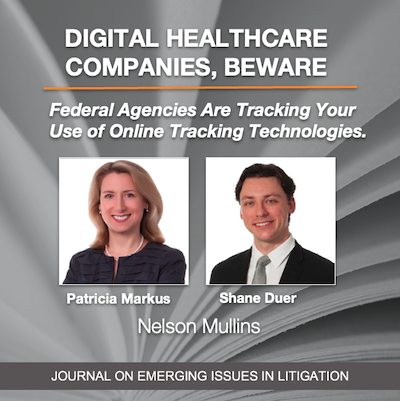
Digital Health Care Companies, Beware: Federal Agencies Are Tracking Your Use of Online Tracking Technologies

June 1st, 2023|Categories: Corporate Compliance, Emerging Litigation & Risk, HB Tort Notes, Journal, Mass Torts, New Featured Post for Home Page, News|Tags: , , , , |

The Authors Patricia A. Markus (trish.markus@nelsonmullins.com) represents health care providers and health technology companies across the country on wide-ranging regulatory compliance, reimbursement, licensure, and operational matters, with a special focus on issues surrounding health information privacy, security, and technology. Shane Duer (shane.duer@nelsonmullins.com) focuses his practice on healthcare regulatory and corporate matters, with an emphasis on data privacy, cyber security, and information management concerns within and beyond the health care industry. Interviews with leading attorneys and other subject matter experts on new twists in the law and how the law is responding to new twists in the world. Digital Health Care Companies, Beware  Federal Agencies Are Tracking Your Use of Online Tracking Technologies. Abstract: Health care industry stakeholders have regularly used online tracking technologies to help improve patient experience. However, growing scrutiny by the Office for Civil Rights, which enforces the Health Insurance Portability and Accountability Act of 1996 (HIPAA), requires covered entities and business associates to proceed cautiously in their use of such technologies. In addition, recent enforcement actions by the Federal Trade Commission make clear that a wide range of digital health companies, whether or not regulated by HIPAA, must tread carefully when collecting and disclosing personal information related to health, especially where consumers’ location data is to be used for [...]

Big Tech’s Race to Develop Superior Artificial Intelligence Technology

May 11th, 2023|Categories: Corporate Compliance, Technology Law|Tags: , , , , |

Big Tech’s Race to Develop Superior Artificial Intelligence Technology Will A.I. Compromise Free Enterprise, Disclosure and Security? America’s Big Five tech companies – Amazon, Apple, Facebook, Google and Microsoft – are racing to develop technology they claim will change the world -- again. The tech Goliaths have more than 33,000 researchers at their disposal to create artificial intelligence (A.I.) technology with an obvious and perpetual prize: revenue.  It's the talk of the world. NBC Nightly News recently predicted the impacts that A.I. will have on society in the coming years. A.I. tech was also the center of attention at the 2023 Davos Economic Summit.  Prominent tech leaders such as Elon Musk and the CEO of OpenAI, Sam Altman, heralded that A.I. will improve virtually everyone’s lives, but with some risks involved.  Andrew Perlman, dean of Suffolk University Law School, says there is nothing "future" about it. In The Implications of ChatGPT for Legal Services and Society, he wrote, "The disruptions from AI's rapid development are no longer in the distant future. They have arrived ..." And for the legal industry, he said, "ChatGPT may portend an even more momentous shift than the advent of the internet." Just one legal application out there today is the use of A.I. technology (GPT-3) by Docket Alarm, a popular court docket [...]

Persuasion as Direct and Honest Trial Advocacy with Jack Siegal

May 6th, 2023|Categories: Complex Business Litigation, ELP, Law Firm Operations|Tags: , , , , |

Persuasion as Direct and Honest Advocacy with Jack Siegal The relevance to jury trials and jury persuasion is obvious. According to studies cited in a 2019 article in Business Insider, people develop first impressions of you “even before you open your mouth.” That means your mere appearance “affects how trustworthy, promiscuous, and powerful people think you are.” It’s the trustworthy part that attorneys need to pay attention to. Regardless of the strength of their case or whether the law is on their side, an attorney still must be persuasive. And, unless the audience – whether it is a judge, a panel of judges, a regulatory body, or a jury – sees you as credible, the rest will likely not matter. But what makes an attorney, or anyone for that matter, credible? Is this something you’re born with or is it something you can develop over time? Is it true, as some studies suggest, that you can change some first impressions by making some changes in how you present yourself, or are you just stuck with a less than trustworthy vibe? Interested in upping your jury persuasion game? A Good Place to Start Listen to my interview with attorney Jack I. Siegal, a partner with Fox Rothschild LLP in Boston. Jack believes we can all make positive adjustments in the nuanced practice [...]

Litigation Funding Battle Over Litigation Control

April 26th, 2023|Categories: Complex Business Litigation, Corporate Compliance, HB Risk Notes|Tags: , , |

Sysco and Burford Capital Butting Heads Over Litigation Control. Food giant claims funder is interfering with antitrust litigation. Funder says its client is settling for too little.  Public dustups over litigation funding are rare. Leading litigation funder Burford Capital LLC and food distribution giant Sysco Corp. are locking horns over the control and use of litigation funds. Burford says Sysco is settling Burford-funded antitrust litigation for amounts that deny the financial company optimal return on its investment. Sysco says the funder has overstepped its bounds and interfered with Sysco’s litigation oversight. Sysco received $140 million from Burford in part to fund price-fixing lawsuits against poultry, pork and beef producers – complex multidistrict litigation involving hundreds of plaintiffs, dozens of defendants, and related criminal suits brought by the Department of Justice (DOJ). So far, settlements of private antitrust litigation have reached into the hundreds of millions, and DOJ has levied more than $100 million in fines. Burford, which gets a share of any settlements in the antitrust litigation, says Sysco is settling for too little. Sysco has sued companies associated with Burford – Glaz LLC, Posen Investments LP, and Kenosha Investments LP – claiming they are meddling in Sysco’s settlement efforts. Glaz, Posen, and Kenosha are all companies which have Burford Capital Limited as the only direct or [...]

Alleged Hair Product Injuries Impact Women of Color

April 26th, 2023|Categories: Class Actions, Complex Business Litigation, Environmental Torts, Mass Torts|Tags: , , , |

L’Oréal Among Defendants in Litigation Over Hair Products. Dozens of hair straightener cases allege higher incidence of cancers and other diseases. Plaintiffs in dry shampoo litigation say products contain benzene.  Seven companies control the U.S. hair product industry. L’Oréal has been hit hard in recent hair care litigation related to straighteners, relaxants, and dry shampoos. L’Oréal was named a defendant in nearly sixty complaints alleging that straightening products manufactured by the beauty giant have caused cancer in its consumers. L’Oréal has also been named a defendant in a proposed class-action for its Redken dry shampoo that allegedly contains the carcinogen benzene. Other large industry players such as Johnson and Johnson and Unilever have also been accused of selling dry shampoos with dangerous levels of benzene. Straighteners and Relaxers Litigation Dozens of cases have been consolidated in multidistrict litigation against L’Oréal for its potentially cancerous hair straighteners and relaxers. Mitchell v. L’Oréal USA Inc. is a typical case.  It was filed by Missourian Jennifer Mitchell, a black woman, after her diagnosis of uterine cancer which she claims was caused by endocrine disrupting chemicals (EDCs) in L’Oréal’s hair straighteners and relaxers. Jennifer Mitchell was diagnosed with her cancer on August 10, 2018. “Ms. Mitchell was first exposed to EDCs and/or phthalate-based products around 2000, at or around the age [...]

Electronic Fund Transfer Fraud with Brad Rustin

April 26th, 2023|Categories: Complex Business Litigation, Corporate Compliance, ELP|Tags: , , , , |

Electronic Fund Transfer Fraud with Brad Rustin Grifters, scammers, con artists Sen. Elizabeth Warren, who championed the creation of Consumer Financial Protection Bureau (CFPB), calls the Zelle digital payments network a “preferred tool for grifters like romance scammers, cryptocurrency con artists, and those who prowl social media sites advertising concert tickets and purebred puppies — only to disappear with buyers’ cash after they pay.”   18 million Americans defrauded Scams and fraud committed via the Zelle platform and other peer-to-peer services are surging. According to one lawsuit 18 million Americans were defrauded by schemes perpetrated via apps like Zelle in 2020. Some 1,500 member banks and credit unions participate in the Zelle service. People sent $490 billion via the app in 2021. But Zelle owner, Early Warning, and its consortium comprising Bank of America, Truist, Capital One, JPMorgan Chase, PNC Bank, U.S. Bank, and Wells Fargo, have refused to refund customers for most of their losses. Sen. Warren issued a report that the claims for fraud received by just four banks will likely exceed $255 million by the end of 2022 – a $165 million increase over 2020. The senator and consumers say Zelle is violating federal consumer protection law. What is fraud? The heart of the problem is this: banks and consumers do not agree on the definition [...]

Go to Top