
Tech’s Big Four Will Testify Before Antitrust Subcommittee

July 13th, 2020|Categories: Complex Business Litigation, Emerging Litigation & Risk, News, Technology Law|Tags: , , , , |

Four Technology Giants’ CEOs Will Testify Before Congress in On-going Antitrust Investigation Executives from Amazon, Apple, Facebook, and Google will appear (either virtually, as they are permitted to, or in person) before the U.S. House of Representatives’ Judiciary Antitrust Subcommittee on July 27, 2020. According to its press release, the Subcommittee has been scrutinizing the companies’ dominance in their respective digital spheres and the “adequacy of existing antitrust laws and enforcement,” since June 2019. The hearing will enable legislators to question the executives about possible antitrust abuses, which have been the focus of many federal, state, and foreign regulatory inquiries. For example, Representatives may inquire about Amazon’s treatment of third-party merchants who sell products on its e-commerce platform, Google’s highly profitable ad business, Apple’s App Store terms that infringe on the rights of third-party app developers, and Facebook’s leverage of previously acquired companies to solidify its social media dominance, according to a July 1, 2020 New York Times article by David McCabe. The hearing may serve as the crowning piece of the Subcommittee’s antitrust probe. As the Subcommittee’s press release stated, the CEOs’ “forthcoming” testimony is “essential” to completion of the investigation.

Monsanto, Bayer Paying Billions for PCB Cleanups

July 3rd, 2020|Categories: Class Actions, Complex Business Litigation, HB Tort Notes, Mass Torts|Tags: , |

Read Baltimore Sun environmental writer Scott Dance's June 24, 2020, article titled, "A $550M national class-action settlement includes money for cleanup of PCBs in Baltimore waterways." He offers the Maryland angle on the $550 million class action settlement between Monsanto and 13 government agencies across the U.S., just part of a much larger agreement. "The settlement was one of several that Monsanto’s owner, German pharmaceutical company Bayer, announced Wednesday. Bayer said it’s paying up to $10.9 billion to settle current and potential future litigation over Monsanto’s weedkiller Roundup, which has faced numerous lawsuits over claims it causes cancer, and $1.22 billion to settle two further cases, including the class action focused on PCBs." Dance writes that the terms of this settlement are off to Judge Fernando M. Olquin of the Central District of California for his review. Judge Olquin was one of the presenters on multiple panels at the Class Action Law Forum presented by Western Alliance Bank and produced by my team at HB. Kenneth R. Feinberg, also a presenter, is the court-appointed special master in the case. The Baltimore Sun piece was one of many that gave the local perspective on this nationwide litigation and settlement in progress, like this one from the San Francisco Chronicle, with a Seattle dateline, and this one from the Washington State Wire quoting [...]

The Intersection of Privacy and Antitrust Webinar Now Available On-Demand on the West LegalEdcenter

April 2nd, 2020|Categories: Complex Business Litigation, Featured On-Demand, HB Risk Notes, Technology Law|Tags: , , , , |

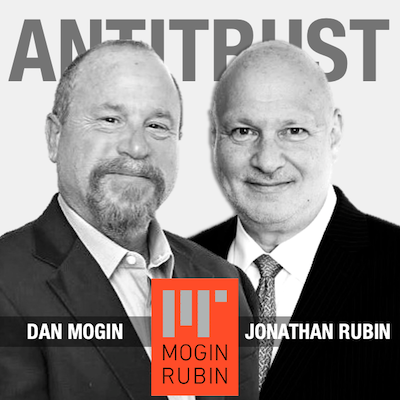
Available as part of your subscription to The Thomson Reuters West LegalEdcenter®. Don't subscribe to the West LegalEdcenter? This webinar is still available directly from HB. Take it now! Questions for speakers Questions@LitigationConferences.com CLE questions CLE@LitigationConferences.com Check out the MoginRubin blog for more insights on antitrust and privacy law. What attorneys and companies need to know about the increasing interplay between these critical areas of the law.  Highly publicized cases and investigations in the U.S. and Europe of big technology, e-commerce, and social media companies demonstrate how anti-competition laws are being used to scrutinize and challenge not only how these corporations conduct themselves in the marketplace, but the very core of their colossal success: the mass collection and utilization of user data. Are the privacy and antitrust worlds beginning to cross over? Or do they simply run parallel while addressing entirely different types of conduct? Whatever the answer, data is the raw material that drives the likes of Google, Facebook, Apple and Amazon, so how it is handled is a critical question when counseling clients on mergers and acquisitions. Moderator Daniel J.  Mogin | Managing Partner, MoginRubin LLP Speakers Jennifer M. Oliver, CIPP/US | Partner, MoginRubin LLP Thomas N. Dahdouh | Director, Western Region, Federal Trade Commission Franklin M. Rubinstein | Partner, Wilson Sonsini Goodrich & Rosati Randi W. Singer, CIPP/US, CIPT [...]

The Intersection of Antitrust & Privacy | A MoginRubin Webinar | 10.31.2019

September 14th, 2019|Categories: CLE OnDemand, Complex Business Litigation, HB Risk Notes, Mass Torts, Technology Law|Tags: , , , , |

[two-fifths-first] Recorded: Oct. 31, 2019 Duration: 100 minutes Presented by:  MoginRubin LLP Produced by: HB Litigation Conferences The Panel Moderator Daniel J.  Mogin | Managing Partner, MoginRubin LLP Speakers Jennifer M. Oliver, CIPP/US | Partner, MoginRubin LLP Thomas N. Dahdouh | Director, Western Region, Federal Trade Commission Franklin M. Rubinstein | Partner, Wilson Sonsini Goodrich & Rosati Randi W. Singer, CIPP/US, CIPT | Partner, Weil, Gotshal & Manges Contributor Dina Srinivasan | Independent Researcher & Author of The Antitrust Case Against Facebook Dina was unable to present but we thank her for her content contributions.  What you will get: At least 1 hour of CLE credit. Answers to your questions via email. The opportunity to share with others on your team. The complete Powerpoint. The Antitrust Case Against Facebook Dina Srinivasan's statement to the House Committee on the Judiciary, Subcommittee on Antitrust, Commercial, and Administrative Law The Chicago Booth School Stigler Center Committee on Digital Platforms Final Report Write to us at CLE@LitigationConferences.com to: Ask about CLE Request the materials Send a question for the speakers [/two-fifths-first][three-fifths] Market Behavior and Data-Driven Market Power Highly publicized cases and investigations in the U.S. and Europe of big technology, e-commerce, and social media companies demonstrate how anti-competition laws are being used to scrutinize and challenge not only how these corporations conduct themselves in the [...]

The Future of Cyber Operations and the Government

June 7th, 2019|Categories: Corporate Compliance, HB Risk Notes, Technology Law|Tags: , , , , |

In the forthcoming National Defense Authorization Act the House Armed Services Committee -- specifically the Subcommittee on Intelligence and Emerging Threat Capabilities -- seeks to amend the annual legislation to ensure that Congress is informed when the executive branch executes offensive or defensive cyber operations. The bill defines offensive or defensive cyber operations as a “sensitive military operation.” The goal of this shared information is additional oversight, especially given the newness of cyber tactics. As reported by journalist Derek B. Johnson of FWC.com, two covert cyber operations have taken place since POTUS announced the new policy. The first was in October 2018, a cyber operation with a goal of informing Russian operatives not to meddle with the midterm election. The second took place the following November in which the U.S. Cyber Command blocked access to Russian Internet Research Agency post election. While these two operations have been called “mild” in some critiques, former White House Director of Cyber Infrastructure Protection under President George W. Bush, Jason Healey, believes this highly specialized tactic is ideal since it presents the least potential for collateral damage. While Healey warns against grand and overt attacks, he states that sometimes "conflict is straightforward and you just have to stop adversaries from punching you in the mouth.” Read the complete post by Derek B. Johnson on FCW.com [...]

Top Class Actions: Vaccine Litigation Case Roundup

April 19th, 2019|Categories: Class Actions, HB Risk Notes, Mass Torts|Tags: , , |

[one-half-first][/one-half-first] [one-half]There have been numerous lawsuits filed alleging injuries caused by the shingles vaccine Zostavax. Cases have stated they were not warned of the adverse side effects of the vaccine alleging it caused the diseases it is meant to prevent, among other things. Here is what the CDC says to consumers: “Your risk of shingles and postherpetic neuralgia (PHN) increases as you get older. CDC recommends that people 60 years old and older get shingles vaccine (Zostavax®) to prevent shingles and PHN. Shingrix (recombinant zoster vaccine) is the preferred vaccine, over Zostavax® (zoster vaccine live), a shingles vaccine in use since 2006. Zostavax may still be used to prevent shingles in healthy adults 60 years and older. For example, you could use Zostavax if a person is allergic to Shingrix, prefers Zostavax, or requests immediate vaccination and Shingrix is unavailable. Zostavax (zoster vaccine live) was licensed by the FDA in 2006. This vaccine reduces the risk of developing shingles by 51% and PHN by 67%. It is given in one dose as a shot, and can be given in a doctor’s office or pharmacy.“ Read more: https://www.cdc.gov/vaccines/vpd/shingles/public/zostavax/index.html The vaccine is produced by Merck & Co.  Their product information can be found here: https://www.merckvaccines.com/Products/Zostavax Here is a roundup of the cases filed. [/one-half] 1.Husband and Wife File Zostavax Shingles Vaccine Lawsuit  "A North Carolina husband and [...]

The Need for Real MDL Rules Will Only Grow More Acute — Drug and Device Law Blog

April 16th, 2019|Categories: Complex Business Litigation, HB Tort Notes, Mass Torts|Tags: , , |

By Bexis  [one-half-first].[/one-half-first] [one-half]"In the ensuing procedural gamesmanship, plaintiffs are in the process of losing one of the main ways they gamed the system to keep diverse cases in state court – the so-called 'forum defendant rule' whereby even a diverse action could be kept in state court by the presence of defendant domiciled in the plaintiff’s chosen forum. The forum defendant rule applies only to parties 'properly joined and served,' and technologically-savvy defendants have discovered that, by monitoring electronic dockets, they can remove diverse cases faster than plaintiffs can serve forum defendants. We call this 'pre-service,' 'snap,' or 'wrinkle' removal, and we’ve chronicled (and advocated) its rise since 2007." Read the complete post by Bexis on Drug and Device Law Blog here. [/one-half] This is an excellent blog. One of my favorites. It's unapologetically defense-oriented, of course. A phrase like "gamed the system" is practically an invitation for rebuttal! So if you would like to respond, rebut, or rebuke, please write to us at Editor@LitigationConferences.com. --Tom Hagy, HB

Product Liability in the Internet of Things — Schiff Hardin Product Liability & Mass Torts Blog

April 14th, 2019|Categories: Complex Business Litigation, HB Risk Notes, Technology Law|Tags: , , , , |

[one-half-first] Photo by Markus Spiske on Unsplash [/one-half-first] [one-half]"Combining a physical object and an intangible technology also creates a novel issue when it comes to strict product liability principles, which typically hold that a product manufacturer may be strictly liable for a product’s defect. The first task in a strict product liability case is to identify the product. In the context of a device that has no internet connectivity, the answer is straightforward. If a ladder is defective and causes an injury, the ladder’s manufacturer may be held strictly liable because a ladder is the product. But when it comes to IoT devices, the line may be blurred. Almost always, the software part of the IoT device is 'manufactured' by a separate entity from the entity that manufactures the physical object. If the IoT device proves to be defective, the question becomes which entity may be held strictly liable." Read the complete post by Schiff Hardin's  Gregory Dickinson & Jeffrey D. Skinner  here. [/one-half]

A Generic Drug Failure to Warn Claim? –Michelle Hart Yeary

April 14th, 2019|Categories: Complex Business Litigation, HB Tort Notes, Mass Torts|Tags: , , , |

[one-half-first][/one-half-first] [one-half] "Rather than focusing on what plaintiff’s off-label marketing claim really was – a claim that defendant’s label should have contained different information or warnings about off-label uses – an impliedly preempted claim, the court got distracted trying to fit the case in under Bausch and started talking about parallel violation claims. "The court found that because plaintiff was alleging a violation of federal regulations, his claims “run parallel to [defendant’s] state law duties,” and thus were not preempted. The problem with this is that Mensing is not an express preemption case.  It was an implied preemption case, and the district court had no business applying 'parallel claim' analysis to implied preemption, where a 'parallel claim' exception does not exist.  It makes no difference whether plaintiff’s off-label promotion claim is 'parallel' to federal regulations, defendant could not have offered any different warning so any claim that the warning or information it provided was inadequate is preempted under Mensing.  The court was trying to fit a square peg into a round whole – and the only way that works is to cut off the corners." Read the complete post by Dechert's Michelle Hart Yeary here! [/one-half]

One Stock for the Coming Marijuana Boom, Says The Motley Fool

April 12th, 2019|Categories: Complex Business Litigation, Corporate Compliance, HB Risk Notes|Tags: , , , , |

"This legal pot stock could be like buying Amazon for $3.19." "Cannabis legalization is sweeping over North America – 10 states plus Washington, D.C., have all legalized recreational marijuana over the last few years, and full legalization arrived in Canada in October 2018. Legal marijuana is worth an estimated $50 billion for the U.S. today. And since experts have projected the U.S. industry to skyrocket to $80 billion by 2030, it’s time for investors to start paying attention. Because whether or not you’re planning on ingesting any THC, you can’t deny the monumental investing opportunity that a potentially $80 billion industry represents." --Grace Phillips, in an article for The Motley Fool

Private Calif. Plaintiffs Seemingly Enforcing FDCA, Drug & Device Law Blog Says

April 12th, 2019|Categories: Complex Business Litigation, HB Tort Notes, Mass Torts|Tags: , , , |

"Doctors treated two plaintiffs for severe psychological problems, ultimately employing defendant’s Thymatron System IV to perform electroconvulsive therapy. Plaintiffs claimed that, as a result, they suffered brain trauma, memory loss and other brain-related injuries. They filed product liability claims based, in the main, on the manufacturer’s alleged failure to report adverse events. The decision in Riera addressed summary judgment motions, ones filed by both the plaintiffs and the defendant. You don’t ordinarily see summary judgment motions by plaintiffs, and Riera is an example of why." Read the complete post by John J. Sullivan of Cozen O'Connor.

Two Judges Find Florida Medical Marijuana Law Unconstitutional

January 4th, 2019|Categories: Complex Business Litigation, Corporate Compliance, HB Risk Notes, HB Tort Notes|Tags: , , , , |

The Program is 'Absolutely Broken' -- Now What? Edited by Tom Hagy Florida Circuit Judge Karen Gievers just held that the Florida medical marijuana law is unconstitutional. Reporting on the judge's Trulieve decision for the Florida Politics news service, journalist Jim Rosica called it "a rebuke to lawmakers and the Rick Scott Administration" that was "stunning even for" Judge Gievers. "In the spirit of boxing legend Muhammad Ali, known for his pre-fight rhymes, Gievers opined that in Florida 'the medical marijuana system was broken. Now, in the Constitution, the people have spoken.'" Rosica reported that while Gov. Scott is appealing the major marijuana decisions against the state Department of Health, the transition team of Republican Governor-elect Ron DeSantis, including Lt. Gov.-elect  Jeanette Nuñez, has suggested that he will not continue to defend the law in court. Rosica continued: "Gievers, who retires in April, said her decision striking down the law 'includ(ed), but (is) not limited to, replacement of the voter-selected registry plan with an arbitrary, inconsistent licensing scheme … throttling access of qualifying patients to … safe use of medical marijuana from (providers that) the Department has a clear, undisputed duty to register.' In fact, just passing the law was itself unconstitutional, Gievers suggested: 'Voters made clear in 2016 that the Legislature was to have no role in implementing access to and [...]

Go to Top