
From AI Principles to Proof: What DOJ Scrutiny Means for Corporate Governance

March 5th, 2026|Categories: Emerging Litigation & Risk, Journal, Law Firm Operations, New Featured Post for Home Page, News|Tags: , , , , |

In this article, Tom Hagy and Reed Smith partner Adria Perez examine how the Department of Justice’s new AI Litigation Task Force is shifting corporate expectations from AI principles to proof. Drawing on insights from The Emerging Litigation Podcast, they discuss how regulators now expect companies to demonstrate real oversight, documented controls, and defensible governance as AI becomes embedded in compliance, investigations, and corporate decision-making.

SCOTUS Rejects Contractor Immunity Sought by Prison Company

March 2nd, 2026|Categories: Emerging Litigation & Risk, Journal, New Featured Post for Home Page, News|Tags: , , , |

In a unanimous decision, the Supreme Court held in The GEO Group, Inc. v. Menocal that private government contractors cannot claim “derivative sovereign immunity” to avoid suit. Writing for the Court, Justice Kagan clarified that the Yearsley doctrine provides only a defense to liability—not immunity from litigation—and never shields unlawful conduct. The ruling ensures that claims alleging forced labor at a privately operated immigration detention facility will proceed on the merits and reinforces that sovereign immunity belongs to the government alone.

Summary Judgment and Sham Affidavits: Protecting Your Motion from Contradictory Testimony

March 2nd, 2026|Categories: Emerging Litigation & Risk, Journal, New Featured Post for Home Page, News|Tags: , , , , , , , , |

In this article, Cat Gavrilidis of Swift Currie examines how inconsistent testimony can undermine summary judgment and how courts apply the sham affidavit rule when affidavits contradict prior deposition statements. She explores jurisdictional differences and outlines practical steps attorneys can take to prevent contradictions, correct the record, and protect a well-founded motion before trial.

Habeas Corpus in Real Time: Minnesota’s Detention Docket Dusts Off Ancient But Foundational Remedy

February 26th, 2026|Categories: Emerging Litigation & Risk, Journal, New Featured Post for Home Page, News|Tags: , , , |

A surge of emergency habeas corpus petitions in Minnesota is reshaping immigration detention litigation. Federal judges are issuing expedited orders, blocking detainee transfers, and demanding immediate statutory justification for custody. With cases such as Hassan v. Bondi, Astudillo Laica v. Bondi, and U.H.A. v. Bondi, courts are treating habeas review as urgent injunctive relief while confronting jurisdictional risks and mandatory-versus-discretionary detention disputes. As practitioners like E. Michelle Drake of Berger Montague navigate a rapidly expanding docket, Minnesota has emerged as a focal point in a nationwide rise in detention challenges—highlighting the continuing power of habeas corpus as a real-time check on executive detention authority.

Maryland Child Victims Act: Defending & Pursuing Insurance Coverage for Abuse Claims | Get CLE

November 26th, 2025|Categories: CLE OnDemand, Complex Business Litigation, Insurance, New Featured Post for Home Page, New Webinars|Tags: , , |

Maryland’s Child Victims Act has opened the door to a surge of revived abuse claims, raising significant challenges for institutions, insurers, and counsel. In this CLE webinar, Cameron Argetsinger, Brian Della Torre, Glen Feinberg, and Sean Gugerty examine the law’s key provisions, emerging litigation trends, and complex insurance coverage issues. The program explores liability risks for schools, nonprofits, and religious organizations, and offers practical guidance on locating historic policies, managing notice obligations, and navigating insurer defenses. Essential insight for anyone handling CVA-related litigation or insurance recovery.

Ninth Circuit Rejects Religious Accommodation Claim in COVID Testing Case

November 17th, 2025|Categories: Complex Business Litigation, Employment, HB Tort Notes, Journal, New Featured Post for Home Page, News|Tags: , , , , |

The Ninth Circuit has rejected a religious accommodation claim from a healthcare worker who objected to weekly COVID-19 testing, holding that the employee failed to show a bona fide religious conflict and that the employer’s masking-and-testing accommodation was reasonable. The ruling offers valuable guidance for employers navigating post-pandemic accommodation requests. Read the full analysis for key takeaways.

Authentic Business Development for Litigators: Stop Chasing Cases and Start Building Clients with John Reed on the Emerging Litigation Podcast

October 16th, 2025|Categories: Complex Business Litigation, ELP, New Featured Post for Home Page|Tags: , , |

What if waiting for lawsuits is the worst growth strategy a litigator can have? In this episode of the Emerging Litigation Podcast, host Tom Hagy speaks with John Reed, founder of Rain BDM and host of Sticky Lawyers, about how litigators can build authentic, lasting client relationships instead of chasing the next case. John shares practical insights on defining your professional brand, using emotional intelligence in business development, and adapting your natural style—especially for introverts or those navigating remote mentorship. Whether you’re a new associate or a seasoned partner, this episode offers a roadmap for making your practice more resilient, visible, and genuinely client-centered.

DEI Programs as a Source of Liability for Law Firms and Other Businesses

August 6th, 2025|Categories: Complex Business Litigation, Employment, HB Tort Notes, Journal, New Featured Post for Home Page, News|Tags: , , , |

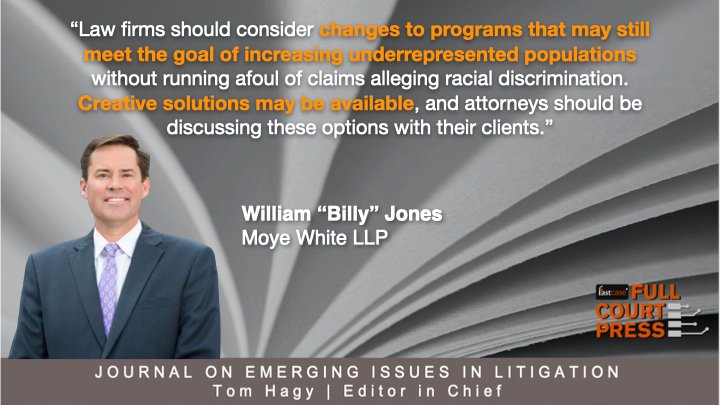
Two recent cases against international law firms point to an emerging trend in litigation that could have wide-spread implications for diversity, equity, and inclusion (DEI) programs. The author, William "Billy" Jones examines these recent cases filed against the law firms for their DEI fellowships and the potential impacts for law firms and other private businesses.

Judge finds flaws in motion for an injunction against Trump’s wind turbine order

July 29th, 2025|Categories: Environmental Torts, HB Tort Notes, Journal, New Featured Post for Home Page, News|Tags: , , , |

While Trump’s freeze on offshore wind permits faces legal challenge, a federal judge isn’t convinced the states bringing the case have shown enough harm. In this article, guest contributor Justin Ward explains why the motion for an injunction was denied, what it means for the broader battle over renewable energy, and how executive power could stall green infrastructure without ever breaking the law.

Sexual Abuse & Insurance

July 23rd, 2025|Categories: Class Actions, CLE OnDemand, New Webinars|Tags: , , , , |

Join Marshall Gilinsky and John Lacey of Anderson Kill, along with Brian Della Torre of ARMR, for a CLE webinar focused on navigating sexual abuse claims through insurance recovery. Learn how to locate and leverage historic liability policies, understand allocation and occurrence issues, and overcome common insurer defenses. Discover how institutions can access valuable coverage through strategic claims, litigation tactics, and insurance archaeology.

Am I Covered For? . . . A Discussion of Insurance Coverage Issues

July 8th, 2025|Categories: CLE OnDemand, Complex Business Litigation, Corporate Compliance, Insurance|Tags: , , , , , , |

Join Steven J. Pudell and Christina Yousef of Anderson Kill and William Harrison of Gallagher for an engaging CLE webinar introducing the fundamentals of insurance coverage. This session breaks down the differences between first-party and third-party claims and provides an overview of key insurance policies—including general liability, property, D&O, E&O, employment practices, cyber, commercial crime, and product recall. Through real-world examples and practical tips, the panel will highlight common challenges policyholders face and how courts have addressed key coverage issues. Ideal for those new to insurance or looking for a comprehensive refresher.

AI tools may be the cause of the explosion in nuclear verdicts — and also the solution

April 6th, 2025|Categories: Complex Business Litigation, HB Tort Notes, Journal, New Featured Post for Home Page, News, Technology Law|Tags: , , , , |

Guest contributor Justin Ward discusses how artificial intelligence is both fueling and fighting the rise of “nuclear verdicts.” Plaintiff attorneys are using AI to identify high-damages cases, favorable jurisdictions, and winning arguments—driving a spike in verdicts over $10 million. At the same time, defense lawyers and insurers are adopting tools like NaVeL to spot high-risk cases early and craft smarter strategies. As AI reshapes legal practice, the very technology accelerating massive awards may also be the best hope for containing them.

Go to Top