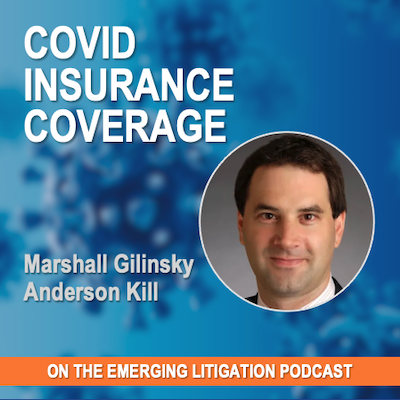
Covid Insurance Coverage Decisions with Guest Marshall Gilinsky. Are Policyholders Catching Up?

September 22nd, 2022|Categories: ELP, Emerging Litigation & Risk, News|Tags: , , , , |

According to the online Covid Coverage Litigation Tracker (CCLT) run by Penn Law there have been more than 2,300 insurance coverage cases filed over denial of claims relating to Covid-19. Restaurants and bars were hardest hit by the pandemic and so led the way in seeking – and being denied – coverage, too. They are also leading the way in suing their insurers. The top five insurers in the defense position are Chubb Limited at #5, then #4 Lloyds of London, #3 Cincinnati Financial, and #2 Zurich.  And in the #1 position facing the most coverage suits is Hartford.  The insurance industry started off strong when this litigation began, winning the vast majority of the coverage suits. And they continue to do well, scoring with the argument that many of the claims do not involve actual property damage. Government closures don’t cause property damage, they argue. Courts have largely been siding with the carriers – but not all. Policyholders, a tenacious bunch, appear to be chipping away at the body of law in this suddenly expanding category. A recent case involving a New Orleans restaurant against Lloyd’s was penciled into the win column for carriers by a trial court , but an appeals court erased it and wrote the policyholder a narrow 3-2 victory. The appeals court said the language [...]

EMR Audit Trail—What Is It? Why Do They Matter? What Should You Look For? by Haley K. Grieco and Brooke E. Reddin

September 20th, 2022|Categories: Emerging Litigation & Risk, HB Tort Notes, Journal, Mass Torts, New Featured Post for Home Page, News|Tags: , , , , |

The Authors Haley K. Grieco (hgrieco@hallboothsmith.com) is a partner in the Paramus, New Jersey, office of Hall Booth Smith, where she defends physicians, hospitals, and other healthcare providers in a wide range of medical malpractice litigation. Brooke E. Reddin (breddin@hallboothsmith.com) is an associate with the firm, where she focuses her practice on healthcare, medical malpractice, and aging services litigation. Interviews with leading attorneys and other subject matter experts on new twists in the law and how the law is responding to new twists in the world. EMR Audit Trail—What Is It? Why Do They Matter? What Should You Look For? "As the healthcare industry becomes increasingly digitized, it is imperative that attorneys appreciate the impact it may have on their clients and their practice. In medical malpractice matters, discovery requests for metadata—specifically, the production of the EMR audit trail—has steadily increased over the past few years." Abstract: Maintaining electronic medical records, or EMRs, is now a nearly universal best practice among medical providers from small physician practices to large hospital networks. Unlike handwritten or typed records, these digital documents carry with them much more data than meets the eye. In this article, the authors—two medical malpractice attorneys— discuss what attorneys need to know about EMRs in the litigation context and [...]

Employers Be WARNed: Workforce Reduction Rules Meet New Workplace Definitions as Employees Go Remote by Juan Enjamio and Steven DiBeneditto

September 6th, 2022|Categories: Emerging Litigation & Risk, Employment, Journal, New Featured Post for Home Page, News|Tags: , , , , |

The Authors: Juan C. Enjamio (jenjamio@huntonak.com) is managing parter of the Miami office of Hunton Andrews Kurth where he dedicates his practice to complex domestic and international employment law matters. Steven J. DiBeneditto Jr. (sdibeneditto@huntonak.com) is a Washington, DC-based associate in the firm’s employment and labor group. Interviews with leading attorneys and other subject matter experts on new twists in the law and how the law is responding to new twists in the world. Employers Be WARNed Workforce Reduction Rules Meet New Workplace Definitions as Employees Go Remote "Numerous courts have opined that a “home base” is a place in which the employee has some sort of physical connection. But this connection must be more than a “notional” base, whereby the employee has a menial relationship." Introduction A common sentiment during the Covid-19 pandemic was that a different society would emerge from its ashes. While overstated in many cases, one segment of society that appears to have changed for good is the white collar workplace. Indeed, after enjoying the flexibility of working from home for more than 2 years, many white collar workers are demanding that a remote work option remain a permanent fixture at their place of employment. And with seemingly no negotiating leverage due to worker shortages across the [...]

The Role of Litigation and Regulation in Making the Web More Accessible with Guests Ken Nakata and Hiram Kuykendall

September 2nd, 2022|Categories: ELP, Emerging Litigation & Risk, News, Technology Law|Tags: , , |

According to the International Agency for the Prevention of Blindness there are 43 million people around the world living with blindness, and 300 million living with moderate to severe visual impairment. Put those statistics next to these: There are nearly 2 billion websites, and 550,000 created every day. Shouldn’t sight-impaired people have the same access to these sites as sighted people? Of course they should. There is good news. After previously announcing guidance, the DOJ says new regulations are on the way under Title II of the Americans with Disabilities Act, which describes the obligations for state and local governments. My guests say there are many reasons to be excited about this. My guests say there are many reasons to be excited about this. Ken Nakata is Co-Founder and Principal at Converge Accessibility, whose solutions help make sure websites and other technologies are accessible to people with disabilities. Ken is former Senior Trial Attorney with the DOJ Disability Rights Section where he developed nationwide ADA policies for the internet. Joining Ken is Hiram Kuykendall, Chief Technology Officer at Microassist, an Austin-based learning and development consulting. Hiram is a technical leader with hands-on experience in instructional design and digital accessibility. This podcast is the audio companion to the Journal on Emerging Issues in Litigation. The Journal is a collaborative project between HB Litigation Conferences and the Fastcase legal research family, which includes Full Court Press, Law [...]

Insurance Coverage for Digital Assets: Mitigating Losses in Cryptocurrency and Non‐Fungible Token Markets by Scott DeVries, Jessica Cohen-Nowak and Adriana Perez of Hunton Andrews Kurth

August 31st, 2022|Categories: Complex Business Litigation, Emerging Litigation & Risk, HB Tort Notes, Insurance, Journal, Mass Torts, New Featured Post for Home Page, News|Tags: , , , , |

Companies and individuals are riding the ups and downs of cryptocurrency and NFTs—with losses and swings in the billions of dollars—but digital assets are not going away. Abstract: The risk of loss in certain categories may be mitigated by insurance, whether provided by tailored policies and/or under policies designed specifically for digital asset owners. Those with exposure to the digital asset sector should be attuned to the emerging marketplace for such insurance products. While it is early days for NFT-specific coverage, the rise of cryptocurrency has created a substantial marketplace for crypto coverage. Insurers are becoming increasingly able to model and assess risk, so more products are coming to market. That said, digital asset holders need to be able to select coverage that best suits their needs. In this article, the authors discuss the history and status of coverage for digital assets to assist readers in exploring how they might use insurance to mitigate risk in this emerging and rocky sector of global finance. "Over the course of a decade, the marketplace for cryptocurrency has increased from zero to an estimated $250 billion. However, only $6 billion in insurance coverage is currently available. It would be a gross understatement to say that there is a truly remarkable imbalance between market value and insurance capacity." Introduction Crypto [...]

The Environmental, Social, and Governance Police Have Arrived: Is Your Insurance Ready? by Robert D. Chesler and Dennis J. Artese

August 29th, 2022|Categories: Complex Business Litigation, Emerging Litigation & Risk, HB Tort Notes, Insurance, Journal, Mass Torts, New Featured Post for Home Page, News|Tags: , , , , |

The Authors Robert D. Chesler (rchesler@andersonkill.com) is a shareholder in Anderson Kill’s New Jersey office and is a member of the firm’s Cyber Insurance Recovery Group. He represents policyholders in a broad variety of coverage claims against their insurers and advises companies with respect to their insurance programs. Dennis J. Artese is a shareholder in Anderson Kill’s New York office and chairs the firm’s Climate Change and Disaster Recovery Group. Both are members of the Editorial Advisory Board of the Journal. Interviews with leading attorneys and other subject matter experts on new twists in the law and how the law is responding to new twists in the world. The ESG Police Have Arrived: Is Your Insurance Ready? "ESG has become a major initiative for corporate America. In particular, the environmental prong of ESG calls for companies to institute sustainability goals and to invest in environmentally friendly companies. This emphasis has both economic and popular support. Environmental sustainability will make companies better able to compete and make their businesses less risky." Abstract: The environmental, social, and governance movement is a positive one, but like many well-intentioned efforts there is room for abuse and risk. As corporations endeavor to earn accolades and good will for “doing the right thing,” they must also be [...]

Telepsychiatry: Mitigating the Risks

August 18th, 2022|Categories: CLE OnDemand, Corporate Compliance, Featured On-Demand, Law Firm Operations|Tags: , , , , |

REGISTER Registration Includes Nearly 90 minutes of insights from experienced professionals. CLE credit: 1+ (subject to bar rules). For CLE questions: CLE@LitigationConference.com The complete Power Point presentation. Continued access to the complete recording for later use. Answers to your questions via email to the presenters or write to HB and we will be sure to contact the speakers. Understand the risks associated with telepsychiatry and how to manage them.  Telemedicine has emerged as an important solution for healthcare in general and psychiatric medicine specifically during the current global pandemic. Remote access for sub-practices including addiction counseling have been commonly used. Our panel of psychiatric professionals who have served as expert witnesses and attorneys who counsel and represent physicians have prepared a 90-minute session to share insights with attorneys, physicians, healthcare providers, risk professionals, and more. Agenda Examining procedures and best practices that exist for ensuring confidentiality in a telemedicine practice How do you draft a telepsychiatric consent form? What is the emerging standard of care for telemedicine? Will the standard of care for telemedicine become a national standard? (Should it?) Review the case law addressing telemedicine or telepsychiatry How do the HIPAA regulations and HITECH privacy laws impact telemedicine? How have the HIPAA regulations and HITECH privacy laws been relaxed during the pandemic? Will the [...]

Litigation’s Role in Gun Safety Advocacy with Adam Skaggs

August 3rd, 2022|Categories: Class Actions, ELP, Emerging Litigation & Risk, Mass Torts, News|Tags: , , , , |

We’re closing in on 400 million guns in America, weapons that have been used to kill 1.5 million Americans between 1968 and 2017. Can litigation be an effective tool in curbing this loss of life? In 2020 alone there were more than 45,000 gun deaths. The beyond tragic and senseless mass shootings at schools has become all too routine. Most Americans want stricter gun laws which they believe will reduce the senseless killing in our country, which leads the world in both the number of privately owned firearms and gun-related deaths. The Supreme Court, of course, didn't take public opinion into account when it struck down a more than century old New York City ban on concealed firearms. Politicians do, however, pay close attention to polls. At the federal level, President Joe Biden signed a bipartisan law designed to make Americans safer in our gun-toting nation. Hailed as a "great start" and a rare but welcome exercise in reaching across the aisle, the law will result in safer citizens, but didn't include much of what gun advocates say is really needed to effect meaningful change. In California, Governor Gavin Newsom signed a new law that gives citizens incentives to pursue gun manufacturers and dealers who sell illegal firearms. In New York, Democratic leaders, undaunted by the Supreme Court, have pushed through [...]

Class Certification After Olean v. Bumble Bee with Jonathan Rubin of MoginRubin LLP

July 19th, 2022|Categories: Class Actions, Complex Business Litigation, Corporate Compliance, Mass Torts|Tags: , , , |

Featured Speaker Jonathan focuses his practice exclusively on antitrust and competition law and policy. As a litigator, he has led trial teams in major antitrust cases in courts throughout the country. As a thought-leader in competition law, he has published in influential academic journals and has spoken to numerous professional groups, including the Directorate General for Competition of the European Commission, the Antitrust Section of the American Bar Association, the University of Wisconsin, and the American Antitrust Institute. Jonathan has also made several appearances before congressional committees. More About Rubin For more information please email Tom Hagy Explore more from MoginRubin LLP! Blog: Emboldened by New Resources and Expanded Authority, Feds Continue 10-Year Look Back at Chinese Investment. By Dan Mogin, Jonathan Rubin, Jennifer Oliver, and Timothy LaComb. List OnDemand CLE Webinar: The Antitrust Case Against Google. Dan Mogin, Jonathan Rubin, Jennifer Oliver, Timothy LaComb, John Newman, Dr. Alan Grant Blog: FTC’s Case Against Facebook Will Test the Flexibility of U.S. Antitrust Law.Authors: Jonathan Rubin and Jennifer Oliver, MoginRubin LLP Blog: Full Ninth Circuit Removes Unwarranted Hurdles to Class Certification. Journal: Policy Derailed: Can U.S. Antitrust Policy Toward Standard Essential Patents Get Back on Track by Jonathan Rubin Webinar: Class Certification After Olean v. Bumble Bee with Jonathan Rubin, James Bogan lll, Jonathan Cohn, Bradley Hamburger. Journal: FTC v. Amazon: Market Definitions and Section 5 [...]

Taking the High Ground: Where Cannabis Insurance Litigation Is Trending (and Why)

May 23rd, 2022|Categories: Complex Business Litigation, HB Tort Notes, Insurance, Journal, Mass Torts, New Featured Post for Home Page, News|Tags: , , , |

The Authors John B. McDonald is an experienced litigator practicing in the Seattle and New York offices of Harris Bricken, where he represents clients in complex commercial, insurance, and partnership matters. Jihee Ahn is an experienced complex commercial litigator with Harris Bricken. She also chairs the firm’s Dispute Resolution/Litigation practice. Interviews with leading attorneys and other subject matter experts on new twists in the law and how the law is responding to new twists in the world. Taking the High Ground:  Where Cannabis Insurance Litigation Is Trending (and Why) "Absent a choice of law provision, the location where most of the insured activity took place will likely dictate which law applies. But how have federal courts reacted to applying cannabis-friendly state law in a forum where federal law arguably addresses underlying state concerns? The answer is: inconsistently." Abstract: The use and possession of cannabis remains illegal under the federal Controlled Substances Act. But a patchwork of state laws is bringing the country closer to some form of legalization. Some states allow its use for medical purposes, others have made it legal for recreational purposes, and others have decriminalized it. But when cannabis is involved in disputes that lead to litigation, and that litigation leads to policyholder–insurer disputes, that state law [...]

Cannabis Coverage Litigation with John McDonald and Jihee Ahn

May 23rd, 2022|Categories: Complex Business Litigation, ELP, Insurance, News|Tags: , , , |

Our Guests John B. McDonald is an experienced litigator practicing in the Seattle and New York offices of Harris Bricken, where he represents clients in complex commercial, insurance, and partnership matters. Prior to joining Harris Bricken, John spent two years in Seattle with the Office of Chief Counsel, U.S. Customs and Border Protection (a component agency of the Department of Homeland Security), and five years in New York City at O’Melveny & Myers LLP, where he managed several cases. John graduated from the University of Miami School of Law, where he was an editorial member of the University of Miami Law Review. He also served as a research assistant for Professor Charlton Copeland on civil procedure and constitutional issues. Jihee is an experienced complex commercial litigator and chair of Harris Bricken’s Dispute Resolution/Litigation practice. She primarily represents clients in business, intellectual property, and real estate matters for both domestic and international clients. Having worked extensively in both federal and state courts, Jihee advises her clients from case intake through arbitration and trial. Over the course of her career, she has successfully prepared and argued numerous procedural and substantive motions, regularly conducted and defended depositions, and mediated disputes when appropriate for her clients. Prior to joining Harris Bricken, Jihee worked at Baker & Hostetler in Los Angeles, where she served as [...]

Flying Cameras: Gaps in Drone Regulation and How Courts Can Fill Them … at Least for Now

April 22nd, 2022|Categories: Complex Business Litigation, Journal, New Featured Post for Home Page, News, Technology Law|Tags: , , , |

Authors With deep experience in the law and regulation of unmanned aerial vehicles, Kathryn practices in the Providence, R.I., offices of Robinson+Cole. She is a member of the firm’s groups that focus on business litigation, data privacy and security, and drone compliance. Kathryn is also a member of the Editorial Board of Advisors for the Journal on Emerging Issues in Litigation and the Emerging Litigation Podcast. Blair Robinson is a cybersecurity intern at Robinson+Cole. She will graduate in 2023 with a J.D. from the Roger Williams University School of Law to complement her Masters of Science degree in Cybersecurity also from Roger Williams University. Get CLE Flying Cameras: Gaps in Drone Regulation and How Courts Can Fill Them … at Least for Now Drones have rapidly transformed dozens of industries since hitting the commercial market. International aid groups use medical drones to deliver life-saving medications and vaccines to remote areas. Agricultural drones have revolutionized how farmers tend their fields. Film and television producers embrace drones for their ability to capture once prohibitively expensive or outright impossible camera shots. Hobbyists love the technology for a variety of recreational purposes.  However, as drones have become increasingly commonplace, lawmakers and policymakers have struggled with effectively regulating this emerging domain. In addition, no federal law, state law, [...]

Go to Top