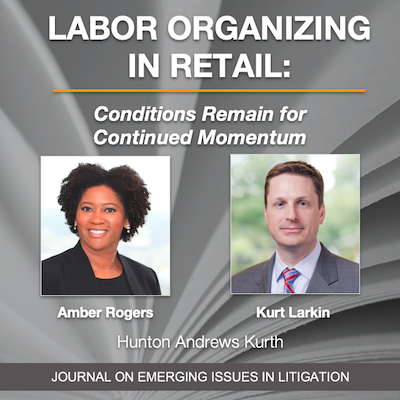
Labor Organizing in Retail: Conditions Remain for Continued Momentum

February 24th, 2023|Categories: Complex Business Litigation, Corporate Compliance, Employment, Journal, New Featured Post for Home Page, News|Tags: , , |

The Authors Amber is Board Certified in Labor & Employment Law by the Texas Board of Legal Specialization, and is a trial lawyer who has extensive experience representing and advising clients in traditional labor relations, such as collective bargaining, representation elections, decertification elections, unfair labor practice charges, arbitrating grievances, contract administration and interpretation, and union avoidance strategies. Amber’s litigation experience includes regularly representing clients in wage and hour collective and class actions, trade secrets and post-employment restrictive covenant disputes, and complex employment discrimination. As a part of Amber’s partnership with clients to avoid litigation, she frequently conducts and coordinates sensitive corporate investigations, and provides training presentations for clients on a multitude of topics. Kurt helps businesses of all sizes solve their complex labor and employment challenges. He counsels clients on all aspects of labor-management relations, including representation elections, collective bargaining and strikes and lockouts, and also advises clients in strategic employment and human relations matters. Kurt litigates labor and employment cases in federal and state trial and appellate courts around the country and before the NLRB and EEOC. Kurt is a recognized thought leader in the area of traditional labor-management relations. He has been recognized as a leader in Labor and Employment by Chambers USA Virginia and as a 2022 Top 10 Labor Lawyer by Benchmark Litigation. [...]

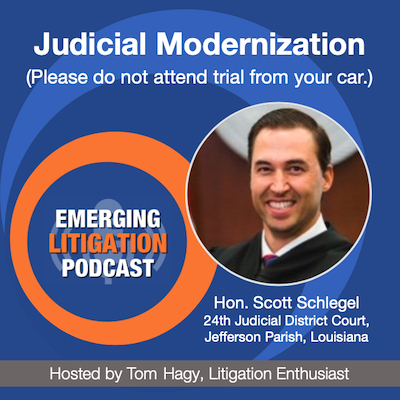
Modernizing Our Court System (but Don’t Attend Trial from Your Car) with Hon. Scott Schlegel

February 15th, 2023|Categories: Complex Business Litigation, ELP, HB Tort Notes, Procedural Law|Tags: , , , |

The judicial system is overburdened for a number of reasons, and greater efficiency is a must if court systems are to achieve their important objectives. Technology and openness to all that it offers is a key solution, something that was tried, tested and proven during the Covid pandemic which closed courthouses and law offices around the nation. Along with technology, improvements can be made by reexamining their orthodoxies about how things should be done based on decades of "that's how we've always done it." This is a matter of importance to judges, lawyers, plaintiffs, defendants, and numerous others whose lives are impacted directly or indirectly when either the civil or criminal justice systems are inefficient, cumbersome, costly, confusing, slow, and even inaccessible. If only we had an example of at least one judge who is trying to do something about it. But wait ... Listen to my interview with the Hon. Scott Schlegel who presides over criminal civil and domestic matters in Louisiana's 24th Judicial District Court in Jefferson Parish. Judge Schlegel was elected to the bench in 2013, and quickly earned a reputation as a modern judge using technology to bring his court into the digital age, even before the pandemic forced the change on other jurists. He partnered with tech companies to develop efficiency tools like chat bots and [...]

Discovery Strategies in Wage and Hour Class and Collective Actions Before and After Certification of Putative Class

February 15th, 2023|Categories: Class Actions, CLE OnDemand, Mass Torts|Tags: , , , , |

Discovery Strategies in Wage and Hour Class and Collective Actions Before and After Certification of Putative Class Strategically Limiting Discovery, Resolving Discovery Disputes Wage and hour class and collective actions are complex and discovery intensive. Discovery requests are often burdensome, seeking information concerning a broad swath of workers. This causes the discovery process to sometimes linger for years and creates a significant expense for employers.In recent years, courts have emphasized that parties must rein in extensive and expensive discovery requests. Employment litigators are increasingly raising proportionality arguments as a basis for objecting to opposing counsel's discovery requests. Drafters are responding by tailoring requests to anticipate such challenges. Drafting discovery requests that are likely to withstand burden and proportionality challenges and objections to broad discovery requests is critical for litigators representing employers in wage and hour class and collective actions. Employment litigators must develop and implement effective discovery strategies both before and, as applicable, after certification of the putative class. These strategies often must anticipate the possibility of a future summary judgment motion, further certification practice, and trial on the merits. Listen as our authoritative panel of employment law attorneys explains effective strategies for pursuing or objecting to discovery requests in wage and hour collective and class actions and resolving discovery disputes that arise during litigation. Questions Addressed: What are the most common discovery [...]

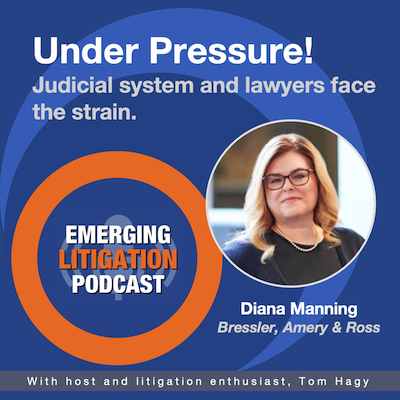
Under Pressure: Courts and Lawyers Trying to Deal With It with Diana Manning

January 6th, 2023|Categories: Complex Business Litigation, ELP, Emerging Litigation & Risk, News|Tags: , , , |

The pressure on trial lawyers, judges, plaintiffs, defendants, and court systems is only increasing. The backlog of cases in New Jersey, for example, nearly quadrupled between February 2020 and 2021, the first year of the pandemic, according to NJ Spotlight News (NJSN). The state is also facing a historic shortage of jurists, NJSN reported, “leading to overworked judges, huge case backlogs and nearly 7,000 defendants in jail without bail, some 500 of them for more than two years despite a law that essentially requires a trial within two years for anyone detained." As reported by NJSN, one court official told the state Assembly Budget Committee about the impact of the pandemic on the court system: “Buildings were closed to most in-person trials for more than a year, although other proceedings continued virtually. The business closures and high unemployment led to a housing crisis that resulted in more than 46,000 pending cases that involve landlord-tenant issues . . . . But with all courts open and staff back to work in person, it is impossible to eliminate the backlog of cases with so many open judge seats.” The problem is attributed to the state Senate, where the process is mired, even though the governor is making appointments. According to the National Counsel for State Courts, backlogs at one third of [...]

Policy Derailed: Can U.S. Antitrust Policy Toward Standard Essential Patents Get Back on Track by Jonathan Rubin

January 4th, 2023|Categories: Class Actions, Complex Business Litigation, Journal, New Featured Post for Home Page, News|Tags: , , |

The Author Jonathan Rubin (jrubin@moginrubin.com) is Co-Founder and Partner of MoginRubin LLP, a boutique antitrust, mergers and acquisitions, and class action law firm. Since 2001, he has focused his legal practice exclusively on antitrust and competition law and policy. As a litigator he has led trial teams in major antitrust cases in courts throughout the country. Rubin is a member of the Editorial Board of Advisors for the Journal of Emerging Issues in Litigation. Interviews with leading attorneys and other subject matter experts on new twists in the law and how the law is responding to new twists in the world. Policy Derailed: Can U.S. Antitrust Policy Toward Standard Essential Patents Get Back on Track? "The failure to appropriately adjust the patent system to accommodate the competitive circumstances created when patents are incorporated into standards undermines the purposes of the standard-setting enterprise and impairs the utility and proliferation of standardized technologies. Without a course correction among the judiciary, the United States risks finding itself as a less desirable jurisdiction for pro-growth and pro-competitive patenting and standard-setting activities." Abstract: A consensus at the intersection of patent and anti-trust law was achieved after a series of decisions finding that in some circumstances owners of standard essential patents (SEPs) have an antitrust duty to [...]

Lawyers for Good with Tara Trask and Jason Flom

December 22nd, 2022|Categories: Class Actions, Complex Business Litigation, ELP, News|Tags: , , |

If you're feeling bad about being a lawyer, or just maybe tingling with the holiday spirit of giving back, this episode is for you. Listen to three professionals (well, maybe two "professionals") who deeply admire for the legal profession, the important role attorneys play in society, and all the potential they have to make the world a better place. When there is strife, there is a supporting organization, and with them are lawyers. Wrongful convictions. Voting rights. Environmental protection. The rights of women, people of color, workers,  LGBTQ, immigrants, asylum seekers.  Lawyers are in a unique position to do something about all of this. And they do. And we hope more will. Join me as I interview nationally acclaimed trial consultant Tara Trask and music industry star-maker Jason Flom. Tara Trask is the President of Trask Consulting, a boutique litigation strategy, jury research and trial consulting firm. Tara  focuses complex commercial litigation, from intellectual property to antitrust, from products liability to insurance, and oil and gas. She has extensive experience assisting institutions and individuals in matters involving regulatory enforcement and white-collar defense. Tara has been involved in more 450 jury trials. Music industry executive Jason Flom is  CEO of Lava Records, Lava Music Publishing, and Lava Media, LLC.  He is former  CEO at Atlantic Records, Virgin Records and Capitol Music Group. [...]

Data-Driven Legal Guidance with Ed Walters

November 26th, 2022|Categories: Complex Business Litigation, ELP, Emerging Litigation & Risk, News|Tags: , , , |

Today we’re going to talk about the weather. But only for a minute. Mostly we’re going to talk about the use of big data in the practice of law. There is a reason IBM acquired the digital assets of The Weather Channel, and it's not because they are climate nerds. They bought it to put weather data to work to “operationalize [the] understanding of the impact of weather on business outcomes.” Think about the economic impact of snowstorms, hurricanes, and even less dramatic weather conditions, or the impact on the durability of manufacturing or building materials as temperatures rise or fall outside the norm. While we all crave meteorological precision, we also crave precision when making legal and business decisions. Clients ask questions like these all the time: What is our case worth? What size award will we get? Where should I file? Will the judge grant summary judgment? Should I even bring this suit?  Lawyers will draw on experience to offer their best advice, providing ranges followed by caveats and usually preceded by the most lawyerly of lawyer answers: “It depends.”  As my guest points out, lawyers also get business-related questions. Business-related answers may begin with "it depends," but must end with a number. When a CEO asks how much revenue your project will generate, "more" is not the [...]

Medical Monitoring for Modern Times with Ed Gentle

November 1st, 2022|Categories: Class Actions, Complex Business Litigation, ELP, Emerging Litigation & Risk, Environmental Torts, News|Tags: , , |

Medical Monitoring for Modern Times: Attorney and court-appointed neutral Ed Gentle shares his vision for a new paradigm for mass torts.  Marissa, a resident of a small town in Kentucky, learned that for some time her drinking water may have been contaminated with so-called "forever chemicals" or PFAS. It's really a collection of chemicals used in products like fire-suppression foam, cookware, stain-resistant sprays, and food packaging. A local public radio reporter covering the story asked Marissa for her reaction. "I was never informed," she said. "And now I'm worried, like, I hope I don't have issues some day in my life."   Marissa's concern is like that of many people who find themselves in this situation and is at the center of this episode. When a case like Marissa's goes to court, plaintiffs will seek a ruling that the responsible parties pay for years of medical monitoring. That means they are suing often without signs of an existing injury, and that defendants must pay for something when an injury may not arise. Attorney, author, and court-appointed case neutral, Edgar C. Gentle III, says  that approach is antiquated. He outlines a better way in his 2014 essay titled The Medical Monitoring Tort Remedy: Its Nationwide Status, Rationale and Practical Application (A Possible Dynamic Tort Remedy for Long Term Tort Maladies). Now he shares [...]

Litigation’s Role in Gun Safety Advocacy: An Interview With Adam Skaggs of Giffords

October 14th, 2022|Categories: Emerging Litigation & Risk, News|Tags: , , , , |

Read the article We’re closing in on 400 million guns in America, weapons that have been used to kill 1.5 million Americans between 1968 and 2017. Can litigation be an effective tool in curbing this loss of life? In 2020 alone there were more than 45,000 gun deaths. The beyond tragic and senseless mass shootings at schools has become all too routine. Most Americans want stricter gun laws which they believe will reduce the senseless killing in our country, which leads the world in both the number of privately owned firearms and gun-related deaths. The Supreme Court, of course, didn't take public opinion into account when it struck down a more than century old New York City ban on concealed firearms. Politicians do, however, pay close attention to polls. At the federal level, President Joe Biden signed a bipartisan law designed to make Americans safer in our gun-toting nation. Hailed as a "great start" and a rare but welcome exercise in reaching across the aisle, the law will result in safer citizens, but didn't include much of what gun advocates say is really needed to effect meaningful change. In California, Governor Gavin Newsom signed a new law that gives citizens incentives to pursue gun manufacturers and dealers who sell illegal firearms. In New York, Democratic leaders, undaunted by the [...]

Covid Insurance Coverage Decisions with Guest Marshall Gilinsky. Are Policyholders Catching Up?

September 22nd, 2022|Categories: ELP, Emerging Litigation & Risk, News|Tags: , , , , |

According to the online Covid Coverage Litigation Tracker (CCLT) run by Penn Law there have been more than 2,300 insurance coverage cases filed over denial of claims relating to Covid-19. Restaurants and bars were hardest hit by the pandemic and so led the way in seeking – and being denied – coverage, too. They are also leading the way in suing their insurers. The top five insurers in the defense position are Chubb Limited at #5, then #4 Lloyds of London, #3 Cincinnati Financial, and #2 Zurich.  And in the #1 position facing the most coverage suits is Hartford.  The insurance industry started off strong when this litigation began, winning the vast majority of the coverage suits. And they continue to do well, scoring with the argument that many of the claims do not involve actual property damage. Government closures don’t cause property damage, they argue. Courts have largely been siding with the carriers – but not all. Policyholders, a tenacious bunch, appear to be chipping away at the body of law in this suddenly expanding category. A recent case involving a New Orleans restaurant against Lloyd’s was penciled into the win column for carriers by a trial court , but an appeals court erased it and wrote the policyholder a narrow 3-2 victory. The appeals court said the language [...]

EMR Audit Trail—What Is It? Why Do They Matter? What Should You Look For? by Haley K. Grieco and Brooke E. Reddin

September 20th, 2022|Categories: Emerging Litigation & Risk, HB Tort Notes, Journal, Mass Torts, New Featured Post for Home Page, News|Tags: , , , , |

The Authors Haley K. Grieco (hgrieco@hallboothsmith.com) is a partner in the Paramus, New Jersey, office of Hall Booth Smith, where she defends physicians, hospitals, and other healthcare providers in a wide range of medical malpractice litigation. Brooke E. Reddin (breddin@hallboothsmith.com) is an associate with the firm, where she focuses her practice on healthcare, medical malpractice, and aging services litigation. Interviews with leading attorneys and other subject matter experts on new twists in the law and how the law is responding to new twists in the world. EMR Audit Trail—What Is It? Why Do They Matter? What Should You Look For? "As the healthcare industry becomes increasingly digitized, it is imperative that attorneys appreciate the impact it may have on their clients and their practice. In medical malpractice matters, discovery requests for metadata—specifically, the production of the EMR audit trail—has steadily increased over the past few years." Abstract: Maintaining electronic medical records, or EMRs, is now a nearly universal best practice among medical providers from small physician practices to large hospital networks. Unlike handwritten or typed records, these digital documents carry with them much more data than meets the eye. In this article, the authors—two medical malpractice attorneys— discuss what attorneys need to know about EMRs in the litigation context and [...]

Employers Be WARNed: Workforce Reduction Rules Meet New Workplace Definitions as Employees Go Remote by Juan Enjamio and Steven DiBeneditto

September 6th, 2022|Categories: Emerging Litigation & Risk, Employment, Journal, New Featured Post for Home Page, News|Tags: , , , , |

The Authors: Juan C. Enjamio (jenjamio@huntonak.com) is managing parter of the Miami office of Hunton Andrews Kurth where he dedicates his practice to complex domestic and international employment law matters. Steven J. DiBeneditto Jr. (sdibeneditto@huntonak.com) is a Washington, DC-based associate in the firm’s employment and labor group. Interviews with leading attorneys and other subject matter experts on new twists in the law and how the law is responding to new twists in the world. Employers Be WARNed Workforce Reduction Rules Meet New Workplace Definitions as Employees Go Remote "Numerous courts have opined that a “home base” is a place in which the employee has some sort of physical connection. But this connection must be more than a “notional” base, whereby the employee has a menial relationship." Introduction A common sentiment during the Covid-19 pandemic was that a different society would emerge from its ashes. While overstated in many cases, one segment of society that appears to have changed for good is the white collar workplace. Indeed, after enjoying the flexibility of working from home for more than 2 years, many white collar workers are demanding that a remote work option remain a permanent fixture at their place of employment. And with seemingly no negotiating leverage due to worker shortages across the [...]

Go to Top