
Emerging Litigation Podcast

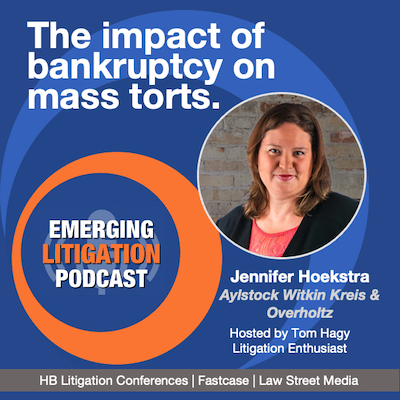
Greatly Exaggerated: The Impact of Bankruptcy on Mass Torts with Jennifer Hoekstra
When large companies face massive mass tort litigation, one way they can survive is to file for bankruptcy protection and reorganize. 3M recently put its Aearo Technologies subsidiary into bankruptcy in the face of more than 230,000 claims that's its defective earplugs caused hearing loss. When it came to filing bankruptcy 3M said Aearo was solely responsible for the product. But for several years of litigation 3M argued that it, as the parent, was solely responsible, not its various subsidiaries. That was a strategy that was beneficial to the company in multidistrict litigation. Why did 3M suddenly change course? What impact does bankruptcy have on claimants? Could corporations use bankruptcy law to neuter mass tort litigation for all eternity? And how did the strategy sit with the federal magistrate judge overseeing the multidistrict litigation? Joining me to discuss this incredibly complex litigation is Jennifer M. Hoekstra, a partner with Aylstock Witkin Kreis & Overholtz. Jennifer has been involved in all varieties of complex litigation since 2007, focusing on mass torts, drug and device litigation, and others. She has a J.D. from Tulane, which she earned while also completing a certificate in Environmental Law. She has actively served as trial counsel or an integral member of the trial team in several of the 3M Earplug trials securing nearly $300 million in compensatory damages for military veterans. Jennifer shared her insights on the intersection of complex mass torts and bankruptcy, an intersection that wasn't originally on her roadmap. This podcast is the audio companion to the Journal on Emerging Issues in Litigation. The Journal is a collaborative project between HB Litigation Conferences and the Fastcase legal research family, which includes Full Court Press, Law Street Media, and Docket Alarm. The podcast itself is a joint effort between HB and our friends at Law Street Media. If you have comments or wish to participate in one our projects please drop me [...]

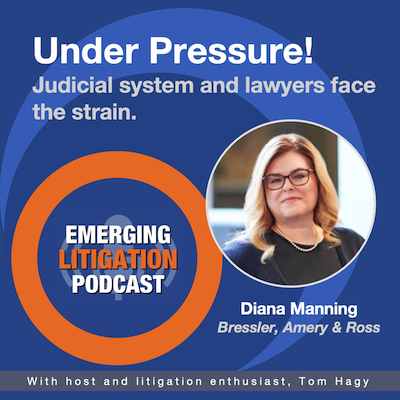
Under Pressure: Courts and Lawyers Trying to Deal With It with Diana Manning
The pressure on trial lawyers, judges, plaintiffs, defendants, and court systems is only increasing. The backlog of cases in New Jersey, for example, nearly quadrupled between February 2020 and 2021, the first year of the pandemic, according to NJ Spotlight News (NJSN). The state is also facing a historic shortage of jurists, NJSN reported, “leading to overworked judges, huge case backlogs and nearly 7,000 defendants in jail without bail, some 500 of them for more than two years despite a law that essentially requires a trial within two years for anyone detained." As reported by NJSN, one court official told the state Assembly Budget Committee about the impact of the pandemic on the court system: “Buildings were closed to most in-person trials for more than a year, although other proceedings continued virtually. The business closures and high unemployment led to a housing crisis that resulted in more than 46,000 pending cases that involve landlord-tenant issues . . . . But with all courts open and staff back to work in person, it is impossible to eliminate the backlog of cases with so many open judge seats.” The problem is attributed to the state Senate, where the process is mired, even though the governor is making appointments. According to the National Counsel for State Courts, backlogs at one third of U.S. courts increased by 5%. It would have been worse had courts not held virtual hearings. Using the Court Statistic Project database, the numbers reveal in stark terms the impact the pandemic had in the year it came to America. Dispositions dropped from 43M in 2019 to 28M in 2020. Bench trials fell from 3M in 2019 to under 2M in 2020. Jury trials plummeted from 49K in 2019 to less than 19K in 2020. The Washington Post reported that the Pennsylvania Supreme Court declared a judicial emergency and [...]

Lawyers for Good with Tara Trask and Jason Flom
If you're feeling bad about being a lawyer, or just maybe tingling with the holiday spirit of giving back, this episode is for you. Listen to three professionals (well, maybe two "professionals") who deeply admire for the legal profession, the important role attorneys play in society, and all the potential they have to make the world a better place. When there is strife, there is a supporting organization, and with them are lawyers. Wrongful convictions. Voting rights. Environmental protection. The rights of women, people of color, workers, LGBTQ, immigrants, asylum seekers. Lawyers are in a unique position to do something about all of this. And they do. And we hope more will. Join me as I interview nationally acclaimed trial consultant Tara Trask and music industry star-maker Jason Flom. Tara Trask is the President of Trask Consulting, a boutique litigation strategy, jury research and trial consulting firm. Tara focuses complex commercial litigation, from intellectual property to antitrust, from products liability to insurance, and oil and gas. She has extensive experience assisting institutions and individuals in matters involving regulatory enforcement and white-collar defense. Tara has been involved in more 450 jury trials. Music industry executive Jason Flom is CEO of Lava Records, Lava Music Publishing, and Lava Media, LLC. He is former CEO at Atlantic Records, Virgin Records and Capitol Music Group. Jason is personally responsible for launching acts such as Katy Perry and Greta Van Fleet, and discovering and developing the likes of Matchbox 20, The Corrs, Tory Amos, Jewel, and Stone Temple Pilots. The New Yorker described Jason as “one of the most successful record men of the past 20 years. He's also committed to doing good. Through his Lava for Good company, Jason hosts the hit podcast Wrongful Conviction, now in its ninth season, which features interviews with people who have spent decades in prison for crimes they [...]
A Shameless Plug for Our Content Services
Your content marketing is everything you’ve ever dreamed of. Right?
 Sara is marketing director at a boutique law firm. When we asked her how their blog was going, she made a sad face. But then, we made Sara smile.*
Critical Legal Content was founded by Tom Hagy, former Editor & Publisher of Mealey’s Litigation Reports and VP at LexisNexis, founder of HB, current litigation podcaster and editor-in-chief. CLC’s mission is to help smaller firms and service providers not only create content — blogs, articles, papers, webinars, podcasts (like the stuff on this site) — but also to get it out there. How? Via social media, this website, your website, and potential via our podcast and journal which we publish in collaboration with vLex Fastcase and Law Street Media. The goal is to attract readers and dizzy them with your brilliance.
*Inspired by actual events.
Create content like a real legal publisher.
Emerging Litigation Journal
TVPRA, State Statutes Open Door for Civil Damage Claims by Human-Trafficking Victims
Since 2003, when Congress opened the door for human-trafficking victims to sue for civil damages under the Trafficking Victims Protection Act of 2000 (TVPRA), the TVPRA and similarly drafted state statutes have allowed for human-trafficking victims to seek civil damages against any party that has benefited from their trafficking. Given this expansive inclusion of third-party liability, more and more businesses, especially those in the hospitality industry, are ultimately the ones left to pay for the criminal acts of human traffickers. In this article, the authors, Coryne Leyendecker and Pamela Lee discuss the evolving litigation around human-trafficking claims and offer guidance on how businesses can build a foundation for their own defense while simultaneously helping prevent human-trafficking crimes from occurring in the first place.

Spotting the Risk, Reaping Rewards: Avoiding Increased Antitrust Scrutiny
The Authors Katie has favorably represented antitrust clients in matters involving monopolization, conspiracy, price fixing, exclusive dealing, and other competition-related disputes, including trade secrets and non-compete actions. She has extensive knowledge of the regulatory hurdles and obligations her clients face. Katie earned her J.D. from the New York University School of Law, cum laude. Natalie West represents sophisticated clients in complex commercial disputes. She regularly serves as the lead brief writer in antitrust cases, employment and consumer class actions, and appellate matters. Natalie graduated with high honors from the University of Texas School of Law, where she served as a member of the Texas Law Review and was elected to the Order of the Coif. Interviews with leading attorneys and other subject matter experts on new twists in the law and how the law is responding to new twists in the world. Avoiding Antitrust Scrutiny Spotting the Risk, Reaping Rewards The increase in aggressive antitrust enforcement has certainly received significant attention. For the moment, juries are not rewarding the prosecutors. That said, even an unsuccessful government investigation is itself costly and can motivate plaintiffs’ lawyers. Best practices involve not only following the law but also maintaining solid optics to avoid the need for an expensive, if ultimately successful, defense. Abstract: A decade ago, few lawyers across the country spent significant time thinking about antitrust law. But, since then, there has been an onslaught of antitrust attacks on businesses and executives across all sectors of the economy. Enforcement efforts have skyrocketed following President Biden’s July 2021 executive order directing a “whole of government” crackdown on competition abuses—and the trend shows no sign of letting up. Today, no matter the industry or the size of the business, everyone needs to understand these risks and have strategies to minimize them. This article will walk [...]


International Discovery Tool Kit Aims to Facilitate Discovery in Both Domestic and Foreign Litigation
The Authors Benjamin Daniels advises financial institutions and global corporations about litigation and dispute resolution. As a member of the Business Litigation Group, Ben provides creative and ardent advocacy during litigation, enforcement actions, investigations, crisis management, and white-collar defense matters. Ben’s clients often face complex, cross-border disputes. He has deep experience with the interplay between domestic and international courts, including discovery disputes and Hague convention proceedings. He also represents clients in international arbitrations and mediations. Jenna Scoville is a member of the firm’s Business Litigation Group. She focuses her practice on all aspects of general business litigation and dispute resolution, as well as government enforcement matters, and appellate work. She helps companies respond to a variety of business disputes, including claims for breach of contract, unfair trade practices and fraud. Jenna also has extensive appellate experience. Prior to joining the firm, she clerked for the Honorable Peter W. Hall of the U.S. Court of Appeals for the Second Circuit. Interviews with leading attorneys and other subject matter experts on new twists in the law and how the law is responding to new twists in the world. International Discovery Tool Kit Aims to Facilitate Discovery in Both Domestic and Foreign Litigation "At a time when litigants have increasingly relied on U.S. federal courts to obtain otherwise unobtainable evidence from entities located within the United States, the U.S. Supreme Court has decisively closed the door to U.S.-style discovery in private arbitrations abroad. That means U.S. companies will no longer face the time, exposure, and expense of U.S.-style discovery that § 1782 had injected into those proceedings." Abstract: Business knows no borders. Every year companies increase their global reach and open new offices both domestically and abroad. The COVID-19 pandemic accelerated this process—remote employees spread documents and witnesses from Chicago to Shanghai to Sumatra. This [...]
HB Webinars on CeriFi LegalEdge
Content Partners