
Emerging Litigation Podcast

The New European Unified Patent Court with Marianne Schaffner and Thierry Lautier
What's the new European patent court mean to global innovators? The European Union’s new Unified Patent Court is an international body set up by participating EU Member States to deal with the infringement and validity of both Unitary Patents and European patents. The court's objective is “putting an end to costly parallel litigation and enhancing legal certainty.” Unitary patents are intended to make it possible to get patent protection in up to 25 EU Member States by submitting a single request to the European Patent Office, making the procedure simpler and more cost effective for applicants. The new system goes live on June 1, 2023. What must U.S. and multi-national U.S.-based companies understand about the court? Why should inventors and their organizations factor it in to any existing or new patent strategy they may be developing? For answers to these questions and more listen to my interview with attorneys Marianne Schaffner and Thierry Lautier who practice out of the Paris office of Reed Smith. Marianne heads the intellectual Property team in Paris and the patent practice in Europe. She manages complex national and transnational patent, trade secrets and trademark disputes in the healthcare, chemistry, technology and telecommunications sectors. Thierry is part of the firm’s global Intellectual Property Group. With a dual legal and engineering/scientific background, Thierry uses his understanding, knowledge, and experience to provide clients with creative, technically robust, and business-oriented patent strategies. This podcast is the audio companion to the Journal on Emerging Issues in Litigation. The Journal is a collaborative project between HB Litigation Conferences and the Fastcase legal research family, which includes Full Court Press, Law Street Media, and Docket Alarm. The podcast itself is a joint effort between HB and our friends at Law Street Media. If you have comments or wish to participate in one our projects please drop me a note at Editor@LitigationConferences.com. (actual size) Tom Hagy Litigation Enthusiast and Host of the Emerging Litigation [...]
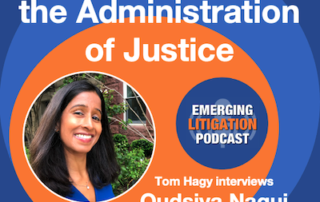
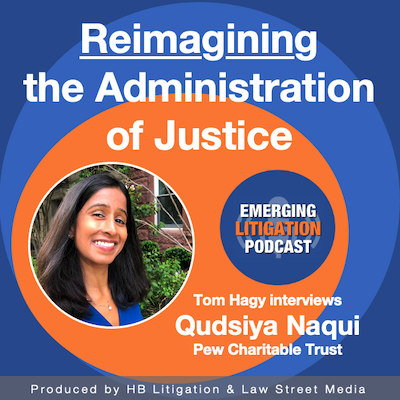
Reimagining the Administration of Justice with Qudsiya Naqui of Pew Charitable Trust
Before COVID-19 came to America in early 2020, “going to court” literally meant putting on your shoes and walking into a courthouse, typically a large building with courtrooms inside, and people in robes and business suits and, in some cases, more restrictive attire. Stoked by necessity, courts sprinted toward solutions for keeping the wheels of justice spinning while also keeping everyone away from each other. Until then it didn’t seem possible that attorneys could or would appear before judges via digital screens, like George Jetson getting yelled at by Mr. Spacely over some hilarious mishap at the sprocket factory. Pew Charitable Trust concluded an in-depth study of the courts with the 2021 release of a report, “How Courts Embraced Technology, Met the Pandemic Challenge, and Revolutionized Their Operations.” After examining emergency orders from all 50 states and Washington, D.C., and court approaches to virtual hearings, e-filing, and digital notarization, the researchers wrote that it was a time for "reimagining how to administer justice.” Was the adoption of technology effective? Were there any hiccups? Was technology widely embraced? Were the effects of new efficiencies enjoyed evenly across the socio-economic spectrum? Do we think courts will continue to reimagine how they administer justice without the crushing pressure of widespread disease? Listen to my interview with Qudsiya Naqui who leads Pew’s research at the intersection of technology and civil legal system reform. In this role, she evaluates and tests new technologies to ensure that they further efficiency, equity, and transparency in the legal process. This work is part of Pew’s Civil Justice Modernization Project. Before joining Pew, Qudsiya designed and implemented immigration, housing, and disaster recovery legal services programs at Equal Justice Works and the Vera Institute of Justice. She began her legal career representing immigrant women and girls seeking relief from deportation. Qudsiya holds a bachelor’s degree in political science and human rights [...]
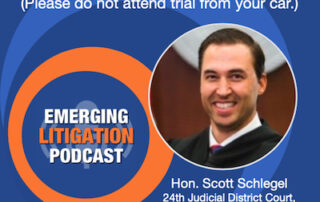
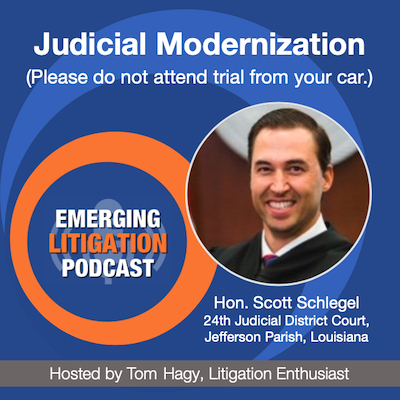
Modernizing Our Court System (but Don’t Attend Trial from Your Car) with Hon. Scott Schlegel
The judicial system is overburdened for a number of reasons, and greater efficiency is a must if court systems are to achieve their important objectives. Technology and openness to all that it offers is a key solution, something that was tried, tested and proven during the Covid pandemic which closed courthouses and law offices around the nation. Along with technology, improvements can be made by reexamining their orthodoxies about how things should be done based on decades of "that's how we've always done it." This is a matter of importance to judges, lawyers, plaintiffs, defendants, and numerous others whose lives are impacted directly or indirectly when either the civil or criminal justice systems are inefficient, cumbersome, costly, confusing, slow, and even inaccessible. If only we had an example of at least one judge who is trying to do something about it. But wait ... Listen to my interview with the Hon. Scott Schlegel who presides over criminal civil and domestic matters in Louisiana's 24th Judicial District Court in Jefferson Parish. Judge Schlegel was elected to the bench in 2013, and quickly earned a reputation as a modern judge using technology to bring his court into the digital age, even before the pandemic forced the change on other jurists. He partnered with tech companies to develop efficiency tools like chat bots and online forms software. He launched courtonline.us and onlinejudge.us to consolidate his processes for the public. Judge Schlegel has received numerous awards and accolades, like the National Center for State Courts' 26th Annual William H. Rehnquist Award for Judicial Excellence. He was the American Bar Association's 2021 Legal Rebel. And he received the Fastcase 50 Award for his innovative approaches to the administration of justice. Prior to becoming a judge, he was a prosecutor and litigator. Judge Schlegel graduated with honors from Loyola University New Orleans College of Law. This podcast [...]
A Shameless Plug for Our Content Services
Your content marketing is everything you’ve ever dreamed of. Right?
 Sara is marketing director at a boutique law firm. When we asked her how their blog was going, she made a sad face. But then, we made Sara smile.*
Critical Legal Content was founded by Tom Hagy, former Editor & Publisher of Mealey’s Litigation Reports and VP at LexisNexis, founder of HB, current litigation podcaster and editor-in-chief. CLC’s mission is to help smaller firms and service providers not only create content — blogs, articles, papers, webinars, podcasts (like the stuff on this site) — but also to get it out there. How? Via social media, this website, your website, and potential via our podcast and journal which we publish in collaboration with vLex Fastcase and Law Street Media. The goal is to attract readers and dizzy them with your brilliance.
*Inspired by actual events.
Create content like a real legal publisher.
Emerging Litigation Journal

Video Game or Casino? An International Examination of Loot Boxes and Gambling Regulations
The author, Darius Gambino of Saul Ewing LLP examines the legal and regulatory challenges surrounding loot boxes in video games, highlighting the risks of litigation, government scrutiny, and the need for industry self-regulation.

FTC v. Amazon: Market Definitions and Section 5 of the FTC Act
Traditional antitrust economics face significant challenges grappling with the relatively new digital economy. The author, Jonathan Rubin examines these and other issues raised in the case of FTC v. Amazon, which he anticipates will be a crucial test for antitrust and the FTC Act.



PFAS Regulation: EPA Ushers in Next Era of Mass Tort and Environmental Litigation
PFAS claims are the next frontier of mass tort and environmental litigation. With the EPA poised to finally enact the first regulation of these chemicals, that frontier is ripe for exploration. This article explores PFAS and the origin of litigation around the substances as well as the state of PFAS litigation and regulation today. It concludes with some thoughts on what to expect when it comes to PFAS litigation going forward.
HB Webinars on CeriFi LegalEdge
Content Partners