
Emerging Litigation Podcast

Data-Driven Legal Guidance with Ed Walters
Today we’re going to talk about the weather. But only for a minute. Mostly we’re going to talk about the use of big data in the practice of law. There is a reason IBM acquired the digital assets of The Weather Channel, and it's not because they are climate nerds. They bought it to put weather data to work to “operationalize [the] understanding of the impact of weather on business outcomes.” Think about the economic impact of snowstorms, hurricanes, and even less dramatic weather conditions, or the impact on the durability of manufacturing or building materials as temperatures rise or fall outside the norm. While we all crave meteorological precision, we also crave precision when making legal and business decisions. Clients ask questions like these all the time: What is our case worth? What size award will we get? Where should I file? Will the judge grant summary judgment? Should I even bring this suit? Lawyers will draw on experience to offer their best advice, providing ranges followed by caveats and usually preceded by the most lawyerly of lawyer answers: “It depends.” As my guest points out, lawyers also get business-related questions. Business-related answers may begin with "it depends," but must end with a number. When a CEO asks how much revenue your project will generate, "more" is not the answer they're looking for. I know. I've tried. Lawyers who seek greater precision in their predictions can take comfort in the increasing sophistication of analytical tools that can evaluate massive troves of data and account for myriad variables. Not only are we seeing advances in machine learning, artificial intelligence, and language processing, but there is greater access to important litigation-related data – BIG DATA – than ever before. Using new technologies to comb through millions of records – combined with an attorney’s insights – cannot only [...]
PFAS Consumer Fraud Litigation with John Gardella
These stubborn chemicals are everywhere. But when they find their way into products, shouldn't someone tell consumers? Per- and poly-fluoroalkyl substances (“PFAS”) are a family of more 12,000 manmade compounds. That's a huge family. Most people would recognize the brand names Teflon, produced by Dupont and Scotchgard produced by 3M. They also go by the nickname “forever chemicals” because they are highly persistent and mobile in the environment and the human body. In addition to bodily injury and environmental pollution litigation, plaintiffs are bringing suits against companies for claiming their products and the making of their products are safe and green. New consumer lawsuits seeking millions in damages are targeting oral hygiene products -- like a recent case involving dental floss -- cosmetics, apparel, and food packaging. Listen to my interview with environmental lawyer John Gardella of CMBG3 Law who discusses why PFAS concern citizens, media and legislators, what legal risks corporations face, and why we're seeing a surge in consumer fraud litigation. This podcast is the audio companion to the Journal on Emerging Issues in Litigation. The Journal is a collaborative project between HB Litigation Conferences and the Fastcase legal research family, which includes Full Court Press, Law Street Media, and Docket Alarm. The podcast itself is a joint effort between HB and our friends at Law Street Media. If you have comments or wish to participate in one our projects please drop me a note at Editor@LitigationConferences.com. (actual size) Tom Hagy Litigation Enthusiast and Host of the Emerging Litigation Podcast Home Page LinkedIn PFAS Consumer Fraud Litigation with John Gardella John Gardella is a Shareholder and recognized thought leader on PFAS issues. He is licensed to practice in Massachusetts and Tennessee. A seasoned trial attorney with over 75 verdicts, John is the Chair of the firm’s PFAS, Environmental, Risk Management & Consulting, and ESG practice groups. His thought leadership and predictive risk abilities with respect to PFAS [...]

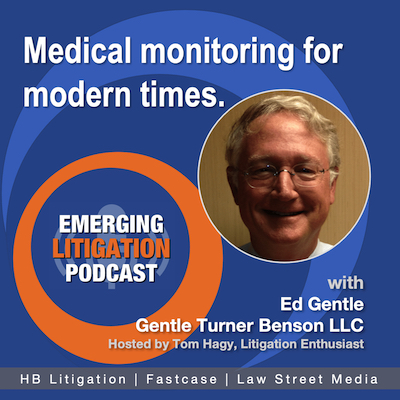
Medical Monitoring for Modern Times with Ed Gentle
Medical Monitoring for Modern Times: Attorney and court-appointed neutral Ed Gentle shares his vision for a new paradigm for mass torts. Marissa, a resident of a small town in Kentucky, learned that for some time her drinking water may have been contaminated with so-called "forever chemicals" or PFAS. It's really a collection of chemicals used in products like fire-suppression foam, cookware, stain-resistant sprays, and food packaging. A local public radio reporter covering the story asked Marissa for her reaction. "I was never informed," she said. "And now I'm worried, like, I hope I don't have issues some day in my life." Marissa's concern is like that of many people who find themselves in this situation and is at the center of this episode. When a case like Marissa's goes to court, plaintiffs will seek a ruling that the responsible parties pay for years of medical monitoring. That means they are suing often without signs of an existing injury, and that defendants must pay for something when an injury may not arise. Attorney, author, and court-appointed case neutral, Edgar C. Gentle III, says that approach is antiquated. He outlines a better way in his 2014 essay titled The Medical Monitoring Tort Remedy: Its Nationwide Status, Rationale and Practical Application (A Possible Dynamic Tort Remedy for Long Term Tort Maladies). Now he shares his latest insights on the Emerging Litigation Podcast. Ed Gentle is the Founding Partner of Gentle Turner & Benson, LLC in Birmingham, Ala. He is a Rhodes Scholar and has five college degrees, three in law. He has practiced for nearly four decades, spending 90% of his professional time serving as a neutral assigned by judges to oversee aspects of mass tort litigation and settlements. He has helped create and administer over $2 billion in settlements during the past 25 years. Education: Bachelor of Science, Auburn University, summa cum laude, [...]
A Shameless Plug for Our Content Services
Your content marketing is everything you’ve ever dreamed of. Right?
 Sara is marketing director at a boutique law firm. When we asked her how their blog was going, she made a sad face. But then, we made Sara smile.*
Critical Legal Content was founded by Tom Hagy, former Editor & Publisher of Mealey’s Litigation Reports and VP at LexisNexis, founder of HB, current litigation podcaster and editor-in-chief. CLC’s mission is to help smaller firms and service providers not only create content — blogs, articles, papers, webinars, podcasts (like the stuff on this site) — but also to get it out there. How? Via social media, this website, your website, and potential via our podcast and journal which we publish in collaboration with vLex Fastcase and Law Street Media. The goal is to attract readers and dizzy them with your brilliance.
*Inspired by actual events.
Create content like a real legal publisher.
Emerging Litigation Journal

The Use—and Abuse—of Rule 41(a) to Destroy Federal Question Jurisdiction Post-Removal
The Authors John defends manufacturers in product liability litigation involving a range of products, e.g., ATVs, RVs, institutional chemicals, medical devices, and pharmaceuticals. From single cases to mass tort litigation and class actions, John has defended clients in courtrooms around the country. Michael is General Counsel of Thor Motor Coach Inc., a final-stage manufacturer of motor homes headquartered in Elkhart, Indiana. He is also an adjunct professor of commercial law at the Notre Dame Law School. Taryn focuses her practice on litigation. She has experience dealing with products liability, discovery issues, corporate structure and governance, wealth management, private and commercial lending, real estate, and Indian affairs for lobbying both on state and federal levels. Taryn contributed valuable research to this article. Interviews with leading attorneys and other subject matter experts on new twists in the law and how the law is responding to new twists in the world. The Use—and Abuse—of Rule 41(a) to Destroy Federal Question Jurisdiction Post-Removal "A plaintiff seeking to divest the court of subject matter jurisdiction post-removal should at least comply with the requirements of the rule they have relied on. Glossing over those requirements undermines the purpose and intent of both the rule and removal statutes. The case should stay put in federal court in the absence of compliance." Abstract: Defendants in civil litigation can level the often uneven state court playing field by removing cases to federal court through federal question removal. In those cases in which the plaintiff has alleged a claim grounded in federal law, the defendant may remove the case to an often more impartial federal forum. Once removed, the plaintiff has few options for defeating removal. About the only option available to the plaintiff is to forgo the federal claim and divest the court of federal question jurisdiction, forcing remand to [...]
The Rise of Multi-Claimant Litigation in England and How Companies Can Manage Potential Exposure
The Authors Sheila L. Birnbaum Mark S. Cheffo Dorothy Cory-Wright Evan Flowers Jacqueline Harrington Will Sachse Stephen Surgeoner Rachel Leary Caroline Power Julie Witham Interviews with leading attorneys and other subject matter experts on new twists in the law and how the law is responding to new twists in the world. The Rise of Multi-Claimant Litigation in England and How Companies Can Manage Potential Exposure "With the growth in US/English partnerships for bringing multi-claimant actions in England, there may be an increased interest in leveraging US discovery for copycat English claims. The larger mass torts become in the United States, the more likely they are to feed into related multi-claimant actions in England." Abstract: Recent court decisions have signaled the English courts’ willingness to embrace multi-claimant litigation and to broaden the types of questions decided on a collective basis. These developments have led UK-based plaintiffs’ lawyers to expand mass tort filings, including doing so in partnership with US plaintiffs’ lawyers who are actively advertising in England. This article provides an overview of multi-claimant litigation in England, highlights some of the factors that may lead to its increase, and discusses steps that companies operating in the English market can take now to manage potential exposure. Three primary mechanisms for bringing collective actions before an English court: 1) Representative actions, group litigation orders (GLOs), and collective actions before the Competition Appeal Tribunal (CAT). 2) Representative actions, in their current form, and GLOs are products of the general Civil Procedure Rules (CPR). 3) Representative actions originated in the common law and permit a representative claimant or defendant with the “same interest” in a claim to represent that interest on behalf of a class. Download the article now!

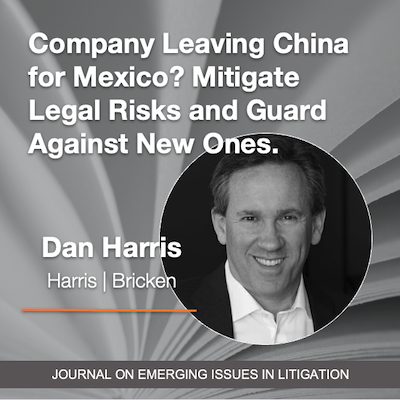
How Companies Seeking to Leave China for Mexico Can Mitigate Their Legal Risks and Protect Against New Ones
The Author Dan Harris (dan@harrisbricken.com) is co-founder of Harris Bricken where he focuses his practice on international law and protecting businesses in their foreign operations. A leading authority on the subject, he is also editor of the highly regarded China Law Blog, and a valued member of the Editorial Board of Advisors for the Journal of Emerging Issues in Litigation. Interviews with leading attorneys and other subject matter experts on new twists in the law and how the law is responding to new twists in the world. How Companies Seeking to Leave China for Mexico Can Mitigate Their Legal Risks and Protect Against New Ones "Chinese manufacturers commonly seek retaliation against foreign buyers that cease buying product from them. For this reason, it is critical that you line up your new suppliers (preferably in a country other than China) and have them ready to go before you even hint to anyone in China that you might cease or reduce production with an existing China supplier." Abstract: The author, one of the leading authorities on the legal issues related to international manufacturing, discusses the risks companies will face if they move their manufacturing out of China, what they should do to mitigate those risks, and what new risks they will face in a new country, such as Mexico. He comments on a variety of concepts, including manufacturing agreements, protection of intellectual property, strategies for a safe departure, potential retaliation tactics, and even personal security matters. Download the article now!
HB Webinars on CeriFi LegalEdge
Content Partners