
Emerging Litigation Podcast
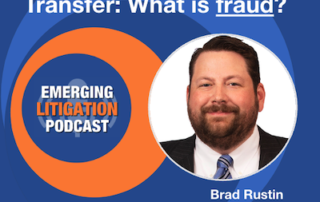
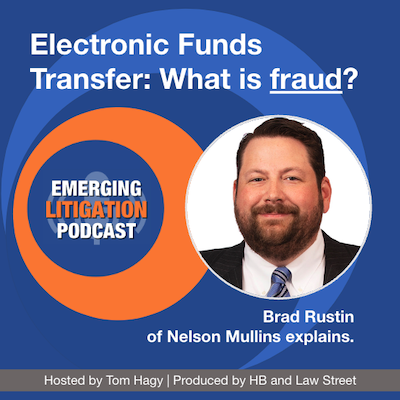
Electronic Fund Transfer Fraud with Brad Rustin
Electronic Fund Transfer Fraud with Brad Rustin Grifters, scammers, con artists Sen. Elizabeth Warren, who championed the creation of Consumer Financial Protection Bureau (CFPB), calls the Zelle digital payments network a “preferred tool for grifters like romance scammers, cryptocurrency con artists, and those who prowl social media sites advertising concert tickets and purebred puppies — only to disappear with buyers’ cash after they pay.” 18 million Americans defrauded Scams and fraud committed via the Zelle platform and other peer-to-peer services are surging. According to one lawsuit 18 million Americans were defrauded by schemes perpetrated via apps like Zelle in 2020. Some 1,500 member banks and credit unions participate in the Zelle service. People sent $490 billion via the app in 2021. But Zelle owner, Early Warning, and its consortium comprising Bank of America, Truist, Capital One, JPMorgan Chase, PNC Bank, U.S. Bank, and Wells Fargo, have refused to refund customers for most of their losses. Sen. Warren issued a report that the claims for fraud received by just four banks will likely exceed $255 million by the end of 2022 – a $165 million increase over 2020. The senator and consumers say Zelle is violating federal consumer protection law. What is fraud? The heart of the problem is this: banks and consumers do not agree on the definition of “fraud.” For clarity on issues surrounding the Electronic Fund Transfer Act (EFTA) and its implementing regulation—Regulation E—listen to my interview with fintech attorney Brad Rustin of Nelson Mullins. In addition to chairing the firm’s Financial Services Regulatory Practice, Brad counsels financial institutions in regulatory matters, including strategic agreements, product development, and operational compliance. Brad is a Certified Anti-Money Laundering Specialist and a Certified Regulatory Compliance Manager. He received his JD, magna cum laude, from the University of South Carolina School of Law and his BA in Political Science and [...]
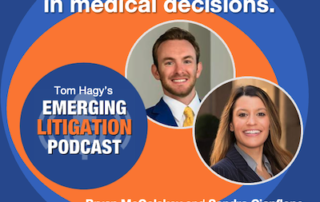
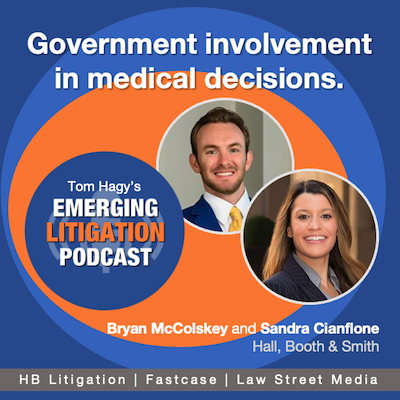
Government Involvement in Medical Decisions During Outbreaks with Bryce McColskey and Sandra Cianflone
Government Involvement in Medical Decisions During Outbreaks It's apparently (and hopefully) on its last legs. The Covid-19 pandemic was the most recent health issue to raise questions around government’s involvement (or interference) in an individual’s control over their own medical treatment. In their article – Government Involvement in Medical Care Decisions During Outbreaks of Disease: How Far is Too Far? – our guests wrote about the intersection of law and medicine. They reviewed medical mandates, implications brought about by the impact of advances in science and medicine, and where role of government to protect public health intersects (or collides) with personal healthcare choices. They focused is on governmental responses to the pandemic, that is, what the government can mandate in the spirit of public health, and not on the separate issue of abortion, which is a “choice” subject for another day. How much authority do government agencies or even the courts have over a person’s healthcare decisions? People often assume the practice of medicine and the enactment and enforcement of laws are separate and independent enterprises; that they remain fixed in their respective corners. However, they wrote, after a deeper dive into history and precedent, it’s evident that the tension between individual rights and health-related mandates has existed for some time. Listen to my interview with the authors, Bryce McCloskey and Sandra M. Cianflone with Hall Booth Smith, P.C. Bryce is based in Jacksonville, Fla., where he focuses on medical malpractice and professional liability law. Sandie is a partner in the firm’s Atlanta office where she concentrates on a variety of aspects of healthcare defense She chairs the firm’s Coronavirus Task Force and is a member of the firm's National Trial Counsel team. She is also a valued member of the Editorial Board of Advisors of the Journal on Emerging Issues in Litigation. *********** This podcast is the audio companion to the Journal on [...]

The Cannabis Employment Law Patchwork with Keya Denner
The Cannabis Employment Law Patchwork with Keya Denner Maryland and Missouri are the latest states to legalize recreational cannabis for people 21 and older. Voters came out in favor of legalization in the November 2022 midterms, bringing the total recreational jurisdictions to 22 states and the District of Columbia. Voters in North Dakota, South Dakota, and Arkansas, however, decided against recreational marijuana. It remains legal for medical reasons in all five states. In the employment context, both recreational and medicinal uses raise questions about protections for employees who use the drug legally. Which states are enacting those protections? What do multi-state employers need to do? What about drug testing? As a requirement to get a job and as a requirement to keep your job? What about this: who is going to say whether a worker is impaired? Will there really be hall monitors trained in spotting your high? For answers to these questions and more, listen to my interview with Keya Denner, a partner at Constangy, Brooks, Smith & Prophete LLP. Keya is an experienced litigator who has been practicing labor and employment law for almost 20 years. Few attorneys nationwide match Keya’s expertise in the area of legal cannabis and its impact on the workplace. He has counseled Fortune 500 companies in the retail, hospitality, and global logistics spaces to create compliant policies and better understand the ever-changing legal landscape brought about by the legalization of cannabis across the United States. Most recently, Keya was named co-chair along with this colleague Ashley Orler of the firm’s new practice group focused on cannabis and employee substance abuse law. Keya received his J.D., cum laude, from Seton Hall University School of Law, J.D., cum laude, and his B.A., also cum laude, from Boston University. This podcast is the audio companion to the Journal on Emerging Issues in Litigation. The Journal is [...]
A Shameless Plug for Our Content Services
Your content marketing is everything you’ve ever dreamed of. Right?
 Sara is marketing director at a boutique law firm. When we asked her how their blog was going, she made a sad face. But then, we made Sara smile.*
Critical Legal Content was founded by Tom Hagy, former Editor & Publisher of Mealey’s Litigation Reports and VP at LexisNexis, founder of HB, current litigation podcaster and editor-in-chief. CLC’s mission is to help smaller firms and service providers not only create content — blogs, articles, papers, webinars, podcasts (like the stuff on this site) — but also to get it out there. How? Via social media, this website, your website, and potential via our podcast and journal which we publish in collaboration with vLex Fastcase and Law Street Media. The goal is to attract readers and dizzy them with your brilliance.
*Inspired by actual events.
Create content like a real legal publisher.
Emerging Litigation Journal

Expert Depositions and Trial Disclosures: What Every Litigator Needs to Know
Expert disclosures in litigation are vitally important for trial testimony and planning for trial. The author, Ethan Minkin examines issues surrounding expert depositions and trial disclosures, which he argues need to be appreciated to avoid unanticipated surprises at trial. As Ethan discusses, "the pretrial process requires an eye toward the future. Trial work is not limited to just knowing the applicable Rules of Evidence. The applicable Rules of Civil Procedure play an equally important, if not greater, role in helping to define what will happen at trial".

Copyright Issues in Generative AI for Software: Doe v. Github, Inc. et al.
The ongoing case of Doe v. Github Inc. et al. addresses copyright-related issues inherent in the Copilot generative AI that allows users to enter prompts to generate software code. This case addresses many of the issues involved in the training and use of generative AI for generating software code. The author, Jeffrey Gluck examines these issues, which he anticipates will have far-reaching implications for AI-generated works in the future. As Jeffrey notes, "Github is a case that may have far-reaching implications for AI-generated works in the future".





The Promise and Peril of Quantum Computing and Its Implications for Cyber Insurance
Quantum computing, like artificial intelligence, is one of several emerging technologies that could either save the planet or end the world, depending on which expert is holding forth on the issue. This article explores the promise and peril of quantum computing and the potential coverage implications under cyber insurance policies. As Cameron notes, "while cyber insurance may provide some coverage for hazards that result from quantum computing, those policies may not respond to many of the risks".
HB Webinars on CeriFi LegalEdge
Content Partners