Emerging Litigation Podcast

Medical Monitoring for Modern Times with Ed Gentle
Medical Monitoring for Modern Times: Attorney and court-appointed neutral Ed Gentle shares his vision for a new paradigm for mass torts. Marissa, a resident of a small town in Kentucky, learned that for some time her drinking water may have been contaminated with so-called "forever chemicals" or PFAS. It's really a collection of chemicals used in products like fire-suppression foam, cookware, stain-resistant sprays, and food packaging. A local public radio reporter covering the story asked Marissa for her reaction. "I was never informed," she said. "And now I'm worried, like, I hope I don't have issues some day in my life." Marissa's concern is like that of many people who find themselves in this situation and is at the center of this episode. When a case like Marissa's goes to court, plaintiffs will seek a ruling that the responsible parties pay for years of medical monitoring. That means they are suing often without signs of an existing injury, and that defendants must pay for something when an injury may not arise. Attorney, author, and court-appointed case neutral, Edgar C. Gentle III, says that approach is antiquated. He outlines a better way in his 2014 essay titled The Medical Monitoring Tort Remedy: Its Nationwide Status, Rationale and Practical Application (A Possible Dynamic Tort Remedy for Long Term Tort Maladies). Now he shares his latest insights on the Emerging Litigation Podcast. Ed Gentle is the Founding Partner of Gentle Turner & Benson, LLC in Birmingham, Ala. He is a Rhodes Scholar and has five college degrees, three in law. He has practiced for nearly four decades, spending 90% of his professional time serving as a neutral assigned by judges to oversee aspects of mass tort litigation and settlements. He has helped create and administer over $2 billion in settlements during the past 25 years. Education: Bachelor of Science, Auburn University, summa cum laude, [...]

Covid Insurance Coverage Decisions with Guest Marshall Gilinsky. Are Policyholders Catching Up?
According to the online Covid Coverage Litigation Tracker (CCLT) run by Penn Law there have been more than 2,300 insurance coverage cases filed over denial of claims relating to Covid-19. Restaurants and bars were hardest hit by the pandemic and so led the way in seeking – and being denied – coverage, too. They are also leading the way in suing their insurers. The top five insurers in the defense position are Chubb Limited at #5, then #4 Lloyds of London, #3 Cincinnati Financial, and #2 Zurich. And in the #1 position facing the most coverage suits is Hartford. The insurance industry started off strong when this litigation began, winning the vast majority of the coverage suits. And they continue to do well, scoring with the argument that many of the claims do not involve actual property damage. Government closures don’t cause property damage, they argue. Courts have largely been siding with the carriers – but not all. Policyholders, a tenacious bunch, appear to be chipping away at the body of law in this suddenly expanding category. A recent case involving a New Orleans restaurant against Lloyd’s was penciled into the win column for carriers by a trial court , but an appeals court erased it and wrote the policyholder a narrow 3-2 victory. The appeals court said the language of the policy was ambiguous, and therefore had to be construed in favor of the restaurant. What's it mean? Does this bode well for policyholders? Or can we expect to see, as we did in previous coverage wars, a mixed bag of decisions across the nation? For more on that case and today’s Covid coverage landscape, listen to my interview with Marshall Gilinsky, a shareholder in the New York office of Anderson Kill. Marshall has represented policyholders of various policy types for two decades, including those seeking coverage [...]
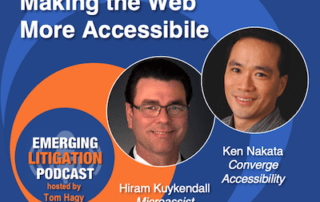
The Role of Litigation and Regulation in Making the Web More Accessible with Guests Ken Nakata and Hiram Kuykendall
According to the International Agency for the Prevention of Blindness there are 43 million people around the world living with blindness, and 300 million living with moderate to severe visual impairment. Put those statistics next to these: There are nearly 2 billion websites, and 550,000 created every day. Shouldn’t sight-impaired people have the same access to these sites as sighted people? Of course they should. There is good news. After previously announcing guidance, the DOJ says new regulations are on the way under Title II of the Americans with Disabilities Act, which describes the obligations for state and local governments. My guests say there are many reasons to be excited about this. My guests say there are many reasons to be excited about this. Ken Nakata is Co-Founder and Principal at Converge Accessibility, whose solutions help make sure websites and other technologies are accessible to people with disabilities. Ken is former Senior Trial Attorney with the DOJ Disability Rights Section where he developed nationwide ADA policies for the internet. Joining Ken is Hiram Kuykendall, Chief Technology Officer at Microassist, an Austin-based learning and development consulting. Hiram is a technical leader with hands-on experience in instructional design and digital accessibility. This podcast is the audio companion to the Journal on Emerging Issues in Litigation. The Journal is a collaborative project between HB Litigation Conferences and the Fastcase legal research family, which includes Full Court Press, Law Street Media, and Docket Alarm. The podcast itself is a joint effort between HB and our friends at Law Street Media. If you have comments or wish to participate in one our projects please drop me a note at Editor@LitigationConferences.com. (actual size) Tom Hagy Host Emerging Litigation Podcast P.S. Anytime I make a self-effacing remark about my ignorance concerning this or any subject, it's strictly for entertainment value, a story I will cling to with every fiber of my being. Ken Nakata is Co-Founder and [...]
A Shameless Plug for Our Content Services
Your content marketing is everything you’ve ever dreamed of. Right?
 Sara is marketing director at a boutique law firm. When we asked her how their blog was going, she made a sad face. But then, we made Sara smile.*
Critical Legal Content was founded by Tom Hagy, former Editor & Publisher of Mealey’s Litigation Reports and VP at LexisNexis, founder of HB, current litigation podcaster and editor-in-chief. CLC’s mission is to help smaller firms and service providers not only create content — blogs, articles, papers, webinars, podcasts (like the stuff on this site) — but also to get it out there. How? Via social media, this website, your website, and potential via our podcast and journal which we publish in collaboration with vLex Fastcase and Law Street Media. The goal is to attract readers and dizzy them with your brilliance.
*Inspired by actual events.
Create content like a real legal publisher.
Emerging Litigation Journal

Digital Health Care Companies, Beware: Federal Agencies Are Tracking Your Use of Online Tracking Technologies
The Authors Patricia A. Markus (trish.markus@nelsonmullins.com) represents health care providers and health technology companies across the country on wide-ranging regulatory compliance, reimbursement, licensure, and operational matters, with a special focus on issues surrounding health information privacy, security, and technology. Shane Duer (shane.duer@nelsonmullins.com) focuses his practice on healthcare regulatory and corporate matters, with an emphasis on data privacy, cyber security, and information management concerns within and beyond the health care industry. Interviews with leading attorneys and other subject matter experts on new twists in the law and how the law is responding to new twists in the world. Digital Health Care Companies, Beware Federal Agencies Are Tracking Your Use of Online Tracking Technologies. Abstract: Health care industry stakeholders have regularly used online tracking technologies to help improve patient experience. However, growing scrutiny by the Office for Civil Rights, which enforces the Health Insurance Portability and Accountability Act of 1996 (HIPAA), requires covered entities and business associates to proceed cautiously in their use of such technologies. In addition, recent enforcement actions by the Federal Trade Commission make clear that a wide range of digital health companies, whether or not regulated by HIPAA, must tread carefully when collecting and disclosing personal information related to health, especially where consumers’ location data is to be used for a company’s advertising purposes, as they may be held accountable for failing to maintain the privacy and security of individuals’ protected and individually identifiable health information. The increasing number of lawsuits and news articles regarding use of these technologies demonstrates that third-party technology tracking vendors who receive PHI often are not operating under Business Associate Agreements (BAAs). The vendors in most instances disavow any need to collect PHI and accordingly instruct users to avoid sending PHI or other personally identifiable information. Under HIPAA, covered entities and business associates generally may [...]
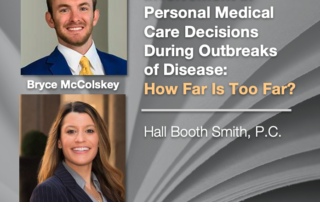 Government Involvement in Personal Medical Care Decisions During Outbreaks of Disease: How Far Is Too Far? by Bryce McColskey and Sandra M. Cianflone Gallery
Government Involvement in Personal Medical Care Decisions During Outbreaks of Disease: How Far Is Too Far? by Bryce McColskey and Sandra M. Cianflone
Government Involvement in Personal Medical Care Decisions During Outbreaks of Disease: How Far Is Too Far? by Bryce McColskey and Sandra M. Cianflone
The Authors Bryce McColskey (bmccolskey@hallboothsmith.com) is an attorney with Hall Booth Smith, P.C., based in Jacksonville, Florida, where he focuses on medical malpractice and professional liability law. Sandra M. Cianflone (scianflone@hallboothsmith.com) is a partner in the Atlanta office of Hall Booth Smith, where she concentrates on a variety of aspects of healthcare defense and chairs the firm’s Coronavirus Task Force. She is also a member of the Editorial Board of Advisors of the Journal of Emerging Issues in Litigation. Interviews with leading attorneys and other subject matter experts on new twists in the law and how the law is responding to new twists in the world. Government Involvement in Personal Medical Care Decisions During Outbreaks of Disease: How Far Is Too Far? "Breakthroughs in technologies, our knowledge of diseases and mutations, and advances in treatment options have been remarkable and have drastically reduced fatality rates from disease outbreaks. However, regardless of medical achievements, rapid changes in any field open the door to renewed debates over different laws and individual rights." Abstract: The coronavirus pandemic is the latest health issue to raise the question of government’s involvement (or interference) with an individual’s control over their own healthcare and medical treatment. In this article, the authors, two health care and professional liability attorneys, discuss the intersection of law and medicine with a review of medical mandates, the impact of advances in science and medicine, and where role of government to protect public health intersects (or collides) with personal healthcare choices. Their focus is on governmental response to the coronavirus pandemic, and not the recent landmark case dealing with choice. But add to the equation the Supreme Court’s ruling on abortion in Dobbs v. Jackson Women’s Health, the “government as healthcare decision maker” is an issue that will be on the front burner for courts, [...]
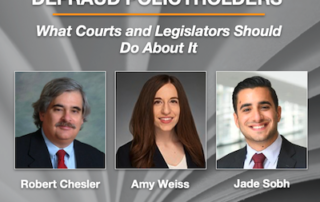
How Insurance Companies Defraud Their Policyholders, and What Courts and Legislators Should Do About It
The Authors Robert D. Chesler (rchesler@andersonkill.com) is a shareholder in Anderson Kill's Newark office. Bob represents policyholders in a broad variety of coverage claims against their insurers and advises companies with respect to their insurance programs. Bob is also a member of Anderson Kill's Cyber Insurance Recovery group. Bob has served as the attorney of record in more than 30 reported insurance decisions, representing clients including General Electric, Ingersoll-Rand, Westinghouse, Schering, Chrysler, and Unilever, as well as many small businesses including gas stations and dry cleaners. He has received numerous professional accolades, including a top-tier ranking for Insurance Litigation: New Jersey in Chambers USA: American's Leading Lawyers for Business, which dubs him a "dominant force in coverage disputes" and cites a client who calls him "a dean of the insurance Bar; one of the brightest in writing about and analyzing insurance coverage." Amy Weiss (aweiss@andersonkill.com) is a law clerk pending admission in Anderson Kill’s New York office. She focuses her practice on insurance recovery, exclusively on behalf of policyholders. While attending the Benjamin N. Cardozo School of Law, Amy worked as a Summer Associate at Anderson Kill and a Judicial Intern for the Honorable Nicholas G. Garaufis at the United States District Court for the Eastern District of New York. She served as Senior Articles Editor for the Cardozo Arts and Entertainment Law Journal, participated in the Cardozo Visual & Performing Arts Law Field Clinic, was a teaching assistant for the Lawyering & Legal writing course, and was a research assistant for Professor Stewart E. Sterk. Amy received the Dean’s Merit Scholarship and graduated with Honors. Jade W. Sobh (jsobh@andersonkill.com) is an attorney in Anderson Kill’s New York office. Jade focuses his practice on both insurance recovery, exclusively on behalf of policyholders, as well as Government Enforcement, Internal Investigations, and White Collar Defense. Jade's practice also encompasses regulatory and complex [...]
HB Webinars on CeriFi LegalEdge
Content Partners