DARN! Nothing here. Apologies.
Emerging Litigation Podcast


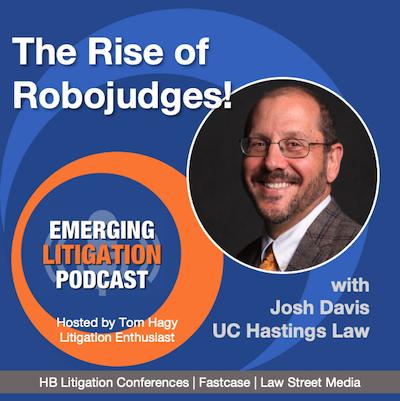
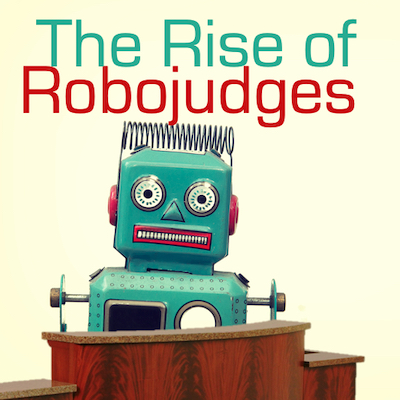
The Rise of Robojudges with Josh Davis
The Rise of Robojudges with Joshua Davis The good news for all of us, not the least of which are the robe and wig industries, is that we still have time. Artificial intelligence is advancing rapidly, but it's still not able to think like a learned jurist. We can say it will have flaws, but so do our human deciders. So it will be a tradeoff, right? What are the risks? What are the upsides? Will robojudges be able to absorb infinitely more information quickly? Will they hand down decisions free from the influence of bias? Wouldn't it be great to eliminate conflicts of interest? Joining me to discuss this not-so-out-there concept is Joshua P. Davis, a nationally recognized expert on legal ethics, class actions, and artificial intelligence in the law. He is Research Professor of Law at the University of California Hastings College of Law, and Shareholder and Manager of Berger & Montague, P.C.'s new San Francisco Bay Area Office. For more than 20 years Josh was a tenured Professor of Law at the University of San Francisco Law School, where he also served as the Director of the Center for Law and Ethics. Josh is authoring two books, one titled Unnatural Law, dealing with AI and the law, and a second on the important issue of class action ethics. Finally, remind me never to assume anything when I ask Josh a question. I said something like, "Surely we're not talking about sci-fi robots here," to which he basically said, "Not so fast." This happened more than once. When will I learn? This podcast is the audio companion to the Journal on Emerging Issues in Litigation, a collaborative project between HB Litigation Conferences and the Fastcase legal research family, which includes Full Court Press, Law Street Media, Docket Alarm and, most recently, Judicata. If you have comments or wish to participate in one our projects, [...]

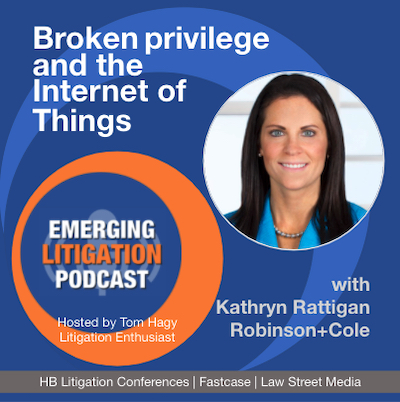
Broken Privilege and IoT with Kathryn Rattigan
Broken Privilege and IoT with Kathryn Rattigan Joining me to discuss this emerging area of law is Kathryn M. Rattigan, a member of the Business Litigation Group, the Data Privacy + Cybersecurity Team, and the Drone Compliance Team in the Rhode Island office of Robinson Cole. Kathryn provides clients guidance regarding privacy and data protection in connection with mobile devices, data storage technologies, mobile apps, and location-based services. She assists with the development of website and mobile app privacy policies and terms and conditions. Kathryn is a frequent contributor to the excellent Robinson Cole Data Privacy + Cybersecurity Insider blog. She holds a J.D. from the Roger Williams University School of Law and a B.A. (magna cum laude) from Stonehill College. This podcast is the audio companion to the Journal on Emerging Issues in Litigation, a collaborative project between HB Litigation Conferences and the Fastcase legal research family, which includes Full Court Press, Law Street Media, Docket Alarm and, most recently, Judicata. If you have comments or wish to participate in one our projects, or want to tell me how insightful and informative Kathryn is, please drop me a note at Editor@LitigationConferences.com. Finally, yes, "skeevy" is a word. And the law is not settled as to whether Shiloh has privacy rights. Tom Hagy Host of the Emerging Litigation Podcast There are now billions and billions of interconnected devices in the world with more coming online every day. Smart cars. Smart cities. Smart agriculture and so much more. Even our pets are connected. And you have to look no further than the Colonial Pipeline ransomware attack to see the real-world consequences of what criminals can pull off by connecting with things large and small. Worried about your privacy? Well. There is plenty to worry about. Fortunately we also have a lot of people fighting back on the technical, security, law enforcement, and legal [...]

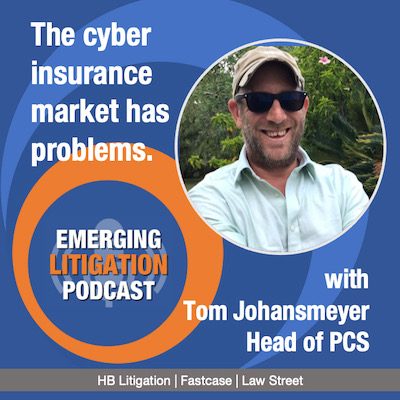
The Cyber Insurance Market Has Problems: A Conversation With Tom Johansmeyer
The Cyber Insurance Market Has Problems: A Conversation With Tom Johansmeyer The author of the piece is my guest on our latest episode. He is Tom Johansmeyer, ARM, is head of PCS, a Verisk business. PCS investigates and provide, independent loss estimates on catastrophes and large individual losses to the benefit of the global risk and capital supply chain. Tom has focused on the broad and rapid expansion of PCS, leading the team into Japan, New Zealand, and other APAC regions in 2019 – as well as Mexico. Tom is the architect of the PCS entry into global specialty lines, most recently adding large risk loss reporting to the group’s portfolio. Previously, Tom held insurance industry roles at Guy Carpenter (where he launched the first corporate blog in the reinsurance sector) and Deloitte. Personally, I like his LinkedIn description: "Aspiring cyclist and distance swimmer, former soldier. Leading the global charge at PCS. Haven't driven anything with a motor since 2007." Excellent. This podcast is the audio companion to the Journal on Emerging Issues in Litigation, a collaborative project between HB Litigation Conferences and the legal news folks at Law Street Media, and the Fastcase legal research family, which includes Docket Alarm and Judicata. If you have comments or wish to participate in one our projects, or want to tell me how insightful our guests are, please drop me a note at Editor@LitigationConferences.com. You might notice that I misused a commonly used term, one specifically common in the world of insurance, or maybe you weren't paying that much attention. That would make two of us. Also, Tom J. was just a fun interview and I hope to get him back! I like the way he explained his candor at the end. He suffers from an infliction that I wish were a pandemic. I hope you enjoy it. Tom Hagy Host of the Emerging Litigation Podcast [...]
A Shameless Plug for Our Content Services
Your content marketing is everything you’ve ever dreamed of. Right?
 Sara is marketing director at a boutique law firm. When we asked her how their blog was going, she made a sad face. But then, we made Sara smile.*
Critical Legal Content was founded by Tom Hagy, former Editor & Publisher of Mealey’s Litigation Reports and VP at LexisNexis, founder of HB, current litigation podcaster and editor-in-chief. CLC’s mission is to help smaller firms and service providers not only create content — blogs, articles, papers, webinars, podcasts (like the stuff on this site) — but also to get it out there. How? Via social media, this website, your website, and potential via our podcast and journal which we publish in collaboration with vLex Fastcase and Law Street Media. The goal is to attract readers and dizzy them with your brilliance.
*Inspired by actual events.
Create content like a real legal publisher.
Emerging Litigation Journal

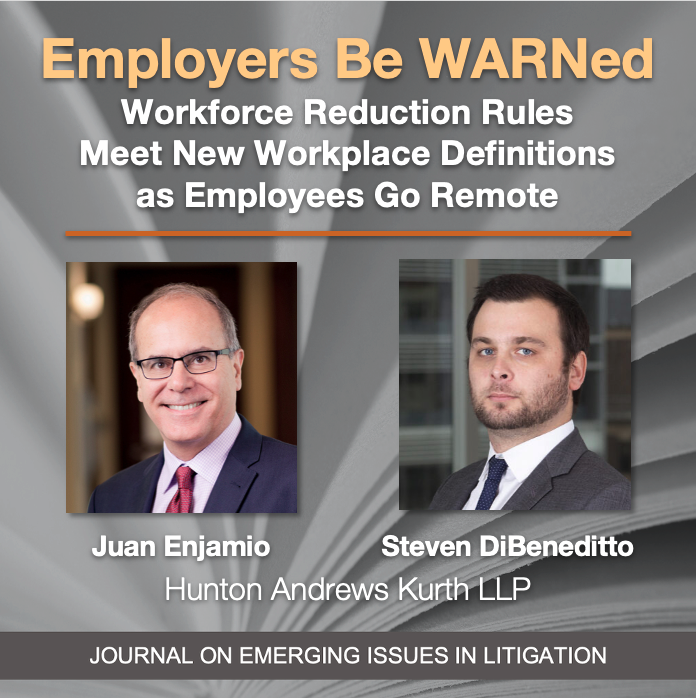
Employers Be WARNed: Workforce Reduction Rules Meet New Workplace Definitions as Employees Go Remote by Juan Enjamio and Steven DiBeneditto
The Authors: Juan C. Enjamio (jenjamio@huntonak.com) is managing parter of the Miami office of Hunton Andrews Kurth where he dedicates his practice to complex domestic and international employment law matters. Steven J. DiBeneditto Jr. (sdibeneditto@huntonak.com) is a Washington, DC-based associate in the firm’s employment and labor group. Interviews with leading attorneys and other subject matter experts on new twists in the law and how the law is responding to new twists in the world. Employers Be WARNed Workforce Reduction Rules Meet New Workplace Definitions as Employees Go Remote "Numerous courts have opined that a “home base” is a place in which the employee has some sort of physical connection. But this connection must be more than a “notional” base, whereby the employee has a menial relationship." Introduction A common sentiment during the Covid-19 pandemic was that a different society would emerge from its ashes. While overstated in many cases, one segment of society that appears to have changed for good is the white collar workplace. Indeed, after enjoying the flexibility of working from home for more than 2 years, many white collar workers are demanding that a remote work option remain a permanent fixture at their place of employment. And with seemingly no negotiating leverage due to worker shortages across the country, employers have mostly acceded to these demands, with many opting to implement a “hybrid” workforce where employees work from home for part of the work week and transit to the physical workplace for the rest of the week. Other employers have opted to have employees work entirely from home in what is now generally known as a “remote” employee. But widespread adoption of a Hybrid Workforce presents a complex set of legal challenges for employers. These challenges are especially prevalent when making employment decisions using laws that were drafted decades ago [...]
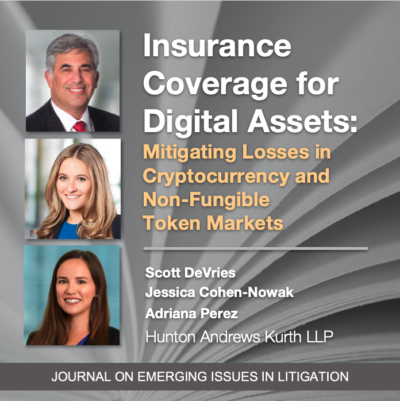
 Insurance Coverage for Digital Assets: Mitigating Losses in Cryptocurrency and Non‐Fungible Token Markets by Scott DeVries, Jessica Cohen-Nowak and Adriana Perez of Hunton Andrews Kurth Gallery
Insurance Coverage for Digital Assets: Mitigating Losses in Cryptocurrency and Non‐Fungible Token Markets by Scott DeVries, Jessica Cohen-Nowak and Adriana Perez of Hunton Andrews Kurth

Insurance Coverage for Digital Assets: Mitigating Losses in Cryptocurrency and Non‐Fungible Token Markets by Scott DeVries, Jessica Cohen-Nowak and Adriana Perez of Hunton Andrews Kurth
Companies and individuals are riding the ups and downs of cryptocurrency and NFTs—with losses and swings in the billions of dollars—but digital assets are not going away. Abstract: The risk of loss in certain categories may be mitigated by insurance, whether provided by tailored policies and/or under policies designed specifically for digital asset owners. Those with exposure to the digital asset sector should be attuned to the emerging marketplace for such insurance products. While it is early days for NFT-specific coverage, the rise of cryptocurrency has created a substantial marketplace for crypto coverage. Insurers are becoming increasingly able to model and assess risk, so more products are coming to market. That said, digital asset holders need to be able to select coverage that best suits their needs. In this article, the authors discuss the history and status of coverage for digital assets to assist readers in exploring how they might use insurance to mitigate risk in this emerging and rocky sector of global finance. "Over the course of a decade, the marketplace for cryptocurrency has increased from zero to an estimated $250 billion. However, only $6 billion in insurance coverage is currently available. It would be a gross understatement to say that there is a truly remarkable imbalance between market value and insurance capacity." Introduction Crypto markets are experiencing the greatest crash in their history to date. The value of a Bitcoin (BTC) has plummeted 70% from its peak and Ethereum (ETH) has fallen 77%. Since last November, the value of cryptocurrency tokens has lost $2 billion in value. As noted financial publication Barron’s put it: “Crypto is having a ‘Lehman moment,’ a shattering of confidence triggered by plunging asset prices, liquidity freezing up, and billions of dollars wiped out in a few scary weeks.” Cryptocurrency companies are halting withdrawals and transfers, platforms are seizing up, and regulators [...]


The Environmental, Social, and Governance Police Have Arrived: Is Your Insurance Ready? by Robert D. Chesler and Dennis J. Artese
The Authors Robert D. Chesler (rchesler@andersonkill.com) is a shareholder in Anderson Kill’s New Jersey office and is a member of the firm’s Cyber Insurance Recovery Group. He represents policyholders in a broad variety of coverage claims against their insurers and advises companies with respect to their insurance programs. Dennis J. Artese is a shareholder in Anderson Kill’s New York office and chairs the firm’s Climate Change and Disaster Recovery Group. Both are members of the Editorial Advisory Board of the Journal. Interviews with leading attorneys and other subject matter experts on new twists in the law and how the law is responding to new twists in the world. The ESG Police Have Arrived: Is Your Insurance Ready? "ESG has become a major initiative for corporate America. In particular, the environmental prong of ESG calls for companies to institute sustainability goals and to invest in environmentally friendly companies. This emphasis has both economic and popular support. Environmental sustainability will make companies better able to compete and make their businesses less risky." Abstract: The environmental, social, and governance movement is a positive one, but like many well-intentioned efforts there is room for abuse and risk. As corporations endeavor to earn accolades and good will for “doing the right thing,” they must also be certain they truly are. In this article the authors discuss increased government scrutiny, the attendant risks of implementing and reporting on ESG initiatives, insurance coverage implications for directors and officers, the pollution and other exclusions, the potential civil fines and penalties, and what companies can expect in the era of ESG. Download the article now! Podcast 1 of 2 series: Insurance Coverage with Dr. Jaana Pietari and Jim Fenstermacher and Litigation with Bob Chesler. Podcast 2 of 2 series: PFAS Insurance Coverage with Robert D. Chesler of Anderson Kill. Sister [...]
HB Webinars on CeriFi LegalEdge
Content Partners