DARN! Nothing here. Apologies.
Emerging Litigation Podcast
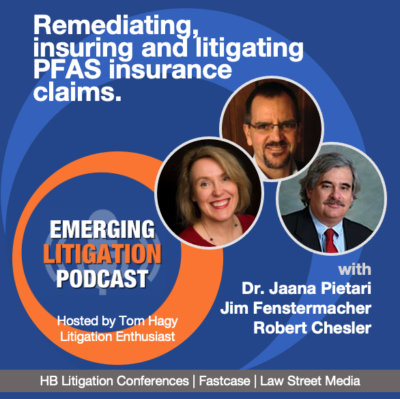

PFAS Science with Jaana Pietari and Jim Fenstermacher and Litigation with Bob Chesler
PFAS Science with Jaana Pietari and Jim Fenstermacher and Litigation with Bob Chesler In Part 1 of the episode, we discussed the PFAS from the scientific and environmental engineering perspective. And to do that I was fortunate to have Jim Fenstermacher and Dr. Jaana Pietari from the global engineering firm Ramboll. Jim and Jaana have deep experience in environmental remediation involving a variety of contaminants, including PFAS. In Part 2, I am joined by Robert Chesler of Anderson Kill. Bob is a long-time expert on insurance coverage for long-tail and other claims. He's considered a guru in the field, and has represented policyholders in disputes over coverage with insurers for as long as I've known him. It's a serious subject and these are seriously qualified folks. I did my part to make a mockery of scientific terms as I struggled to say the name of this family of chemicals. Fortunately for you my guests were much more linguistically nimble and it is their voices you will hear more of. This podcast is the audio companion to the Journal on Emerging Issues in Litigation, a collaborative project between HB Litigation Conferences and the Fastcase legal research family, which includes Full Court Press, Law Street Media, and Docket Alarm. The podcast itself is a joint effort between HB and Law Street Media. If you have comments or wish to participate in one our projects, or want to tell me how much you learned from Jaana, Jim and Bob, please drop me a note at Editor@LitigationConferences.com. Tom Hagy Litigation Enthusiast and Host of the Emerging Litigation Podcast p.s. Here's a bonus for you. Write to me and I will send you the latest issue of the Journal on Emerging Issues in Litigation with my compliments. That's some serious value right there. In our first two-part episode, we dive into the troubling existence of a group of chemicals referred to as PFAS, with the [...]

The Humble Beginnings and Wild Evolution of the TCPA with Joe Apatov
The Humble Beginnings and Wild Evolution of the TCPA with Joe Apatov Only $32 million! I mean, why bother even getting out of bed? Joining me to discuss the evolution of the TCPA is Joseph A. Apatov (japatov@mcglinchey.com), a member of the McGlinchey Stafford law firm’s Consumer Financial Services Litigation practice group. Based in their Fort Lauderdale office, Joe litigates on behalf of financial services clients in both state and federal courts, with an emphasis on defending banks, mortgage lenders and servicers, private-label card issuers, and automobile finance companies. Apologies for my trip down memory lane. Bear with me as I regale you with stories from the newsroom at Mealey’s Litigation Reports and the team’s anxious reliance on the "latest" technology: the facsimile machine. This podcast is the audio companion to the Journal on Emerging Issues in Litigation, a collaborative project between HB Litigation Conferences and the Fastcase legal research family, which includes Full Court Press, Law Street Media, and Docket Alarm. The podcast itself is a joint effort between HB and Law Street Media. If you have comments or wish to participate in one our projects, or want to tell me how much Joe enlightened you, please drop me a note at Editor@LitigationConferences.com. Tom Hagy Litigation Enthusiast and Host of the Emerging Litigation Podcast “The Telephone Consumer Protection Act had humble beginnings,” our guest writes, “with the bill’s sponsor explaining that the statute would permit consumers to bring small claims cases ‘without an attorney,’ and provides for an ‘amount of damages … fair to both the consumer and the telemarketer.’ Twenty-eight years after its enactment in 1991, the Eighth Circuit Court of Appeals affirmed a District Court’s decision to reduce a $1.6 billion jury award in a TCPA class action to only $32 million because the former was ‘shockingly large’ and ‘oppressive,’ in violation of the Due Process Clause .....” [...]


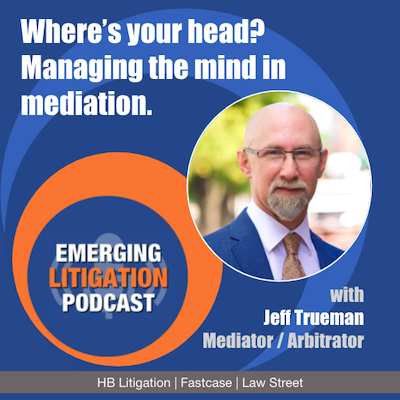
Where’s Your Head? Managing the Mind in Mediation with Jeff Trueman
Where's Your Head? Managing the Mind in Mediation with Jeff Trueman Joining me to discuss this is Jeff Trueman, an experienced, full-time mediator and arbitrator. Jeff helps parties resolve a wide variety of litigated and pre-suit disputes and interpersonal problems concerning catastrophic injuries, professional malpractice, wrongful death, employment, family business dissolution, real property, estate, and domestic relations. He is a panel mediator for the American Arbitration Association; a panel arbitrator for the Financial Industry Regulatory Authority; a Distinguished Fellow of the International Academy of Mediators; a recipient of the Paul A. Dorf Alternative Dispute Resolution Memorial Award by the Bar Association of Baltimore City; and will soon hold an LLM from the Straus Institute for Dispute Resolution at the prestigious Pepperdine School of Law. Finally, did I really suggest that having a mediator with a bad hip could help achieve a faster resolution? Did I really give a review of the HBO original movie Oslo, which I consider a must-see for anyone interested in conflict resolution? Did I really compare married couples during Covid-19 lockdowns to angry bees in a jar? Listen and find out. Spoiler alert: Yes. Yes I did. This podcast is the audio companion to the Journal on Emerging Issues in Litigation, a collaborative project between HB Litigation Conferences and the Fastcase legal research family, which includes Full Court Press, Law Street Media, and Docket Alarm. The podcast itself is a joint effort between HB and Law Street Media. If you have comments or wish to participate in one our projects, or want to tell me how Jeff really got you thinking, please drop me a note at Editor@LitigationConferences.com. Tom Hagy Litigation Enthusiast and Host of the Emerging Litigation Podcast "Attorneys possess many of the same characteristics as their human cousins." Someone said that. Probably me. They often bring to their jobs cognitive barriers that get in the way of [...]
A Shameless Plug for Our Content Services
Your content marketing is everything you’ve ever dreamed of. Right?
 Sara is marketing director at a boutique law firm. When we asked her how their blog was going, she made a sad face. But then, we made Sara smile.*
Critical Legal Content was founded by Tom Hagy, former Editor & Publisher of Mealey’s Litigation Reports and VP at LexisNexis, founder of HB, current litigation podcaster and editor-in-chief. CLC’s mission is to help smaller firms and service providers not only create content — blogs, articles, papers, webinars, podcasts (like the stuff on this site) — but also to get it out there. How? Via social media, this website, your website, and potential via our podcast and journal which we publish in collaboration with vLex Fastcase and Law Street Media. The goal is to attract readers and dizzy them with your brilliance.
*Inspired by actual events.
Create content like a real legal publisher.
Emerging Litigation Journal

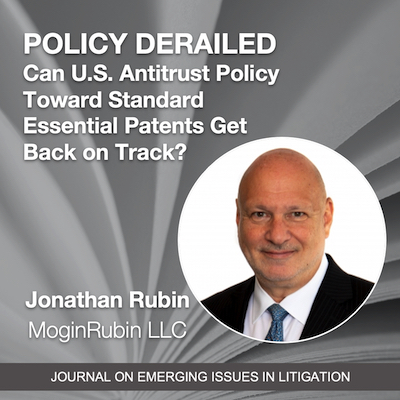
Policy Derailed: Can U.S. Antitrust Policy Toward Standard Essential Patents Get Back on Track by Jonathan Rubin
The Author Jonathan Rubin (jrubin@moginrubin.com) is Co-Founder and Partner of MoginRubin LLP, a boutique antitrust, mergers and acquisitions, and class action law firm. Since 2001, he has focused his legal practice exclusively on antitrust and competition law and policy. As a litigator he has led trial teams in major antitrust cases in courts throughout the country. Rubin is a member of the Editorial Board of Advisors for the Journal of Emerging Issues in Litigation. Interviews with leading attorneys and other subject matter experts on new twists in the law and how the law is responding to new twists in the world. Policy Derailed: Can U.S. Antitrust Policy Toward Standard Essential Patents Get Back on Track? "The failure to appropriately adjust the patent system to accommodate the competitive circumstances created when patents are incorporated into standards undermines the purposes of the standard-setting enterprise and impairs the utility and proliferation of standardized technologies. Without a course correction among the judiciary, the United States risks finding itself as a less desirable jurisdiction for pro-growth and pro-competitive patenting and standard-setting activities." Abstract: A consensus at the intersection of patent and anti-trust law was achieved after a series of decisions finding that in some circumstances owners of standard essential patents (SEPs) have an antitrust duty to deal with willing licensees. Beginning in 2017, however, the Department of Justice derailed U.S. policy by undermining the role and usefulness of antitrust for policing abuses of the standard setting process. This article traces the emergence of the consensus, its abrogation by the DOJ, and the resulting effects and prospects for the future. Download the article now! Explore more from MoginRubin LLP! Blog: Emboldened by New Resources and Expanded Authority, Feds Continue 10-Year Look Back at Chinese Investment. By Dan Mogin, Jonathan Rubin, Jennifer Oliver, and Timothy LaComb. List [...]
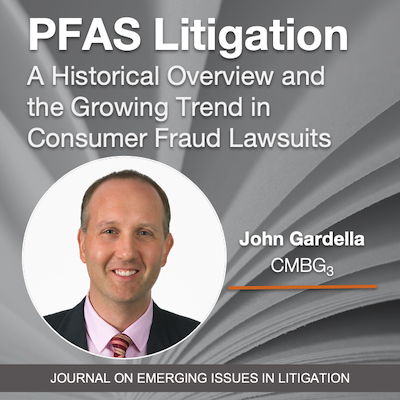
 PFAS Litigation—A Historical Overview and the Growing Trend in Consumer Fraud Lawsuits: What Are the Legal and Business Risks to Companies by John Gardella Gallery
PFAS Litigation—A Historical Overview and the Growing Trend in Consumer Fraud Lawsuits: What Are the Legal and Business Risks to Companies by John Gardella
PFAS Litigation—A Historical Overview and the Growing Trend in Consumer Fraud Lawsuits: What Are the Legal and Business Risks to Companies by John Gardella
The Author John P. Gardella (jgardella@cmbg3.com) is a shareholder and Chief Services Officer at CMBG3 Law, where he also chairs the firm’s PFAS, Environmental, Risk Management and Consulting and ESG practice groups. John is the latest addition to the Editorial Board of Directors for the Journal on Emerging Issues in Litigation. Interviews with leading attorneys and other subject matter experts on new twists in the law and how the law is responding to new twists in the world. PFAS Litigation A Historical Overview and the Growing Trend in Consumer Fraud Lawsuits "It is of the utmost importance that businesses along the whole supply chain in the consumer goods sector evaluate their PFAS risk and fully understand the legal arguments that plaintiffs could make against companies in litigation." Abstract: Per- and polyfluoroalkyl substances (PFAS) are a class of over 12,000 man-made compounds. Most people would recognize the brand names Teflon, produced by DuPont, and Scotchgard, produced by 3M. They also go by the nickname “forever chemicals” because they are highly persistent and mobile in the environment and the human body. In addition to bodily injury and environmental pollution litigation, plaintiffs are also bringing suits against companies for claiming their products and the making of their products are safe and green. This article explains why PFAS are of concern to citizens, media, and legislators; what legal risks they pose to corporations; and the recent surge in consumer fraud litigation. The article examines the legal theories at issue in the PFAS consumer fraud cases, as well as the potential damages that can stem from the cases to corporations. Questions addressed include: What do state and federal regulations say about PFAS in drinking water? If your company doesn't use the two original types of PFAS, are you at less risk of litigation? Which [...]

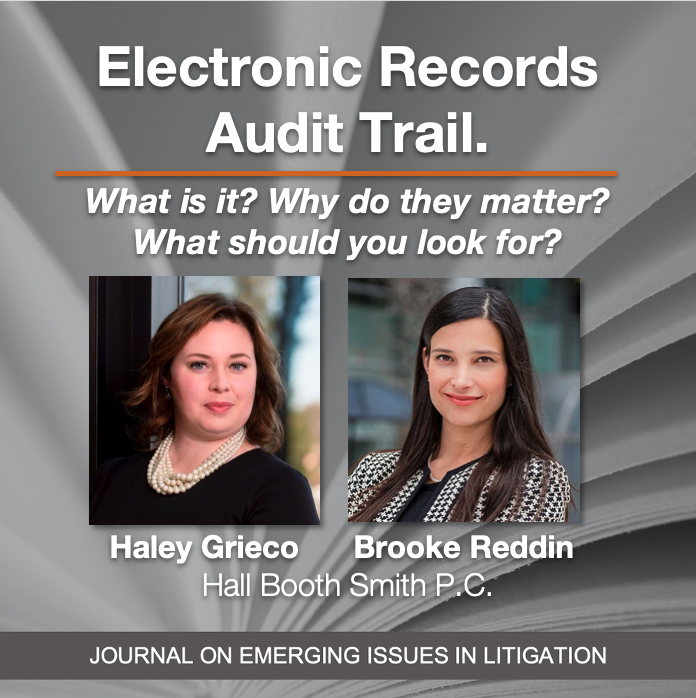
EMR Audit Trail—What Is It? Why Do They Matter? What Should You Look For? by Haley K. Grieco and Brooke E. Reddin
The Authors Haley K. Grieco (hgrieco@hallboothsmith.com) is a partner in the Paramus, New Jersey, office of Hall Booth Smith, where she defends physicians, hospitals, and other healthcare providers in a wide range of medical malpractice litigation. Brooke E. Reddin (breddin@hallboothsmith.com) is an associate with the firm, where she focuses her practice on healthcare, medical malpractice, and aging services litigation. Interviews with leading attorneys and other subject matter experts on new twists in the law and how the law is responding to new twists in the world. EMR Audit Trail—What Is It? Why Do They Matter? What Should You Look For? "As the healthcare industry becomes increasingly digitized, it is imperative that attorneys appreciate the impact it may have on their clients and their practice. In medical malpractice matters, discovery requests for metadata—specifically, the production of the EMR audit trail—has steadily increased over the past few years." Abstract: Maintaining electronic medical records, or EMRs, is now a nearly universal best practice among medical providers from small physician practices to large hospital networks. Unlike handwritten or typed records, these digital documents carry with them much more data than meets the eye. In this article, the authors—two medical malpractice attorneys— discuss what attorneys need to know about EMRs in the litigation context and the metadata bread crumb trail they leave behind. They discuss the types of data involved, federal requirements, discovery considerations, privacy implications, and the pros and cons and risks of using these records in defending healthcare providers. During the past ten years electronic medical records (EMR) have all but rendered obsolete handwritten medical records. Medical providers have had to learn computer systems, programs, software, hardware, and forms like never before. When hospitals, facilities, and medical offices change EMR systems, the process of learning the new system starts over. But what about [...]
HB Webinars on CeriFi LegalEdge
Content Partners