DARN! Nothing here. Apologies.
Emerging Litigation Podcast

Putting an AI App to Work to Protect IP with Jan-Diederik Lindemans and Judith Bussé
Putting an AI App to Work to Protect IP with Jan-Diederik Lindemans and Judith Bussé They are Crowell & Moring partner Jan-Diederik Lindemans and Judith Bussé, both part of the firm’s Technology & Intellectual Property Department in Brussels. And, working with Neotalogic, they developed an interactive app that takes you through a set of attorney-crafted questions that, depending on your answers, take you to other questions. The app applies a layer of artificial intelligence to enhance the information gathering process. Listen to what these innovators had to say about the Crowell & Moring IP Check-Up application, and take it for a test drive yourself. Or, here is a quick video of someone using the app. This podcast is the audio companion to the Journal on Emerging Issues in Litigation*, a collaborative project between HB Litigation Conferences and the legal news folks at Law Street Media, and the Fastcase legal research family, which includes Docket Alarm and Judicata. If you have comments or wish to participate in one our projects, or want to tell me how insightful our guests are, please drop me a note at Editor@LitigationConferences.com. Tom Hagy Host of the Emerging Litigation Podcast * Highly regarded insurance and reinsurance industry attorney Laura Foggan of Crowell & Moring's Washington, DC, office is on the Editorial Advisory Board. Thanks to Laura for connecting me with J.D. and Judith. An organization’s intellectual property is often its most valuable asset. Whether it’s a patent or a trademark, a graphic design or proprietary market information, or just the unique way they do what they do, organizations must protect their innovations or risk significant damage to their future prospects. Assessing the vulnerabilities of such valuable inventory is as important as it is time-consuming. But a portfolio protection and process review involves answering the same long set of questions posed to any organization, no matter what type. There is the problem. You have a [...]
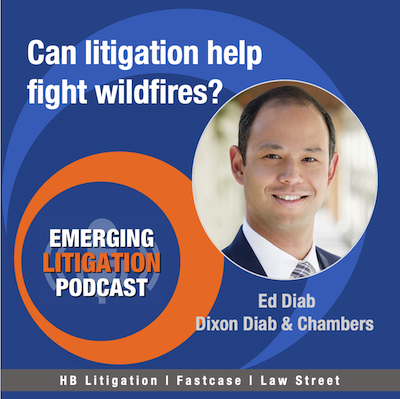
Wildfire Litigation and Recovery with Ed Diab
Wildfire Litigation and Recovery with Ed Diab I had the pleasure of interviewing Ed Diab, co-founder of Dixon Diab & Chambers in San Diego, about his firm’s role in the litigation, what the claims are, what defenses they encounter, settlements they have secured, what evidentiary hurdles plaintiffs face, and more. They’ve been successful. Since 2018, Dixon Diab & Chambers has recovered more $1.4 billion in settlements. And there is more to come. The firm represents more than 40 public entities – including some of the largest cities and counties in California – as well as thousands of individuals and families. Ed leads the firm’s mass tort practice which, in addition to wildfire litigation, represents people who allege injuries from defective drugs and medical devices. This podcast is the audio companion to the Journal on Emerging Issues in Litigation, a collaborative project between HB Litigation Conferences and the legal news folks at Law Street Media. If you have comments or wish to participate in one our projects, or want to tell me how insightful our guests are, please drop me a note at Editor@LitigationConferences.com. Thanks to Ed Diab for speaking with me about this fascinating and frightening subject, and to Baron & Budd's Scott Summy for introducing us. For my part, I am sure my suggestion that they install smoke detectors all over the forest is complete nonsense. Also, I spoke with a friend who majored in Latin. Even though I showed zero confidence, I apparently stumbled close to the pronunciation of flammagenitus, Latin for “fire cloud.” I promised you a photo of one. Also called pyrocumulus clouds, they look as terrifying as they sound. Tom Hagy Host Emerging Litigation Podcast Wildfires are causing more destruction in North America than at any time in recorded history. In 2010 they consumed 3.4 million acres, but nearly tripled to devour more than [...]
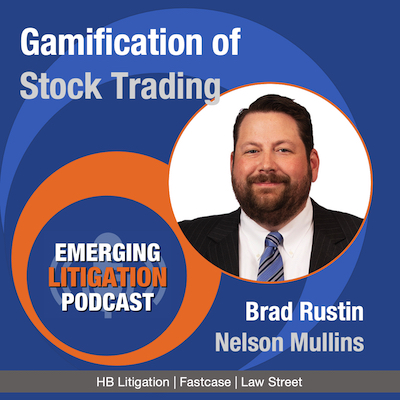
Gamification of Stock Trading with Brad Rustin
Gamification of Stock Trading with Brad Rustin "What's the deal?" you ask? Find out! Listen to my interview with FinTech attorney Brad Rustin, a partner with Nelson Mullins. In addition to chairing the firm’s Financial Services Regulatory Practice, Brad counsels financial institutions in regulatory matters, including strategic agreements, product development, and operational compliance. A large portion of his work is on bank and non-bank partnerships involving white-label deployments, FinTech partnerships, or payments, digital assets, cryptocurrency, and lending partnerships. Brad is a Certified Anti-Money Laundering Specialist (CAMS) by ACAMS and a Certified Regulatory Compliance Manager (CRCM) by the American Bankers Association. He received his JD, magna cum laude, from the University of South Carolina School of Law and his BA in Political Science and History, cum laude, from Furman University. And now, he is not only a guest on the Emerging Litigation Podcast, but the FinTech advisor on the Editorial Advisory Board of the Journal on Emerging Issues in Litigation. This podcast is the audio companion to the Journal on Emerging Issues in Litigation, a collaborative project between HB Litigation Conferences and the legal news folks at Law Street Media, and the Fastcase legal research family, which includes Docket Alarm and Judicata. If you have comments or wish to participate in one our projects, or want to tell me how insightful and informative our guests are, please drop me a note at Editor@LitigationConferences.com. Thanks to Brad for speaking with me about this fascinating subject. As for me, I will stay away from "game trading." Hearing people describe it reminds me of my PacMan obsession in college, which frequently cost me many hours that I should have spent differently, and too often a functioning shoulder. Tom Hagy As brokerages focus on enhancing user experience, they risk shifting their customer’s focus from serious financial decisions to a game-like experience. Some think this is a good thing. That [...]
A Shameless Plug for Our Content Services
Your content marketing is everything you’ve ever dreamed of. Right?
 Sara is marketing director at a boutique law firm. When we asked her how their blog was going, she made a sad face. But then, we made Sara smile.*
Critical Legal Content was founded by Tom Hagy, former Editor & Publisher of Mealey’s Litigation Reports and VP at LexisNexis, founder of HB, current litigation podcaster and editor-in-chief. CLC’s mission is to help smaller firms and service providers not only create content — blogs, articles, papers, webinars, podcasts (like the stuff on this site) — but also to get it out there. How? Via social media, this website, your website, and potential via our podcast and journal which we publish in collaboration with vLex Fastcase and Law Street Media. The goal is to attract readers and dizzy them with your brilliance.
*Inspired by actual events.
Create content like a real legal publisher.
Emerging Litigation Journal
Announcing the Complex Litigation Ethics Conference
A leading academic and practitioner, Joshua P. Davis (davisj@usfca.edu) is a nationally recognized expert on legal ethics and class actions, as well as on artificial intelligence in the law, antitrust, civil procedure, free speech, and jurisprudence. He has published more than 30 scholarly articles and book chapters on these subjects and is currently writing a book on AI titled Unnatural Law, which will be published by Cambridge University Press. He is Research Professor of Law at the University of California Hastings College of Law, and a Shareholder of the Berger Montague PC law firm and Manager of its new San Francisco Bay Area Office. Before taking these posts, for more than 20 years Davis was a tenured Professor of Law at University of San Francisco Law School, where he also served as the Director of the Center for Law and Ethics. Davis is also a member of the Editorial Board of Advisors for the Journal on Emerging Issues in Litigation, published by Fastcase Full Court Press. Tom Hagy, Editor in Chief. An expert in civil procedure and federal courts, Professor Scott Dodson is the James Edgar Hervey Chair in Litigation and Geoffrey C. Hazard Jr. Distinguished Professor of Law at UC Hastings Law. He has published seven book titles, including The Legacy of Ruth Bader Ginsburg (Cambridge 2015) and New Pleading in the Twenty-First Century (Oxford 2013). He has written around 100 shorter works appearing in such journals as Stanford Law Review, New York University Law Review, Michigan Law Review, University of Pennsylvania Law Review, California Law Review, Virginia Law Review, Duke Law Journal, Northwestern University Law Review, Georgetown Law Journal, American Journal of Comparative Law, American Journal of International Law, and Law & Society Review. His scholarly writings have been cited in more than 30 court opinions and have been downloaded more than 45,000 times. For 2010-14, he was listed as the 9th [...]
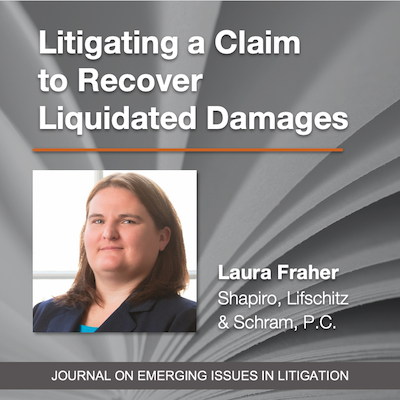
Litigating a Claim to Recover Liquidated Damages by Laura Fraher
The Author Laura C. Fraher (fraher@slslaw.com) is a senior attorney in the trial and construction group at Shapiro, Lifschitz & Schram in Washington, D.C. She has extensive experience in civil litigation at both the trial court and appellate level. Competitive by nature, Laura played rugby for nearly 20 years. She puts this competitive spirit to work through her passion for the law and her clients. Education: St. John’s University School of Law, J.D., 2001, magna cum laude; SUNY College at Geneseo, B.A., Political Science, 1998. Interviews with leading attorneys and other subject matter experts on new twists in the law and how the law is responding to new twists in the world. Litigating a Claim to Recover Liquidated Damages: Enforceability Depends on Evidence of Good Faith Expectations "The tests and standards that courts apply to evaluate whether a particular liquidated damage provision is enforceable vary from state to state and it is imperative that litigants research and fully appreciate the particular standards that will be applied by the court in which they are litigating." Abstract: The liquidated damages provision in a contract is a useful mechanism for mitigating risk in the event one of the parties to an agreement breaches the contract, costing the aggrieved party sometimes significant difficulty and substantial expense. Unfortunately, these provisions are often challenged, allowing the party responsible for the beach to exacerbate the burdens on the other party. In this article, the author discusses concepts of enforceability, proof, and avoiding litigation over liquidated damage provisions. A liquidated damage provision is an advance agreement of the damages that a party will be entitled to recover in the event of a future breach by the other party to a contract. These provisions can be an important tool for risk allocation and mitigation between parties when entering into [...]
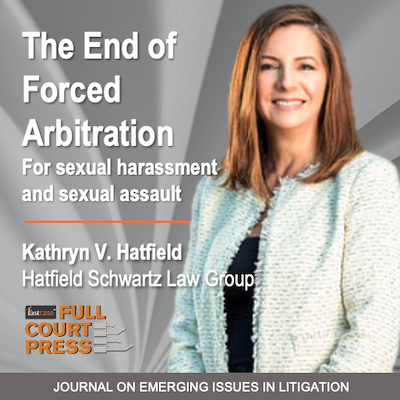
The “Ending Forced Arbitration of Sexual Assault and Sexual Harassment Act of 2021” Finally Levels the Playing Field by Kathryn Hatfield
The Author Kathryn V. Hatfield (khatfield@hatfieldschwartzlaw.com) is a partner in the women-owned law firm of Hatfield Schwartz Law Group LLC where she focuses on advising and representing management in labor and employment law matters. Kathryn is a member of the Editorial Advisory Board for the Journal of Emerging Issues in Litigation. Interviews with leading attorneys and other subject matter experts on new twists in the law and how the law is responding to new twists in the world. The “Ending Forced Arbitration of Sexual Assault and Sexual Harassment Act of 2021” Finally Levels the Playing Field "While arbitration offers privacy and confidentiality, it is for exactly these reasons that the #MeToo movement developed. Moreover, other than perhaps the differences in the speed of the two processes, the advantages of arbitration can be flipped on their head and become disadvantages." Abstract: The Equal Employment Opportunity Center alone receives on average approximately 7,000 sexual harassment claims a year, a figure that does not include claims filed with state and local agencies. The cost of resolving these claims logged by the EEOC averages $63 million a year based on the past four years. On average, there are nearly 464,000 victims (age 12 or older) of rape and sexual assault in the United States each year. The Centers for Disease Control and Prevention reports that nearly 1 in 5 women in America experiences a rape or attempted rape, and nearly 44 percent of women and about 25 percent of all men experience some form of sexual violence in their lifetime. A White House statement called sexual assault a “public health crisis.” But victims of sexual harassment and assault in the workplace have not had open access to the courts due to mandatory arbitration clauses in their employment agreements. In this article, an experienced labor law attorney discusses [...]
HB Webinars on CeriFi LegalEdge
Content Partners