DARN! Nothing here. Apologies.
Emerging Litigation Podcast
Takeaways from the SEC’s $100M Fine Against FinTech Lender BlockFi
Our Guest Brad is a partner in the Greenville, South Carolina, office of Nelson Mullins Riley and Scarborough where he chairs the firm’s Financial Services Regulatory Practice, leading a team of attorneys in a national practice representing clients in financial regulatory and FinTech matters. He is a valued member of the Editorial Board of Advisors for the Journal on Emerging Issues in Litigation, a companion to this podcast. Takeaways from the SEC's $100M Fine Against FinTech Lender BlockFi So, apparently this is true: Running a lending operation without registering with the SEC makes them crabby. Spoiler Alert: On Valentine’s Day this year the SEC announced a $100 million fine against retail crypto lender BlockFi Lending. Nothing says "will you be mine?" like a nine-figure bill -- for that special someone who has everything. The company agreed to put an end to some of its offers and sales, and to get to work bringing itself into compliance with, you know, the law, like the Securities Act of 1933 and the Investment Company Act of 1940. So, what does the SEC want companies to do? What remedies does the SEC have for unregistered securities offerings? What impact will this have on private litigation? Is there a risk that BlockFi Interest Account investors will have claims against BlockFi? Want to find out? Listen to my interview with attorney Brad Rustin. Brad is a partner in the Greenville, South Carolina, office of Nelson Mullins Riley and Scarborough where he chairs the firm’s Financial Services Regulatory Practice, leading a team of attorneys in a national practice representing clients in financial regulatory and FinTech matters. This is Brad’s third appearance on the podcast! He spoke on one episode about the Impact of the Russia Sanctions on Global Financial Markets, and on another popular episode on the Gamification of Stock Trading. Brad is [...]


What Businesses and Lawyers Should Know About the U.S./China Relationship
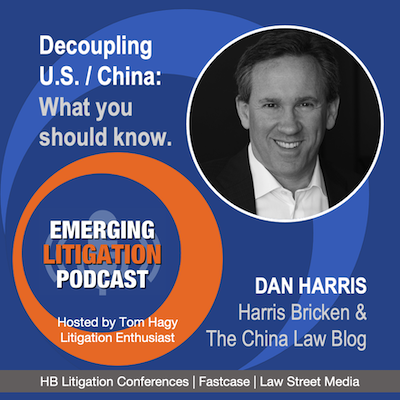
Our Guest Dan Harris is a leading authority on the legal and strategic aspects of conducting business in emerging markets. He is co-founder of the international practice of Seattle-based HarrisBricken, which has offices across the U.S., as well as in China, Spain, Mexico, and Brazil. His China Law Blog was named, and with good reason, to the ABA Journal’s “Blawg Hall of Fame.” Forbes, Business Week, Fortune, The BBC, The Wall Street Journal, The Washington Post, The Economist, CNBC, The New York Times, and many other major media players have looked to him for his perspective on international law issues. Dan writes and speaks extensively on international law with a focus on protecting businesses in their foreign operations and he has had the rare honor of being designated a “Super Lawyer.” He is also a member of the Editorial Board of Advisors for the Journal on Emerging Issues in Litigation and the Emerging Litigation Podcast. What Businesses and Lawyers Should Know About the U.S. / China Relationship “Americans mistakenly believe that China operates as a rational economic actor and that economics is their highest priority. It’s not and it never has been. Their highest priority is whatever is good for the Chinese Communist Party.” “Chinese companies view American and EU companies as very risky, in large part because so many American and EU companies are looking to move their manufacturing out of China.” A major potential avalanche of risks are those that would shake the business world should – as some expect it will – trade relations between China, and America and EU, come to an end. China is America’s largest trading partner, a relationship responsible for $600B a year in commerce, according to the Office of the U.S. Trade Representative. By comparison, U.S. / European Union trade exceeds $1T. The trade [...]

Insurance Coverage for PFAS Claims
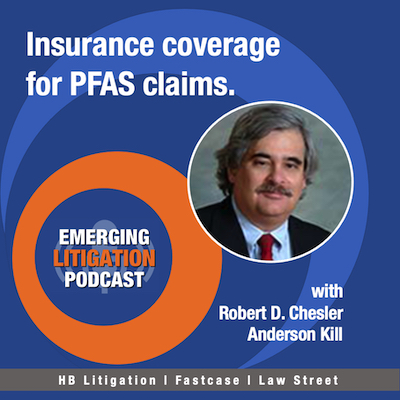
PFAS Insurance Coverage with Robert D. Chesler of Anderson Kill Listen to my interview with Anderson Kill's Robert D. Chesler, a preeminent expert on insurance coverage law especially in the context of highly complex long-tail claims scenarios involving multiple parties and events that can span decades and always cost many millions of dollars. Considered by many to be an insurance guru on these cases -- as well as on D&O, cyber and privacy, and intellectual property insurance -- Bob holds a Ph.D. and masters degree from Princeton University, and a J.D. (cum laude) from Harvard Law School. This podcast is the audio companion to the Journal on Emerging Issues in Litigation, and Bob is one of our most valued editorial advisors. The Journal is a collaborative project between HB Litigation Conferences and the Fastcase legal research family, which includes Full Court Press, Law Street Media, and Docket Alarm. The podcast itself is a joint effort between HB and our friends at Law Street Media. If you have comments or wish to participate in one our projects, or want to tell me how much you learned from Bob, please drop me a note at Editor@LitigationConferences.com. Tom Hagy Host and Litigation Enthusiast P.S. The fact that I make myself laugh during these interviews probably has less to do with the subject matter (most definitely, is more precise) or my sense of humor, and more to do with cabin fever. Or I'm just nuts. The PFAS family of chemicals is one stubborn bunch. They are a class of man-made products dubbed "forever chemicals," because of the difficulty of removing them from the environment, humans, and other animals. They are also at the center of sprawling litigation around the country involving alleged property damage, water contamination, and bodily injury. More than 1,500 cases are consolidated in closely-watched multi-district litigation in federal court in South Carolina. Listen to [...]
A Shameless Plug for Our Content Services
Your content marketing is everything you’ve ever dreamed of. Right?
 Sara is marketing director at a boutique law firm. When we asked her how their blog was going, she made a sad face. But then, we made Sara smile.*
Critical Legal Content was founded by Tom Hagy, former Editor & Publisher of Mealey’s Litigation Reports and VP at LexisNexis, founder of HB, current litigation podcaster and editor-in-chief. CLC’s mission is to help smaller firms and service providers not only create content — blogs, articles, papers, webinars, podcasts (like the stuff on this site) — but also to get it out there. How? Via social media, this website, your website, and potential via our podcast and journal which we publish in collaboration with vLex Fastcase and Law Street Media. The goal is to attract readers and dizzy them with your brilliance.
*Inspired by actual events.
Create content like a real legal publisher.
Emerging Litigation Journal
Supplier Beware: The DOJ & FTC Investigating Manufacturing & Supply Chains
The Author Jennifer M. Driscoll (jdriscoll@rc.com) is counsel with Robinson+Cole in New York where she focuses on investigations, litigation, arbitration, mergers, and counseling. She has extensive experience in the medical devices, pharmaceuticals, electronics, and automotive industries. Interviews with leading attorneys and other subject matter experts on new twists in the law and how the law is responding to new twists in the world. Supplier Beware: DOJ & FTC Investigating Manufacturing & Supply Chain Issues “Although competitors may attend trade association meetings, the company representative in attendance should be well versed on the line between lawful discussions and ruses to disguise unlawful collusion in violation of the Sherman Act.” Abstract: Challenged by the pandemic, the global supply chain has generated a heightened amount of scrutiny for its impact on the economy, the labor market, the delivery of goods and services, and national security. Attention from the Biden administration portends an era when the federal government will shine a spotlight on the supply chain to root out misconduct. In this article, the author reviews recent supply chain disruptions and reactions from the DOJ and FTC, as well as the government’s efforts to support competition in the labor markets by eliminating noncompete agreements in employment contracts. Finally, she discusses proactive steps companies can take to mitigate the risk that they will find themselves the subject of a government investigation. Download the article now!
Medical Monitoring and PFAS Litigation—A Significant Growing Trend
The Author John P. Gardella (jgardella@cmbg3.com) is a shareholder with CMBG3 Law and a recognized thought leader on PFAS issues. In his environmental and toxic torts practice, he represents companies ranging in size from small shops to the Fortune 100. John is also a member of the Editorial Board of Advisors for the Journal of Emerging Issues in Litigation. Interviews with leading attorneys and other subject matter experts on new twists in the law and how the law is responding to new twists in the world. Medical Monitoring and PFAS Litigation—A Significant Growing Trend "The arguments in favor of medical monitoring as a cause of action in lawsuits stem from the notion that having such programs funded by allegedly tortious companies promotes the public health benefit of early detection, which in turn often results in lower health care costs to plaintiffs and society at large." Abstract: Medical monitoring as a tort claim is a hot-button issue in toxic torts, personal injury, and product liability litigation. The ubiquity of PFAS chemical compounds and the real and potential harm to health and the environment they create make examination of the medical monitoring debate specific to this burgeoning litigation worthy of individual attention. This article provides an explanation of PFAS, a brief overview of medical monitoring claims, how PFAS medical monitoring claims have impacted the litigation thus far, and what legal cases are pending that could alter the course of traditional medical monitoring litigation in the future. Download the article now!
 The Medical Monitoring Tort Remedy: Its Nationwide Status, Rationale, and Practical Application (A Possible Dynamic Tort Remedy for Long-Term Tort Maladies) Gallery
The Medical Monitoring Tort Remedy: Its Nationwide Status, Rationale, and Practical Application (A Possible Dynamic Tort Remedy for Long-Term Tort Maladies)

The Medical Monitoring Tort Remedy: Its Nationwide Status, Rationale, and Practical Application (A Possible Dynamic Tort Remedy for Long-Term Tort Maladies)
The Author Edgar C. Gentle III (egentle@gtandslaw.com) is founder and managing partner of Gentle, Turner, Sexton & Harbison LLC in Birmingham, Alabama, where he focuses on complex commercial litigation, mass torts, and class actions. He also serves as a court appointed neutral and settlement administrator. Interviews with leading attorneys and other subject matter experts on new twists in the law and how the law is responding to new twists in the world. The Medical Monitoring Tort Remedy: Its Nationwide Status, Rationale, and Practical Application (A Possible Dynamic Tort Remedy for Long-Term Tort Maladies) "States that allow medical monitoring do so when a group of claimants has been exposed to a known hazardous substance, such as lead, or a dangerous product, such as football helmet concussions, or air decompression in an airplane, through the conduct of the Defendant, with the claimants therefore being at increased risk of contracting disease. Under this tort remedy, claimants are tested periodically, for an agreed or decided period, usually between 10 and 40 years, to see if they contract the disease linked to the toxic substance or dangerous product. Thus, medical monitoring recognizes the long-term harmful nature of toxins and man-made products, thereby matching a remedy with the malady." Abstract: The author administers six mass tort settlements with a medical component, including two with medical monitoring. This article reviews the status and history of medical monitoring, known claimant medical monitoring participation rates, the rationale for the remedy, arguments for and against its implementation, and its execution in practice. The author suggests a more holistic medical monitoring remedy, which includes not only testing/or disease but paying claimants for personal injury when they get sicker later, from a capped fund and under an agreed payment matrix, to provide closure to defendants and class members for claims resulting from toxic substances and product [...]
HB Webinars on CeriFi LegalEdge
Content Partners