DARN! Nothing here. Apologies.
Emerging Litigation Podcast
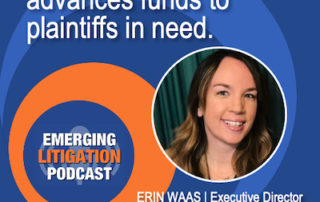
Alternative Financial Support for Plaintiffs During Litigation with Erin Waas
Our Guest Erin Waas is Executive Director of The Milestone Foundation, a national 501(c)(3) nonprofit that provides financial assistance to people pursuing a personal injury lawsuit. Erin brings nearly two decades of experience working in the public sector and with nonprofits in fundraising and communications, most recently at the University at Buffalo, where she served as senior advancement writer. Prior to relocating to Buffalo, Erin spent the bulk of her career to-date in Boston, where she worked in stewardship at Harvard University and as a consultant for nonprofits of all sizes. Alternative Financial Support for Plaintiffs During Litigation with Erin Waas For an individual, merely navigating litigation can be expensive, time consuming, and at times overwhelming. But when that individual is also unable to work, or cannot function normally because they have been disabled by an injury, that explodes the level of stress on a person and their family. There are companies in the "non-recourse settlement advancement" space that will provide financial support to claimants in litigation. This helps them with their regular daily expenses – plus medical costs – until their case settles or until they receive an award. But most of these companies, as you can imagine, are for-profit entities. As such, their fees can make their support unaffordable and can leave the plaintiff with a substantially diminished payout. Listen to my interview with Erin Waas, Executive Director of The Milestone Foundation, a national 501(c)(3) nonprofit that provides financial assistance to people pursuing a personal injury lawsuit. Erin brings nearly two decades of experience working in the public sector and with nonprofits in fundraising and communications, most recently at the University at Buffalo, where she served as senior advancement writer. Prior to relocating to Buffalo, Erin spent the bulk of her career to-date in Boston, where she worked in [...]
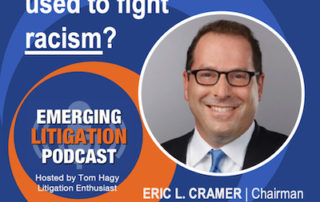
Antiracism and Antitrust with Eric Cramer
Our Guest Eric Cramer is Chairman of the Firm and Co-Chair of the Firm’s antitrust department. He has a national practice in the field of complex litigation, primarily in the area of antitrust class actions. He is currently co-lead counsel in multiple significant antitrust class actions across the country in a variety of industries and is responsible for winning numerous significant settlements for his clients totaling well over $3 billion. Mr. Cramer is also a frequent speaker at antitrust and litigation related conferences and a leader of multiple non-profit advocacy groups. He was the only Plaintiffs’ lawyer selected to serve on the American Bar Association’s Antitrust Section Transition Report Task Force delivered to the incoming Obama Administration in 2012. Antiracism and Antitrust with Eric Cramer Among the legal and regulatory avenues one might follow to mitigate the impact of racism, most of us would look to various manifestations of discrimination law in employment, lending, real estate, education, healthcare, voting rights, and other categories. When presented in those contexts, the anti-racism objectives are clear. There are several federal laws and many state laws that prohibit anticompetitive behavior. At the top of the heap is the Sherman Antirust Act of 1890, which outlaws illegal monopolies and anticompetitive tactics, conspiracies to restrain trade, cartels and syndicates. But what do wages, including those paid to minorities, have to do with antitrust? What about no-poach agreements, whereby groups of companies agree not to hire employees away from each other? The answer is "quite a lot." Listen to my interview with Eric Cramer, Chairman of Berger Montague and co-chair of the firm's antitrust department, a team that handles antitrust class actions across the country involving a variety of industries. Eric and the firm are responsible for winning numerous significant settlements for clients -- a total value that now exceeds [...]


Cannabis Coverage Litigation with John McDonald and Jihee Ahn
Our Guests John B. McDonald is an experienced litigator practicing in the Seattle and New York offices of Harris Bricken, where he represents clients in complex commercial, insurance, and partnership matters. Prior to joining Harris Bricken, John spent two years in Seattle with the Office of Chief Counsel, U.S. Customs and Border Protection (a component agency of the Department of Homeland Security), and five years in New York City at O’Melveny & Myers LLP, where he managed several cases. John graduated from the University of Miami School of Law, where he was an editorial member of the University of Miami Law Review. He also served as a research assistant for Professor Charlton Copeland on civil procedure and constitutional issues. Jihee is an experienced complex commercial litigator and chair of Harris Bricken’s Dispute Resolution/Litigation practice. She primarily represents clients in business, intellectual property, and real estate matters for both domestic and international clients. Having worked extensively in both federal and state courts, Jihee advises her clients from case intake through arbitration and trial. Over the course of her career, she has successfully prepared and argued numerous procedural and substantive motions, regularly conducted and defended depositions, and mediated disputes when appropriate for her clients. Prior to joining Harris Bricken, Jihee worked at Baker & Hostetler in Los Angeles, where she served as the lead attorney on several cases and mentored junior associates. Jihee graduated from the UCLA School of Law with a Business Law and Policy Specialization, and she served as a research assistant to Professor Sung Hui Kim on securities regulation issues throughout her third year of law school. Prior to relocating to Buffalo, Erin spent the bulk of her career to-date in Boston, where she worked in stewardship at Harvard University and as a consultant for nonprofits of all sizes. Cannabis Coverage Litigation: [...]
A Shameless Plug for Our Content Services
Your content marketing is everything you’ve ever dreamed of. Right?
 Sara is marketing director at a boutique law firm. When we asked her how their blog was going, she made a sad face. But then, we made Sara smile.*
Critical Legal Content was founded by Tom Hagy, former Editor & Publisher of Mealey’s Litigation Reports and VP at LexisNexis, founder of HB, current litigation podcaster and editor-in-chief. CLC’s mission is to help smaller firms and service providers not only create content — blogs, articles, papers, webinars, podcasts (like the stuff on this site) — but also to get it out there. How? Via social media, this website, your website, and potential via our podcast and journal which we publish in collaboration with vLex Fastcase and Law Street Media. The goal is to attract readers and dizzy them with your brilliance.
*Inspired by actual events.
Create content like a real legal publisher.
Emerging Litigation Journal
How Insurance Companies Defraud Their Policyholders, and What Courts and Legislators Should Do About It
The Authors Robert D. Chesler (rchesler@andersonkill.com) is a shareholder in Anderson Kill's Newark office. Bob represents policyholders in a broad variety of coverage claims against their insurers and advises companies with respect to their insurance programs. Bob is also a member of Anderson Kill's Cyber Insurance Recovery group. Bob has served as the attorney of record in more than 30 reported insurance decisions, representing clients including General Electric, Ingersoll-Rand, Westinghouse, Schering, Chrysler, and Unilever, as well as many small businesses including gas stations and dry cleaners. He has received numerous professional accolades, including a top-tier ranking for Insurance Litigation: New Jersey in Chambers USA: American's Leading Lawyers for Business, which dubs him a "dominant force in coverage disputes" and cites a client who calls him "a dean of the insurance Bar; one of the brightest in writing about and analyzing insurance coverage." Amy Weiss (aweiss@andersonkill.com) is a law clerk pending admission in Anderson Kill’s New York office. She focuses her practice on insurance recovery, exclusively on behalf of policyholders. While attending the Benjamin N. Cardozo School of Law, Amy worked as a Summer Associate at Anderson Kill and a Judicial Intern for the Honorable Nicholas G. Garaufis at the United States District Court for the Eastern District of New York. She served as Senior Articles Editor for the Cardozo Arts and Entertainment Law Journal, participated in the Cardozo Visual & Performing Arts Law Field Clinic, was a teaching assistant for the Lawyering & Legal writing course, and was a research assistant for Professor Stewart E. Sterk. Amy received the Dean’s Merit Scholarship and graduated with Honors. Jade W. Sobh (jsobh@andersonkill.com) is an attorney in Anderson Kill’s New York office. Jade focuses his practice on both insurance recovery, exclusively on behalf of policyholders, as well as Government Enforcement, Internal Investigations, and White Collar Defense. Jade's practice also encompasses regulatory and complex [...]
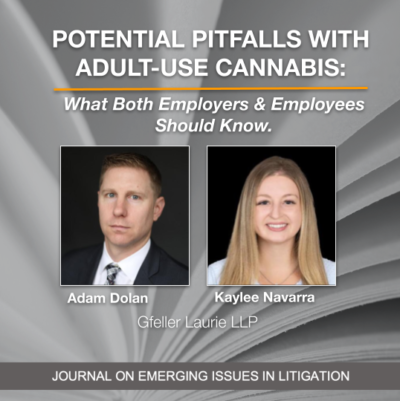
Potential Pitfalls with Adult-Use Cannabis: What Both Employers and Employees Should Know
The Authors Adam R. Dolan (adolan@gllawgroup.com) is a partner with Gfeller Laurie LLP, a tested litigator with a multifaceted practice, he has extensive experience handling catastrophic transportation, general liability, and products liability matters. He is a frequent writer and speaker on topics related to the cannabis industry. Kaylee E. Navarra (knavarra@gllawgroup.com) is an associate with Gfeller Laurie LLP where she works on matters involving commercial disputes, bad faith/ extracontractual liability, and insurance coverage. Interviews with leading attorneys and other subject matter experts on new twists in the law and how the law is responding to new twists in the world. Potential Pitfalls with Adult-Use Cannabis: What Both Employers and Employees Should Know "Employers may also take action when the employee, while working, manifests specific articulable symptoms of cannabis impairment that decrease or lessen the employee’s performance of the employee’s tasks or duties and/or the employee, while working, manifests specific articulable symptoms of cannabis impairment that interfere with the employer’s obligation to provide a safe and healthy workplace as required by state and federal workplace safety laws." Abstract: Recreational cannabis use for adults is legal in 21 states, having made its way eastward from Western jurisdictions that first addressed the issue. But these laws govern personal use during personal time. While they generally prohibit discrimination based on such use, these laws do not greenlight consumption at work or going to work under the influence. But with so many jurisdictions and job types, and variance among state laws, there aren’t simple answers. This is especially true for employers who conduct business nationwide, and because cannabis continues to be a Schedule I substance on the federal Controlled Substances Act. What rights and remedies do companies and workers have to resolve disputes? Are employers permitted to conduct drug tests? What about low-THC products and CBD? In this [...]
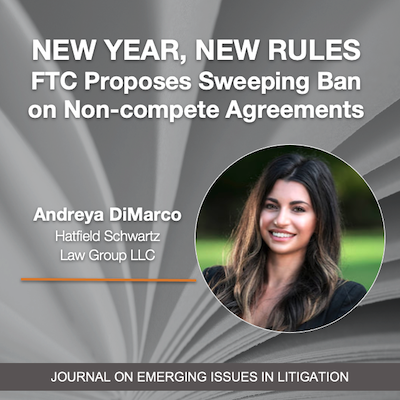
New Year, New Rules: FTC Proposes Sweeping Ban on Noncompete Agreements
The Author Andreya DiMarco (adimarco@hatfieldschwartzlaw.com) is counsel with Hatfield Schwartz Law Group LLC where she focuses on employment law and transactional matters. She has defended clients in state and federal courts and before administrative agencies, including the EEOC and DCR. Interviews with leading attorneys and other subject matter experts on new twists in the law and how the law is responding to new twists in the world. New Year, New Rules: FTC Proposes Sweeping Ban on Noncompetes "This is the FTC’s first attempt to ban non-compete agreements and strong opposition to the Proposed Rule as well as challenges regarding the scope of the FTC’s rule-making authority are likely to arise especially given the tremendous impact a retroactive and absolute non-compete ban would have. .... [P]otential litigation over the FTC’s authority to issue and enforce such a rule may cause further delays.... Moreover, the Proposed Rule is full of ambiguity which will likely be challenged." Abstract: On January 5, 2023, the Federal Trade Commission published a Notice of Proposed Rulemaking that would ban the use of noncompete agreements between employers and workers and would create an affirmative obligation for employers to void existing noncompete agreements. The Proposed Rule would also prohibit contractual clauses in other agreements or employment policies that have a similar effect. The Proposed Rule applies categorically to all workers, including independent contractors, without regard to a worker’s earnings or job function. This article discusses the nuances of the Proposed Rule as well as the legal and practical impact it will have if it is adopted. Download the article now!
HB Webinars on CeriFi LegalEdge
Content Partners