DARN! Nothing here. Apologies.
Emerging Litigation Podcast

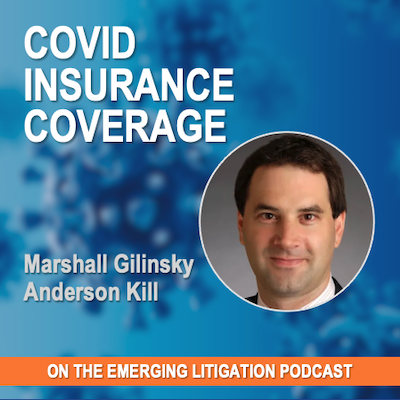
Covid Insurance Coverage Decisions with Guest Marshall Gilinsky. Are Policyholders Catching Up?
According to the online Covid Coverage Litigation Tracker (CCLT) run by Penn Law there have been more than 2,300 insurance coverage cases filed over denial of claims relating to Covid-19. Restaurants and bars were hardest hit by the pandemic and so led the way in seeking – and being denied – coverage, too. They are also leading the way in suing their insurers. The top five insurers in the defense position are Chubb Limited at #5, then #4 Lloyds of London, #3 Cincinnati Financial, and #2 Zurich. And in the #1 position facing the most coverage suits is Hartford. The insurance industry started off strong when this litigation began, winning the vast majority of the coverage suits. And they continue to do well, scoring with the argument that many of the claims do not involve actual property damage. Government closures don’t cause property damage, they argue. Courts have largely been siding with the carriers – but not all. Policyholders, a tenacious bunch, appear to be chipping away at the body of law in this suddenly expanding category. A recent case involving a New Orleans restaurant against Lloyd’s was penciled into the win column for carriers by a trial court , but an appeals court erased it and wrote the policyholder a narrow 3-2 victory. The appeals court said the language of the policy was ambiguous, and therefore had to be construed in favor of the restaurant. What's it mean? Does this bode well for policyholders? Or can we expect to see, as we did in previous coverage wars, a mixed bag of decisions across the nation? For more on that case and today’s Covid coverage landscape, listen to my interview with Marshall Gilinsky, a shareholder in the New York office of Anderson Kill. Marshall has represented policyholders of various policy types for two decades, including those seeking coverage [...]

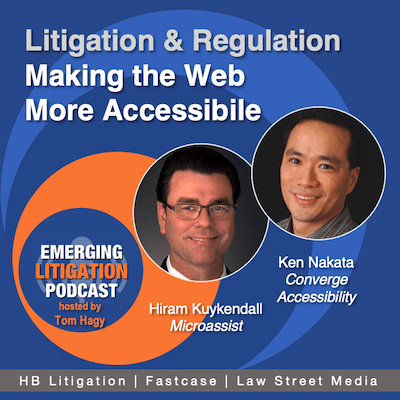
The Role of Litigation and Regulation in Making the Web More Accessible with Guests Ken Nakata and Hiram Kuykendall
According to the International Agency for the Prevention of Blindness there are 43 million people around the world living with blindness, and 300 million living with moderate to severe visual impairment. Put those statistics next to these: There are nearly 2 billion websites, and 550,000 created every day. Shouldn’t sight-impaired people have the same access to these sites as sighted people? Of course they should. There is good news. After previously announcing guidance, the DOJ says new regulations are on the way under Title II of the Americans with Disabilities Act, which describes the obligations for state and local governments. My guests say there are many reasons to be excited about this. My guests say there are many reasons to be excited about this. Ken Nakata is Co-Founder and Principal at Converge Accessibility, whose solutions help make sure websites and other technologies are accessible to people with disabilities. Ken is former Senior Trial Attorney with the DOJ Disability Rights Section where he developed nationwide ADA policies for the internet. Joining Ken is Hiram Kuykendall, Chief Technology Officer at Microassist, an Austin-based learning and development consulting. Hiram is a technical leader with hands-on experience in instructional design and digital accessibility. This podcast is the audio companion to the Journal on Emerging Issues in Litigation. The Journal is a collaborative project between HB Litigation Conferences and the Fastcase legal research family, which includes Full Court Press, Law Street Media, and Docket Alarm. The podcast itself is a joint effort between HB and our friends at Law Street Media. If you have comments or wish to participate in one our projects please drop me a note at Editor@LitigationConferences.com. (actual size) Tom Hagy Host Emerging Litigation Podcast P.S. Anytime I make a self-effacing remark about my ignorance concerning this or any subject, it's strictly for entertainment value, a story I will cling to with every fiber of my being. Ken Nakata is Co-Founder and [...]

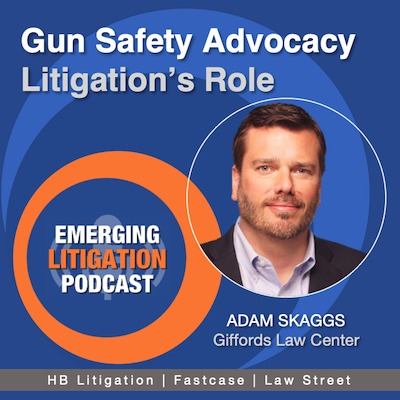
Litigation’s Role in Gun Safety Advocacy with Adam Skaggs
We’re closing in on 400 million guns in America, weapons that have been used to kill 1.5 million Americans between 1968 and 2017. Can litigation be an effective tool in curbing this loss of life? In 2020 alone there were more than 45,000 gun deaths. The beyond tragic and senseless mass shootings at schools has become all too routine. Most Americans want stricter gun laws which they believe will reduce the senseless killing in our country, which leads the world in both the number of privately owned firearms and gun-related deaths. The Supreme Court, of course, didn't take public opinion into account when it struck down a more than century old New York City ban on concealed firearms. Politicians do, however, pay close attention to polls. At the federal level, President Joe Biden signed a bipartisan law designed to make Americans safer in our gun-toting nation. Hailed as a "great start" and a rare but welcome exercise in reaching across the aisle, the law will result in safer citizens, but didn't include much of what gun advocates say is really needed to effect meaningful change. In California, Governor Gavin Newsom signed a new law that gives citizens incentives to pursue gun manufacturers and dealers who sell illegal firearms. In New York, Democratic leaders, undaunted by the Supreme Court, have pushed through new gun restrictions at vulnerable locations like schools, malls, and stadiums. But what can lawyers and lawsuits do about it? Plenty. What reasonable measurers can be put into place that will not infringe on Second Amendment rights? Several. Are we seeing litigation over these issues? You bet. For more specifics, listen to my interview with Adam Skaggs, chief counsel and policy director at leading gun safety advocacy group Giffords Law Center, co-founded by former Congresswoman Gabby Giffords. Prior to Giffords Law Center Adam was senior counsel at Everytown for [...]
A Shameless Plug for Our Content Services
Your content marketing is everything you’ve ever dreamed of. Right?
 Sara is marketing director at a boutique law firm. When we asked her how their blog was going, she made a sad face. But then, we made Sara smile.*
Critical Legal Content was founded by Tom Hagy, former Editor & Publisher of Mealey’s Litigation Reports and VP at LexisNexis, founder of HB, current litigation podcaster and editor-in-chief. CLC’s mission is to help smaller firms and service providers not only create content — blogs, articles, papers, webinars, podcasts (like the stuff on this site) — but also to get it out there. How? Via social media, this website, your website, and potential via our podcast and journal which we publish in collaboration with vLex Fastcase and Law Street Media. The goal is to attract readers and dizzy them with your brilliance.
*Inspired by actual events.
Create content like a real legal publisher.
Emerging Litigation Journal
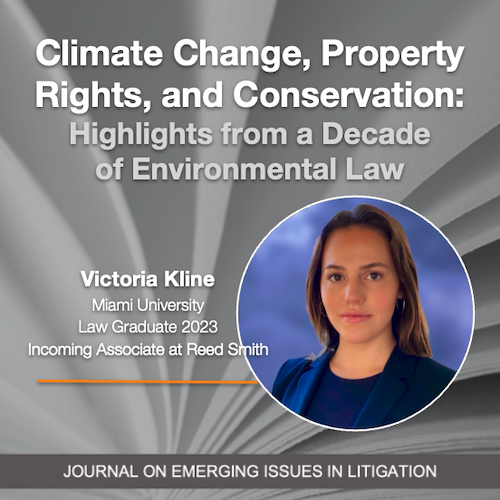
Climate Change, Property Rights, and Conservation: Highlights from a Decade of Environmental Law (2013–2023)
The Author Victoria Kline (linkedin.com/in/victoria-kline) just graduated from the University of Miami School of Law, and is an incoming associate at Jones Day. She focused her studies on environmental law, which also will be her area of practice. (Congratulations to Victoria on her graduation and getting her start at Reed Smith!) Interviews with leading attorneys and other subject matter experts on new twists in the law and how the law is responding to new twists in the world. Climate Change, Property Rights, and Conservation: Highlights from a Decade of Environmental Law (2013–2023) Abstract: The author discusses nine recent decisions—all but one handed down by the Supreme Court—that demonstrate the ongoing debate over responsibility for the effects of climate change, how the courts are essentially asked to strike a balance between environmental protection and economic development, the intersection of property rights and conservation, and how litigants fared with their arguments over different aspects of this important and, many would say, existential dilemma. The author concludes with an update from the United Nations Framework Convention on Climate Change and the establishment of a loss and damage fund for countries harmed by climate change. "The past decade has seen numerous legal challenges and landmark rulings in environmental law, reflecting the growing recognition of the critical importance of protecting the environment for current and future generations. From the Supreme Court’s decision in Michigan v. EPA to the recent Juliana v. United States case, the judicial branch has dramatically changed the way litigation can be used to protect the interests of the earth and its inhabitants." Download the article now!

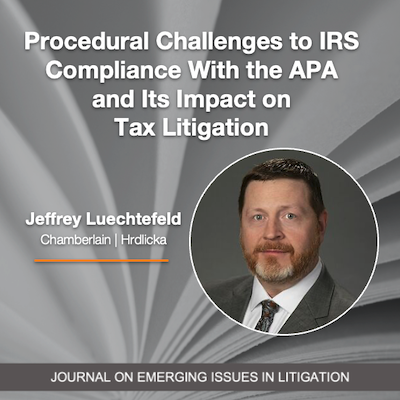
Procedural Challenges to the IRS’s Compliance With the APA and Its Impact on Tax Litigation
The Author Jeffrey S. Luechtefeld (jeff.luechtefeld@chamberlainlaw.com) is a tax controversy and litigation attorney with Chamberlain, Hrdlicka, White, Williams, and Aughtry (Atlanta, Georgia) where he focuses his practice on resolving tax disputes with the Internal Revenue Service, administratively or through litigation. Jeff previously was a Special Trial Attorney for the IRS Office of Chief Counsel as well as a director in the tax controversy practice of a big four accounting firm. Interviews with leading attorneys and other subject matter experts on new twists in the law and how the law is responding to new twists in the world. Procedural Challenges to IRS Compliance With the APA and Its Impact on Tax Litigation Abstract: The Administrative Procedure Act (APA) places specific requirements on agencies of the federal government when engaged in a “rule making” that has the force and effect of law. Recently, the APA has become a focal point in tax litigation, due in large part to the IRS’s history of refusing to comply with the process mandated by the APA. This article focuses on procedural challenges to the IRS’s compliance with the APA based on the IRS’s history of non-compliance with the APA’s notice-and-comment requirement. It highlights recent trends in tax litigation and considers the future of APA challenges in this area. "IRS’s level of APA non-compliance matters significantly ... "APA challenges predicated on the IRS’s failure to adequately follow the APA’s notice-and-comment process are inherently fact-intensive endeavors ... "The challenging party should gauge the usefulness of the relief requested and balance that against the cost required to prevail ... "Ultimately, APA challenges are important, and may be necessary for a taxpayer to get to argue the merits of their case, but they do not often end the dispute with the IRS." Download the article now!
 Ohio Supreme Court Ruling Sends Important Reminder: Long-Standing, Fundamental Principles of Insurance Policy Construction and Law Are Applicable to Cyber Claims Gallery
Ohio Supreme Court Ruling Sends Important Reminder: Long-Standing, Fundamental Principles of Insurance Policy Construction and Law Are Applicable to Cyber Claims
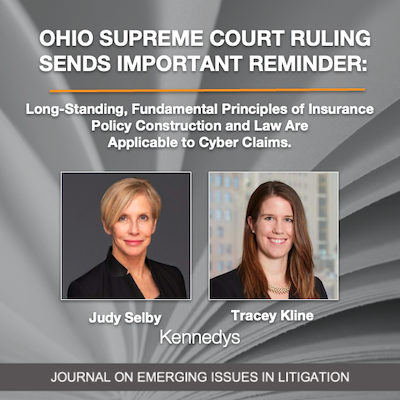
Ohio Supreme Court Ruling Sends Important Reminder: Long-Standing, Fundamental Principles of Insurance Policy Construction and Law Are Applicable to Cyber Claims
The Authors Judy Selby (judy.selby@kennedyslaw.com) is a Partner at Kennedys (New York) where she focuses her practice primarily on insurance coverage matters with a concentration in coverage for exposures arising out of emerging technology, digital, and compliance risks. Tracey M.Kline (tracey.kline@kennedyslaw.com) is an Associate at Kennedys (Philadelphia) where she focuses her practice primarily on insurance coverage litigation and cyber matters. Interviews with leading attorneys and other subject matter experts on new twists in the law and how the law is responding to new twists in the world. Ohio Supreme Court Ruling Sends Important Reminder: Long-Standing, Fundamental Principles of Insurance Policy Construction and Law Are Applicable to Cyber Claims Abstract: On December 27, 2022, the Ohio Supreme Court unanimously ruled that a business owner’s property insurance policy issued by Owners Insurance Co. to EMOI Services, LLC did not afford coverage for losses sustained in a ransomware attack because computer software is “entirely intangible” and “cannot experience ‘direct physical loss or physical damage.’” EMOI Servs., LLC. v. Owners Ins. Co., 2022-Ohio-4649 (Ohio 2022). In doing so, the court reversed an attention-getting split decision by the lower appellate court. This article takes an in-depth look at the case and discusses its significant implications. The Ohio Supreme Court’s decision was based on its commonsense conclusions that software (as intangible property) cannot suffer physical damage, and that coverage for restoration of information under the Electronic Equipment Endorsement could not be triggered absent the threshold requirement of “direct physical loss or damage” to the media on which the information was stored. Although claims involving cyber events may be relatively new, this decision is an important reminder that long-standing, fundamental principles of insurance policy construction and law are applicable to cyber claims. Download the article now!
HB Webinars on CeriFi LegalEdge
Content Partners