
HB Partner Webinars on the West LegalEdcenter
Take these CLE webinars on the West LegalEdcenter platform. Each program features leading litigators in their respective fields on emerging subjects. Speakers and topics are handpicked by HB. Your organization may have already subscribed to the platform, but each session is also available for individual purpose. For questions or if you wish to propose a webinar, write to us at: Webinars@LitigationConferences.com.

The Plight of the Indirect Purchaser
Consumers and businesses -- indirect purchasers of products whose prices are fixed by those who supply the maker of your purchase may not collect damages in states that -- surprisingly, do not have antitrust laws that give them standing. But what about federal law? Why do some states provide for damages and others do not? Are there alternatives?

The IRS and Rules About Rules
The Administrative Procedures Act outlines the rules of rule making for federal agencies. Lately it has become a focal point in tax litigation, due in large part to the IRS’s record of refusing to comply with the law's notice-and-comment mandate. Listen to learn more about recent trends in tax litigation. Get an article, too.

Does the European Union Commission’s Proposal on AI Liability Act as a Game Changer for Fault-Based Liability Regimes in the EU?
Guest Writer Does the European Union Commission’s Proposal on AI Liability Act as a Game Changer for Fault-Based Liability Regimes in the EU? By Nils Lölfing Abstract: In this article, the author discusses increasing risks that artificial intelligence system providers, developers, and users will face from a liability directive proposed by the European Union Commission. The AI Liability Directive proposed by the European Union Commission puts additional liability risks on providers, developers and users of specifically high-risk artificial intelligence (AI) systems. If enacted, it could become a game changer for fault-based liability regimes in the European Union, as it introduces a presumption of causality to prove fault and a right of access to evidence from companies and suppliers regarding high-risk AI systems. This will help victims enforce non-contractual civil law claims for damages caused by an AI system. What this is about and how it increases the liability risk exposure of actors in the AI systems supply chain will be discussed in this article. Background On September 28, 2022, the EU Commission published its proposal for a Directive to establish new fault-based liability rules for AI systems (AI Liability Directive), along with a reform for the existing rules on the strict liability of manufacturers for defective products. The current article focuses on the draft AI Liability Directive, which complements the AI Act by facilitating fault-based civil liability claims for damages, which the AI Act as specific product safety Regulation does not offer. On June 30, 2021, the EU Commission published an inception impact assessment road map on adapting civil liability rules to the digital age, in particular considering AI (based on the EU Commission’s White Paper on AI of February 19, 2020). With respect to AI in particular, the AI [...]

The Blueprint for an “AI Bill of Rights”
Authors Peter Schildkraut is a co-leader of the firm's Technology, Media & Telecommunications industry team and provides strategic counsel on artificial intelligence, spectrum use, broadband, and other TMT regulatory matters. Mr. Schildkraut helps clients navigate the ever-changing opportunities and challenges of technology, policy, and law to achieve their business objectives at the US Federal Communications Commission (FCC) and elsewhere. He is the author of "AI Regulation: What You Need To Know To Stay Ahead of the Curve. James W. Kim is a nationally recognized expert in procurement law that regularly advises companies that do business with the US government, with a focus on professional services organizations and the life sciences industry. He is a regular speaker and author on procurement and drug pricing matters and his work is regularly featured in nationally-distributed industry print and digital media. Mr. Kim provides clients with strategic counsel related to US government funding and US market access, including assistance with more than $5 billion in procurement and grant awards and regulatory counsel related to more than $40 billion in successful M&A transactions. Marne Marotta works with clients facing complex challenges to develop and implement dynamic government relations strategies. Drawing from her experience in the Senate and the executive branch, she provides clients with strategic guidance and counseling, devises and implements comprehensive advocacy campaigns, and builds coalitions with allied stakeholders. Focused on the intersection between business and public policy, Marne uses a multidisciplinary approach to help clients achieve their legislative and agency goals. James Courtney focuses his work on a variety of policy areas, including technology, national security, education, and energy and environmental. He conducts research and monitors developing policy issues to aid clients and engage with members of Congress and the Executive Branch. Mr. Courtney works closely with and advises [...]
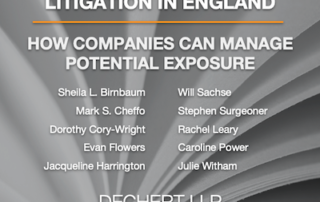
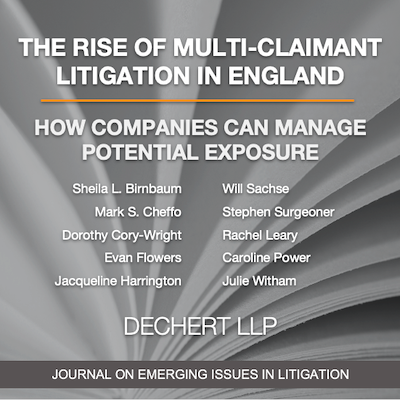
The Rise of Multi-Claimant Litigation in England and How Companies Can Manage Potential Exposure
The Authors Sheila L. Birnbaum Mark S. Cheffo Dorothy Cory-Wright Evan Flowers Jacqueline Harrington Will Sachse Stephen Surgeoner Rachel Leary Caroline Power Julie Witham Interviews with leading attorneys and other subject matter experts on new twists in the law and how the law is responding to new twists in the world. The Rise of Multi-Claimant Litigation in England and How Companies Can Manage Potential Exposure "With the growth in US/English partnerships for bringing multi-claimant actions in England, there may be an increased interest in leveraging US discovery for copycat English claims. The larger mass torts become in the United States, the more likely they are to feed into related multi-claimant actions in England." Abstract: Recent court decisions have signaled the English courts’ willingness to embrace multi-claimant litigation and to broaden the types of questions decided on a collective basis. These developments have led UK-based plaintiffs’ lawyers to expand mass tort filings, including doing so in partnership with US plaintiffs’ lawyers who are actively advertising in England. This article provides an overview of multi-claimant litigation in England, highlights some of the factors that may lead to its increase, and discusses steps that companies operating in the English market can take now to manage potential exposure. Three primary mechanisms for bringing collective actions before an English court: 1) Representative actions, group litigation orders (GLOs), and collective actions before the Competition Appeal Tribunal (CAT). 2) Representative actions, in their current form, and GLOs are products of the general Civil Procedure Rules (CPR). 3) Representative actions originated in the common law and permit a representative claimant or defendant with the “same interest” in a claim to represent that interest on behalf of a class. Download the article [...]

How Companies Seeking to Leave China for Mexico Can Mitigate Their Legal Risks and Protect Against New Ones
The Author Dan Harris (dan@harrisbricken.com) is co-founder of Harris Bricken where he focuses his practice on international law and protecting businesses in their foreign operations. A leading authority on the subject, he is also editor of the highly regarded China Law Blog, and a valued member of the Editorial Board of Advisors for the Journal of Emerging Issues in Litigation. Interviews with leading attorneys and other subject matter experts on new twists in the law and how the law is responding to new twists in the world. How Companies Seeking to Leave China for Mexico Can Mitigate Their Legal Risks and Protect Against New Ones "Chinese manufacturers commonly seek retaliation against foreign buyers that cease buying product from them. For this reason, it is critical that you line up your new suppliers (preferably in a country other than China) and have them ready to go before you even hint to anyone in China that you might cease or reduce production with an existing China supplier." Abstract: The author, one of the leading authorities on the legal issues related to international manufacturing, discusses the risks companies will face if they move their manufacturing out of China, what they should do to mitigate those risks, and what new risks they will face in a new country, such as Mexico. He comments on a variety of concepts, including manufacturing agreements, protection of intellectual property, strategies for a safe departure, potential retaliation tactics, and even personal security matters. Download the article now!
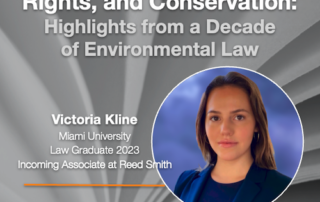
Climate Change, Property Rights, and Conservation: Highlights from a Decade of Environmental Law (2013–2023)
The Author Victoria Kline (linkedin.com/in/victoria-kline) just graduated from the University of Miami School of Law, and is an incoming associate at Jones Day. She focused her studies on environmental law, which also will be her area of practice. (Congratulations to Victoria on her graduation and getting her start at Reed Smith!) Interviews with leading attorneys and other subject matter experts on new twists in the law and how the law is responding to new twists in the world. Climate Change, Property Rights, and Conservation: Highlights from a Decade of Environmental Law (2013–2023) Abstract: The author discusses nine recent decisions—all but one handed down by the Supreme Court—that demonstrate the ongoing debate over responsibility for the effects of climate change, how the courts are essentially asked to strike a balance between environmental protection and economic development, the intersection of property rights and conservation, and how litigants fared with their arguments over different aspects of this important and, many would say, existential dilemma. The author concludes with an update from the United Nations Framework Convention on Climate Change and the establishment of a loss and damage fund for countries harmed by climate change. "The past decade has seen numerous legal challenges and landmark rulings in environmental law, reflecting the growing recognition of the critical importance of protecting the environment for current and future generations. From the Supreme Court’s decision in Michigan v. EPA to the recent Juliana v. United States case, the judicial branch has dramatically changed the way litigation can be used to protect the interests of the earth and its inhabitants." Download the article now!

Procedural Challenges to the IRS’s Compliance With the APA and Its Impact on Tax Litigation
The Author Jeffrey S. Luechtefeld (jeff.luechtefeld@chamberlainlaw.com) is a tax controversy and litigation attorney with Chamberlain, Hrdlicka, White, Williams, and Aughtry (Atlanta, Georgia) where he focuses his practice on resolving tax disputes with the Internal Revenue Service, administratively or through litigation. Jeff previously was a Special Trial Attorney for the IRS Office of Chief Counsel as well as a director in the tax controversy practice of a big four accounting firm. Interviews with leading attorneys and other subject matter experts on new twists in the law and how the law is responding to new twists in the world. Procedural Challenges to IRS Compliance With the APA and Its Impact on Tax Litigation Abstract: The Administrative Procedure Act (APA) places specific requirements on agencies of the federal government when engaged in a “rule making” that has the force and effect of law. Recently, the APA has become a focal point in tax litigation, due in large part to the IRS’s history of refusing to comply with the process mandated by the APA. This article focuses on procedural challenges to the IRS’s compliance with the APA based on the IRS’s history of non-compliance with the APA’s notice-and-comment requirement. It highlights recent trends in tax litigation and considers the future of APA challenges in this area. "IRS’s level of APA non-compliance matters significantly ... "APA challenges predicated on the IRS’s failure to adequately follow the APA’s notice-and-comment process are inherently fact-intensive endeavors ... "The challenging party should gauge the usefulness of the relief requested and balance that against the cost required to prevail ... "Ultimately, APA challenges are important, and may be necessary for a taxpayer to get to argue the merits of their case, but they do not often end the dispute with [...]
 Ohio Supreme Court Ruling Sends Important Reminder: Long-Standing, Fundamental Principles of Insurance Policy Construction and Law Are Applicable to Cyber Claims Gallery
Ohio Supreme Court Ruling Sends Important Reminder: Long-Standing, Fundamental Principles of Insurance Policy Construction and Law Are Applicable to Cyber Claims

Ohio Supreme Court Ruling Sends Important Reminder: Long-Standing, Fundamental Principles of Insurance Policy Construction and Law Are Applicable to Cyber Claims
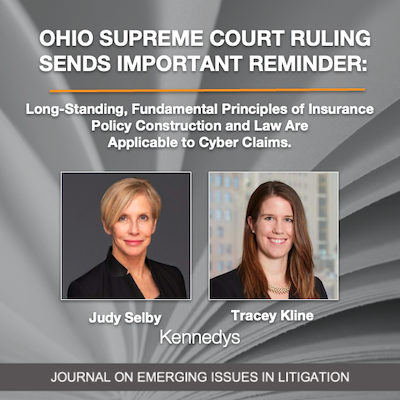
The Authors Judy Selby (judy.selby@kennedyslaw.com) is a Partner at Kennedys (New York) where she focuses her practice primarily on insurance coverage matters with a concentration in coverage for exposures arising out of emerging technology, digital, and compliance risks. Tracey M.Kline (tracey.kline@kennedyslaw.com) is an Associate at Kennedys (Philadelphia) where she focuses her practice primarily on insurance coverage litigation and cyber matters. Interviews with leading attorneys and other subject matter experts on new twists in the law and how the law is responding to new twists in the world. Ohio Supreme Court Ruling Sends Important Reminder: Long-Standing, Fundamental Principles of Insurance Policy Construction and Law Are Applicable to Cyber Claims Abstract: On December 27, 2022, the Ohio Supreme Court unanimously ruled that a business owner’s property insurance policy issued by Owners Insurance Co. to EMOI Services, LLC did not afford coverage for losses sustained in a ransomware attack because computer software is “entirely intangible” and “cannot experience ‘direct physical loss or physical damage.’” EMOI Servs., LLC. v. Owners Ins. Co., 2022-Ohio-4649 (Ohio 2022). In doing so, the court reversed an attention-getting split decision by the lower appellate court. This article takes an in-depth look at the case and discusses its significant implications. The Ohio Supreme Court’s decision was based on its commonsense conclusions that software (as intangible property) cannot suffer physical damage, and that coverage for restoration of information under the Electronic Equipment Endorsement could not be triggered absent the threshold requirement of “direct physical loss or damage” to the media on which the information was stored. Although claims involving cyber events may be relatively new, this decision is an important reminder that long-standing, fundamental principles of insurance policy construction and law are applicable to cyber claims. Download the [...]
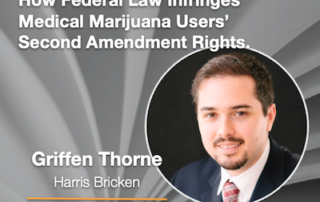
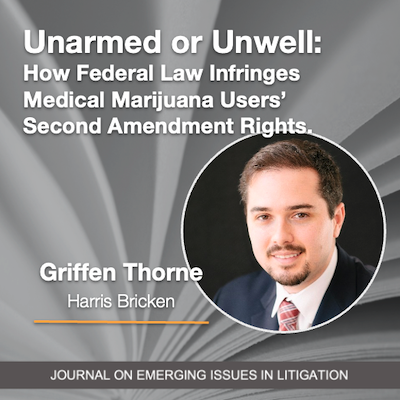
Unarmed or Unwell: How Federal Law Infringes Medical Marijuana Users’ Second Amendment Rights
The Author Griffen Thorne (griffen@harrisbricken.com) is an attorney in the Los Angeles office of Harris Bricken Sliwoski LLP, an international emerging markets law firm. He represents clients in highly regulated emerging industries, such as cannabis, in corporate and commercial transactions. Interviews with leading attorneys and other subject matter experts on new twists in the law and how the law is responding to new twists in the world. Unarmed or Unwell: How Federal Law Infringes Medical Marijuana Users’ Second Amendment Rights As Justice Amy Coney Barrett noted while on the Seventh Circuit, “legislatures have the power to prohibit dangerous people from possessing guns. But that power extends only to people who are dangerous.” In the coming years, the government’s ability to write off all medical marijuana users as dangerous is likely to be curtailed, even if the Controlled Substances Act continues to make marijuana use a federal crime. Abstract: In the wake of the 2022 U.S. Supreme Court case New York State Rifle & Pistol Association, Inc. v. Bruen, federal courts have reached opposite outcomes on whether federal prohibitions on marijuana users’ rights to own or possess firearms are constitutional. As a result, there is a high likelihood of a circuit split that results in the overturning of those federal laws. The author discusses Bruen and several other cases at the intersection of drug laws and gun laws. Download the article now!

Law Firm Technology Directors? Yes.
In this episode we talk about the advantages of having technology and software development capabilities inside your law firm. Can you imagine? And we’re not just talking about someone who is adept at unjamming the printer.

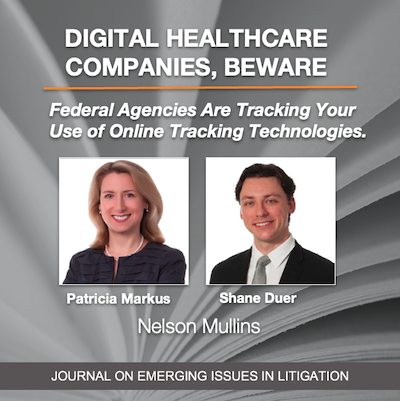
Digital Health Care Companies, Beware: Federal Agencies Are Tracking Your Use of Online Tracking Technologies
The Authors Patricia A. Markus (trish.markus@nelsonmullins.com) represents health care providers and health technology companies across the country on wide-ranging regulatory compliance, reimbursement, licensure, and operational matters, with a special focus on issues surrounding health information privacy, security, and technology. Shane Duer (shane.duer@nelsonmullins.com) focuses his practice on healthcare regulatory and corporate matters, with an emphasis on data privacy, cyber security, and information management concerns within and beyond the health care industry. Interviews with leading attorneys and other subject matter experts on new twists in the law and how the law is responding to new twists in the world. Digital Health Care Companies, Beware Federal Agencies Are Tracking Your Use of Online Tracking Technologies. Abstract: Health care industry stakeholders have regularly used online tracking technologies to help improve patient experience. However, growing scrutiny by the Office for Civil Rights, which enforces the Health Insurance Portability and Accountability Act of 1996 (HIPAA), requires covered entities and business associates to proceed cautiously in their use of such technologies. In addition, recent enforcement actions by the Federal Trade Commission make clear that a wide range of digital health companies, whether or not regulated by HIPAA, must tread carefully when collecting and disclosing personal information related to health, especially where consumers’ location data is to be used for a company’s advertising purposes, as they may be held accountable for failing to maintain the privacy and security of individuals’ protected and individually identifiable health information. The increasing number of lawsuits and news articles regarding use of these technologies demonstrates that third-party technology tracking vendors who receive PHI often are not operating under Business Associate Agreements (BAAs). The vendors in most instances disavow any need to collect PHI and accordingly instruct users to avoid sending PHI [...]

Big Tech’s Race to Develop Superior Artificial Intelligence Technology
Big Tech’s Race to Develop Superior Artificial Intelligence Technology Will A.I. Compromise Free Enterprise, Disclosure and Security? America’s Big Five tech companies – Amazon, Apple, Facebook, Google and Microsoft – are racing to develop technology they claim will change the world -- again. The tech Goliaths have more than 33,000 researchers at their disposal to create artificial intelligence (A.I.) technology with an obvious and perpetual prize: revenue. It's the talk of the world. NBC Nightly News recently predicted the impacts that A.I. will have on society in the coming years. A.I. tech was also the center of attention at the 2023 Davos Economic Summit. Prominent tech leaders such as Elon Musk and the CEO of OpenAI, Sam Altman, heralded that A.I. will improve virtually everyone’s lives, but with some risks involved. Andrew Perlman, dean of Suffolk University Law School, says there is nothing "future" about it. In The Implications of ChatGPT for Legal Services and Society, he wrote, "The disruptions from AI's rapid development are no longer in the distant future. They have arrived ..." And for the legal industry, he said, "ChatGPT may portend an even more momentous shift than the advent of the internet." Just one legal application out there today is the use of A.I. technology (GPT-3) by Docket Alarm, a popular court docket search service. Docket Alarm allows users to see A.I.-generated summaries of filings without even opening them. Michael Sander, VP of analytics with Docket Alarm owner Fastcase, told legal technology enthusiast Bob Ambrogi that the feature is experimental and should be relied upon with some healthy caution. [Disclosure: HB collaborates with Fastcase in creating litigation content, e.g., the Journal of Emerging Issues in Litigation and the Emerging Litigation Podcast.] As non-attorney and comic book hero Spiderman famously said, “With [...]

Intellectual Property Trial Team Diversity with Tara Trask
Intellectual Property Trial Team Diversity with Tara Trask Diversity and inclusion initiatives aren’t just valuable for checking off compliance boxes and writing marketing copy. Those benefits are a distant second and third to the genuine value team diversity has on the success of a company or a project. That also means law firms and trials. A recent article published by the American Bar Association Tort and Insurance Practice Section hailed diversity of perspectives for how they improve a team’s ability to resolve legal issues, innovate solutions, and introduce factors homogeneous teams may miss. The National Association for Law Placement reported that women and people of color are making great progress at major law firms. Nearly half of associates are women and, based on summer associate statistics, women are expected to break the 50% as early as this year or next. Black associates made impressive gains, but there remains room for improvement. At the partner level, however, Black and Latinx women and men remain stuck in the low single digits. In this episode we drill down even further to examine trial teams in the intellectual property arena. I was thrilled to speak with Tara Trask, one of the nation’s leading experts on IP trials and juries, having directly worked on or observed more of these proceedings than just about anyone. Tara has championed research on this topic as part of her work and presentations for the American Intellectual Property Law Association. The diversity spark lit up for Tara when she and her panelists enjoyed an enthusiastic reaction to an AIPLA conference session she moderated titled, “Perspectives on Diversity: Views on Trial Teams From the Bench, The Boardroom, and the Jury Box.” Listen to Tara’s insights based on analysis of her own cases, analysis of related studies, and expanded fact-gathering [...]
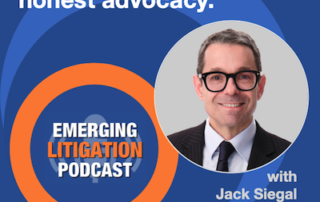
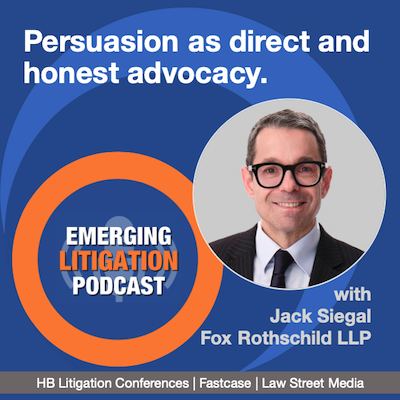
Persuasion as Direct and Honest Trial Advocacy with Jack Siegal
Persuasion as Direct and Honest Advocacy with Jack Siegal The relevance to jury trials and jury persuasion is obvious. According to studies cited in a 2019 article in Business Insider, people develop first impressions of you “even before you open your mouth.” That means your mere appearance “affects how trustworthy, promiscuous, and powerful people think you are.” It’s the trustworthy part that attorneys need to pay attention to. Regardless of the strength of their case or whether the law is on their side, an attorney still must be persuasive. And, unless the audience – whether it is a judge, a panel of judges, a regulatory body, or a jury – sees you as credible, the rest will likely not matter. But what makes an attorney, or anyone for that matter, credible? Is this something you’re born with or is it something you can develop over time? Is it true, as some studies suggest, that you can change some first impressions by making some changes in how you present yourself, or are you just stuck with a less than trustworthy vibe? Interested in upping your jury persuasion game? A Good Place to Start Listen to my interview with attorney Jack I. Siegal, a partner with Fox Rothschild LLP in Boston. Jack believes we can all make positive adjustments in the nuanced practice of achieving credibility. This podcast is the audio companion to the Journal on Emerging Issues in Litigation. The Journal is a collaborative project between HB Litigation Conferences and the Fastcase legal research family, which includes Full Court Press, Law Street Media, and Docket Alarm. The podcast itself is a joint effort between HB and our friends at Law Street Media. If you have comments or wish to participate in one our projects please drop me a note at Editor@LitigationConferences.com. P.S. Toward the end I could barely manager my ADHD [...]

“Years of Deception” Behind Consumer Privacy Violations Alleged
Mental Health Platform's Data Sharing Practices Challenged. BetterHelp allegedly shared personal identifiable info with third parties. FTC files administrative complaint asserting "years of deception." Days later, two class actions were filed in the Northern District of California. Online mental health company BetterHelp, Inc. is facing allegations on two fronts for allegedly sharing personal identifiable information with third parties and breaching consumer privacy. The Federal Trade Commission (“FTC”) initiated an administrative complaint against the California-based online mental health company on March 2, 2023, after what they call years of deceptive practices and blatant denial of a media report published by Jezebel in February 2020. The article cited evidence that BetterHelp shares sensitive patient information and email account information with third parties such as Facebook, Snapchat, Criteo, and Pinterest. Days after the FTC filed its complaint, consumers filed two class actions in the Northern District of California’s San Jose Division (C.M. v. BetterHelp, Inc., March 7, 2023, 5:23-cv-01033 and Jane Doe v. BetterHelp, Inc., March 11, 2023, 5:23-cv-01096). Both consumer privacy lawsuits state that their facts are largely supported by experts in the field of data privacy. BetterHelp is a Delaware corporation with its principal office or place of business in Mountain View, Calif. On its website the company claims it is the “world’s largest therapy platform” with more than 25,000 licensed therapists available. BetterHelp operates generalized mental health therapy services and operates specialized therapy services for members of the LGBTQ community, members of the Christian Faith, Spanish-speaking clients, and teen counseling with parental consent. BetterHelp founder Alon Matas stated in a Medium article published Oct. 8, 2018, that, “One of our core missions is to destigmatize mental health. We firmly believe that nobody should ever feel ashamed or embarrassed to reach out for help.” Explosive Growth [...]

Litigation Funding Battle Over Litigation Control
Sysco and Burford Capital Butting Heads Over Litigation Control. Food giant claims funder is interfering with antitrust litigation. Funder says its client is settling for too little. Public dustups over litigation funding are rare. Leading litigation funder Burford Capital LLC and food distribution giant Sysco Corp. are locking horns over the control and use of litigation funds. Burford says Sysco is settling Burford-funded antitrust litigation for amounts that deny the financial company optimal return on its investment. Sysco says the funder has overstepped its bounds and interfered with Sysco’s litigation oversight. Sysco received $140 million from Burford in part to fund price-fixing lawsuits against poultry, pork and beef producers – complex multidistrict litigation involving hundreds of plaintiffs, dozens of defendants, and related criminal suits brought by the Department of Justice (DOJ). So far, settlements of private antitrust litigation have reached into the hundreds of millions, and DOJ has levied more than $100 million in fines. Burford, which gets a share of any settlements in the antitrust litigation, says Sysco is settling for too little. Sysco has sued companies associated with Burford – Glaz LLC, Posen Investments LP, and Kenosha Investments LP – claiming they are meddling in Sysco’s settlement efforts. Glaz, Posen, and Kenosha are all companies which have Burford Capital Limited as the only direct or indirect partner. All three are controlled by Burford and Burford operates as the sole funder of their respective litigation efforts. Sysco also criticized its attorneys at Boies Schiller Flexner, whom, they say, allegedly spoke with Burford representatives without Sysco’s knowledge. Sysco says the firm gave into Burford’s demands, an accusation the firm vehemently denies. Meanwhile, Burford has obtained an arbitration ruling blocking Sysco from finalizing any of the price-fixing settlements against the meat producers. Sysco has moved [...]

Alleged Hair Product Injuries Impact Women of Color
L’Oréal Among Defendants in Litigation Over Hair Products. Dozens of hair straightener cases allege higher incidence of cancers and other diseases. Plaintiffs in dry shampoo litigation say products contain benzene. Seven companies control the U.S. hair product industry. L’Oréal has been hit hard in recent hair care litigation related to straighteners, relaxants, and dry shampoos. L’Oréal was named a defendant in nearly sixty complaints alleging that straightening products manufactured by the beauty giant have caused cancer in its consumers. L’Oréal has also been named a defendant in a proposed class-action for its Redken dry shampoo that allegedly contains the carcinogen benzene. Other large industry players such as Johnson and Johnson and Unilever have also been accused of selling dry shampoos with dangerous levels of benzene. Straighteners and Relaxers Litigation Dozens of cases have been consolidated in multidistrict litigation against L’Oréal for its potentially cancerous hair straighteners and relaxers. Mitchell v. L’Oréal USA Inc. is a typical case. It was filed by Missourian Jennifer Mitchell, a black woman, after her diagnosis of uterine cancer which she claims was caused by endocrine disrupting chemicals (EDCs) in L’Oréal’s hair straighteners and relaxers. Jennifer Mitchell was diagnosed with her cancer on August 10, 2018. “Ms. Mitchell was first exposed to EDCs and/or phthalate-based products around 2000, at or around the age of 10, when she began using Defendants’ Product.” She used the products as instructed for 22 years, leaving the chemicals in her hair for long periods of time. At the age of 28, she was diagnosed with uterine cancer despite the cancer not being in her family history. As a result of her cancer diagnosis, Ms. Mitchell had to undergo a full hysterectomy, causing her emotional and physical pain, and rendering her unable to have children. The complaint [...]
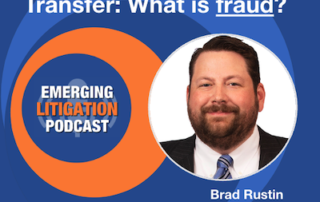
Electronic Fund Transfer Fraud with Brad Rustin
Electronic Fund Transfer Fraud with Brad Rustin Grifters, scammers, con artists Sen. Elizabeth Warren, who championed the creation of Consumer Financial Protection Bureau (CFPB), calls the Zelle digital payments network a “preferred tool for grifters like romance scammers, cryptocurrency con artists, and those who prowl social media sites advertising concert tickets and purebred puppies — only to disappear with buyers’ cash after they pay.” 18 million Americans defrauded Scams and fraud committed via the Zelle platform and other peer-to-peer services are surging. According to one lawsuit 18 million Americans were defrauded by schemes perpetrated via apps like Zelle in 2020. Some 1,500 member banks and credit unions participate in the Zelle service. People sent $490 billion via the app in 2021. But Zelle owner, Early Warning, and its consortium comprising Bank of America, Truist, Capital One, JPMorgan Chase, PNC Bank, U.S. Bank, and Wells Fargo, have refused to refund customers for most of their losses. Sen. Warren issued a report that the claims for fraud received by just four banks will likely exceed $255 million by the end of 2022 – a $165 million increase over 2020. The senator and consumers say Zelle is violating federal consumer protection law. What is fraud? The heart of the problem is this: banks and consumers do not agree on the definition of “fraud.” For clarity on issues surrounding the Electronic Fund Transfer Act (EFTA) and its implementing regulation—Regulation E—listen to my interview with fintech attorney Brad Rustin of Nelson Mullins. In addition to chairing the firm’s Financial Services Regulatory Practice, Brad counsels financial institutions in regulatory matters, including strategic agreements, product development, and operational compliance. Brad is a Certified Anti-Money Laundering Specialist and a Certified Regulatory Compliance Manager. He received his JD, magna cum laude, from the University of South Carolina School of [...]

Pixel Litigation the Latest Craze in Privacy Law
Meta, Google Face Barrage of Pixel Lawsuits in Digital Privacy War META PLATFORMS INC. AND GOOGLE are currently facing nearly 70 lawsuits involving large companies and some hospital systems or individual health care providers utilizing Pixel tracking tools embedded on their websites and applications. Sensitive private data such as financial information gathered from filing tax returns online or patient healthcare information stored on patient portals is being actively tracked and sent to Meta and Google for both analytical and advertising purposes. Tracking pixels are a 1x1 Pixel graphic that serves as a snippet of code used for tracking user behavior, site conversions, web traffic, and other metrics generated from a site’s server. In 2018, Meta told Congress that there were more than 2 million Pixels across the web, which at the time, was one of the largest data-harvesting operations most internet users had ever seen. Meta makes their Pixel code freely available to anyone and any business – thus the amount of Pixel tracking has exponentially grown since Meta testified before Congress. The analytical information that companies gleam from Pixel tracking is paying off and is featured on everything from fast food companies such as Chick-Fil-A, media companies like iHeart Radio, and even tax-filing websites such as Tax Slayer or TaxAct. Pixel Tax Data On November 22, 2022, theverge.com co-published a report with The Markup, revealing that Pixel tracking tools located on several renown American tax-filing websites were sending individual tax filers’ contact and financial information to Meta and Google. From January to July 2022, The Markup tracked websites’ use of the Pixel as part of the Pixel Hunt in partnership with Mozilla Rally. Participants of the Pixel Hunt installed a browser extension that provided The Markup with a copy of all data shared with Meta [...]

Toxic Train Wreck Sparks Litigation
Legal News: Ohio AG Sues Norfolk Southern Over East Palestine Train Spill. Legal News On March 14, 2023, Ohio filed a lawsuit against Norfolk Southern Railway Company, a multi-billion dollar entity, in the U.S. District Court for the Northern District of Ohio. The lawsuit stems from the East Palestine train derailment (the “Derailment”), which took place on February 3, 2023. The lawsuit seeks to “recover response costs, redress damages to natural resources, and receive an order for injunctive relief, civil penalties, and damages.” The Derailment The Derailment of train 32N occurred at approximately 9 PM in East Palestine, Ohio—roughly fifty miles northwest of Pittsburgh, Pennsylvania. The accident is believed to have been caused by the overheating and failure of at least one wheel bearing. Twenty of the derailed cars contained hazardous materials, including vinyl chloride, butyl acrylate, ethylhexyl, acrylate, and ethylene glycol monobutyl ether. Chief among the substance concerns was vinyl chloride, which emits toxic substances when it burns. The Environmental Protection Agency (EPA) states that it was notified of the Derailment about two hours after it occurred, and personnel were on site five hours after the accident. The surrounding downwind area was evacuated. Reports were made of health and safety hazards to people and animals in the affected region. Three days after the crash, emergency responders intitiated a controlled release and burn of the remaining vinyl chloride. All the while, the EPA was overseeing air monitoring, water sampling, and other safety controls. On February 10, 2023, EPA Region Five sent a notice of potential liability to Norfolk Southern’s Deputy General Counsel, Matt Gernand. The letter conveyed that the company was a potentially responsible party that might be responsible for cleaning up the Derailment site, or reimbursing the EPA for the cleanup costs incurred by the Agency, under [...]

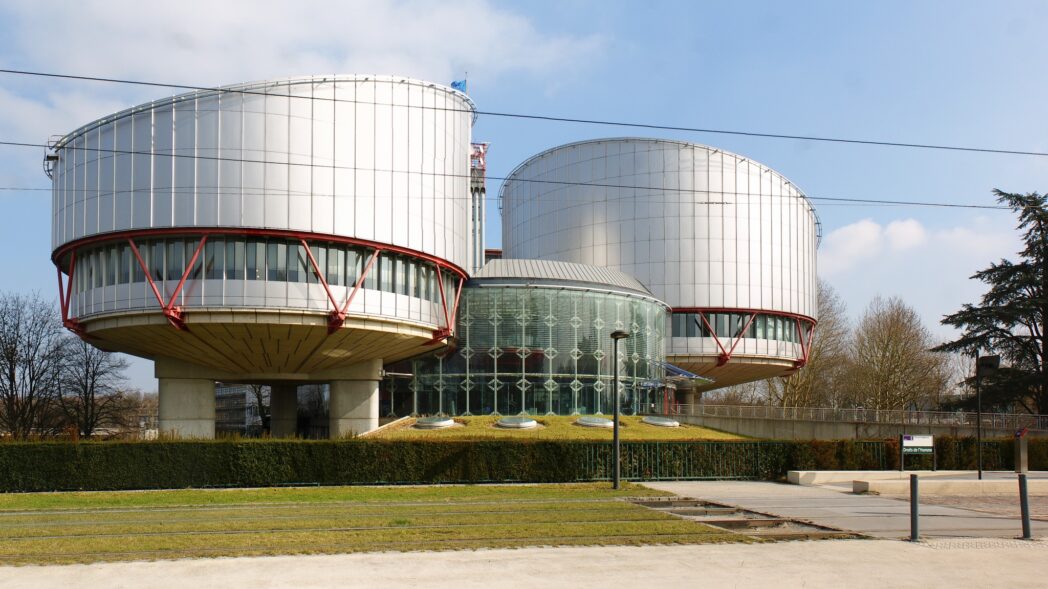
European Court of Human Rights to Hear Case on Climate Change by Victoria Kline
Guest Writer Victoria is a third-year student at the University of Miami School of Law, Juris Doctorate Candidate 2023, Law Review Staff Editor, and soon-to-be associate at Jones Day. European Court of Human Rights to Hear Case on Climate Change By Victoria Kline The European Court of Human Rights (ECHR) is hearing a landmark case brought forward by the Senior Women for Climate Protection Switzerland, who are suing the Swiss government (the “State”) for human rights violations related to climate change. Verein KlimaSeniorinnen Schweiz and others v. Switzerland (“KlimaSeniorinnen”) is one of the first climate change matters the court has taken up. On Wednesday, March 29, 2023, the ECHR held a public hearing. History of the Case KlimaSeniorinnen began back in 2016, ignited by a group of women called KlimaSeniorinnen Schweiz, the Senior Women for Climate Protection Switzerland. The group filed suit in Swiss court against a variety of Swiss federal government bodies alleging violations of obligations set forth in the Swiss Constitution and the European Convention on Human Rights (the “Convention”). The heart of the suit is the State’s shortcomings in progress being made towards the adopted Paris Agreement’s goal to keep “the increase in the global average temperature to well below 2°C above pre-industrial levels.” The elderly plaintiffs purport that their demographic is especially vulnerable to the “temperature-related morbidity and mortality” caused by “climate change-induced excessive heat.” On April 25, 2017, the suit was dismissed by the Federal Department of the Environment Transport, Energy and Communications for lack of standing on the prongs of injury and remedy. Over a year later, the Swiss Federal Administrative Court rejected the plaintiffs’ appeal. Subsequently, on May 20, 2020, the Swiss Supreme Court also rejected the plaintiffs’ filed appeal, holding that plaintiffs should seek their desired [...]

AI Image Generators and Copyright: Eligibility in the U.S., UK, EU, and More; Fair Use, Derivative Works, Liability
AI Image Generators and Copyright: Eligibility in the U.S., UK, EU, and More; Fair Use, Derivative Works, Liability AI programs are now readily available for all. Stability AI, Lensa, and other AI image creation tools create original works of art, raising the question of IP protection for such art. The United States requires human authorship in order to obtain copyright protection, and so far, the U.S. Copyright Office has declined to grant copyright registrations for AI-created works of art based on a lack of human authorship (one of these decisions is being challenged in Thaler v. Perlmutter (D.D.C. filed June 2, 2022)). While some countries take a similar approach to the US, others treat the issue of copyright eligibility for AI-generated art quite differently and provide at least some protection of computer generated works. Questions have also been raised as to whether AI-generated images constitute derivative works and whether such images and the AI generation tools used to create them infringe third-party copyrights, or whether the fair use doctrine or other defenses may apply. The first lawsuits involving image generators have now been filed raising copyright claims in addition to other claims. Listen as our authoritative panel of IP attorneys examines AI image generators and the associated copyright issues. The panel will discuss eligibility in the U.S. and the recent actions by the Copyright Office and contrast this with the approaches used in other countries. The panel will also address the recent cases that have been filed and the potential liability for copyright infringement in the U.S. and other countries. Michael R. Graif Member Mintz Levin Cohn Ferris Glovsky and Popeo Lisa T. Oratz Senior Counsel Perkins Coie Scott J. Sholder Partner Cowan DeBaets Abrahams & Sheppard CLE On-Demand Webinar This Strafford production has been specially selected for HB [...]

Greenhouse Gases Cited in Suit to Invalidate Drilling Leases
Environmentalists Argue Federal Government Failed to Analyze Social Costs of Fossil Fuel Emissions from Drilling Leases “Federal public lands used for fossil fuel extraction contribute 24% of the United States’ Greenhouse Emissions,” according to 10 environmental groups in their ongoing lawsuit against the U.S. Department of the Interior, Secretary of the Interior Debra Haaland, the Bureau of Land Management (BoLM), and BoLM Director Tracy Stone-Manning (Dakota Resource or Council, et al, v. U.S. Department of the Interior, et al., D. D.C., No. 1:22-cv-1853 ). Their lawsuit seeks to invalidate 173 oil and gas leases approved in June 2022 across eight states: Colorado, Montana, Nevada, New Mexico, North Dakota, Oklahoma, and Utah, and Wyoming. Plaintiffs include: Dakota Resource Center, Center for Biological Diversity, Citizens for a Healthy Community, Living Rivers & Colorado Riverkeeper, Montana Environmental Information Center, Rio Grande Waterkeeper, Sierra Club, Waterkeeper Alliance, Western Waterheads Project, and WildEarth Guardians. The environmental groups argue the BoLM is in violation of the National Environmental Policy Act (NEPA) 42 U.S.C. § 4321, for failing to make efforts to prevent or eliminate damage to the environment and biosphere. The groups also argue that Secretary Haaland failed to follow the instructions of the Federal Land Policy and Management Act (FLPMA) 43 U.S.C. § 1701, which requires her office to “take any action necessary to prevent unnecessary or undue degradations of the land.” Five states have intervened for the defendants: Montana, North Dakota, Oklahoma, Utah, and Wyoming. Defendants, through Montana Attorney General Austin Knudsen, argued in their answer filed Oct. 21, 2022, the complaint failed to state a claim upon which relief could be granted, the plaintiffs lacked standing, that plaintiffs failed to exhaust their administrative remedies, and that the intervening states reserve the right to further amend pleadings throughout the course of litigation. [...]

















Conservationists Try Again to Block Drilling in Alaska’s Western Arctic
Willow II: Conservation Groups Sue Again to Stop Oil Project in Alaska’s Western Arctic Several conservation groups filed a lawsuit in the U.S. District Court for the District of Alaska against the federal government in another effort to halt the Willow Master Development Plan (Willow Oil Project), a proposed oil and gas development in Alaska’s Western Arctic. Spearheading the development is ConocoPhillips Alaska Incorporated. The project was approved for a second time by the Biden Administration only a day before the filing of the plaintiffs’ complaint. The Willow Oil Project The Willow Oil Project is a multi-billion dollar project that would involve the construction of drilling pads, pipelines, and other infrastructure in the National Petroleum Reserve-Alaska (Reserve). The project involves drilling up to 250 wells for the purpose of generating 586 million barrels of oil within its 30-year lifespan. As a direct result of the activity, roughly 258 million metric tons of greenhouse gas emissions would be released into the atmosphere. The project has been controversial due to concerns over its potential impacts on the environment and wildlife in the area. Willow II Case History ConocoPhillips first proposed the Willow Oil Project to the Bureau of Land Management (BoLM) in May of 2018. After determining that the project was a major federally-involved action that would significantly affect the quality of the human environment, the BoLM knew it had to prepare an Environmental Impact Statement (EIS) pursuant to the National Environmental Policy Act (NEPA). After studying the Willow Oil Project and comparing it to three action-alternatives and one no-action alternative, as well as seeking public comment, the BLM published a final EIS for the Willow Oil Project on Aug. 14, 2020. The BLM’s approval was immediately contested in the Alaskan District Court by conservation and Alaska-native groups. [...]