HB Partner Webinars on the West LegalEdcenter
Take these CLE webinars on the West LegalEdcenter platform. Each program features leading litigators in their respective fields on emerging subjects. Speakers and topics are handpicked by HB. Your organization may have already subscribed to the platform, but each session is also available for individual purpose. For questions or if you wish to propose a webinar, write to us at: Webinars@LitigationConferences.com.


Massive Mass Tort Settlements and Liability Forecasting
In this episode, we discuss Liability Forecasting and the role it plays in the administration of massive, sometimes multi-billion-dollar mass tort settlement trusts with guests Mark Eveland and Ed Silverman of Verus LLC, which provides litigation support services to law firms working on mass torts, such as case management and medical review services, settlement administration, business and advisory services, and analytics. Liability forecasting mechanisms were built to fairly and judiciously compensate current and future claimants for their injuries. Listen and learn more!
Navigating International Discovery
In this episode, we discuss navigating the complexities of international discovery with Ben Daniels of Robinson+Cole and the benefits of understanding jurisdictional differences and having specialized tools and strategies to cut through the complexities. As Ben notes, "if you litigate in a foreign court, discovery, as it is known in the U.S., is not going to happen. But parties often forget a powerful tool to get around those restrictions". Listen and learn more!

Fresh Produce Law, Contracts, and Risks
In this episode, we discuss Fresh Produce Transportation Law with Katy Esquivel of Esquivel Law Chartered and the challenges of transporting fresh fruits and vegetables from farms to stores in a safe and timely manner. What legal and reputational risks do growers, brokers, and shippers face? What laws come into play? What are the essential components of contracts among participants in the supply chain? As Katy notes, "there is nobody in this country with a more tangible vested interest in the safety of produce than growers and everyone along the supply chain". Listen and learn more!

Property Insurance Coverage for Emerging Risk: Underground Climate Change
Studies have shown that “underground climate change” is affecting ground soil conditions, causing structural strains on buildings and exacerbating cracks and defects in walls and foundations. The authors, Dennis Artese, Ethan Middlebrooks, and Thomas Dupont analyze permutations of policy language and state law that may affect coverage for damage caused by underground climate change, including how state law treats anti-concurrent causation clauses, whether “human-caused” exceptions to earth movement exclusions may apply to underground climate change, and whether “abrupt collapse” exceptions to exclusions for building collapse may apply when undetected structural damage triggered by underground climate change triggers collapse. As the authors note, "there are numerous arguments in favor of coverage under all-risk property insurance policies for losses related to underground climate change".

Litigation After Biometric Privacy Law Violations: Policyholder Victories and Their Implications
Insurance companies are implementing new measures to try to avoid paying for liabilities attached to consumer and employee biometric privacy law violations. The authors, Cort Malone and Abigail Damsky explore the issues companies and policyholders should be examining to ensure adequate protection in the present and future. As the authors note, “as more states pass biometric privacy laws, it is critical not only to follow court decisions but also to understand how insurance companies are attempting to avoid liability for such claims.”
Expert Depositions and Trial Disclosures: What Every Litigator Needs to Know
Expert disclosures in litigation are vitally important for trial testimony and planning for trial. The author, Ethan Minkin examines issues surrounding expert depositions and trial disclosures, which he argues need to be appreciated to avoid unanticipated surprises at trial. As Ethan discusses, "the pretrial process requires an eye toward the future. Trial work is not limited to just knowing the applicable Rules of Evidence. The applicable Rules of Civil Procedure play an equally important, if not greater, role in helping to define what will happen at trial".

Copyright Issues in Generative AI for Software: Doe v. Github, Inc. et al.
The ongoing case of Doe v. Github Inc. et al. addresses copyright-related issues inherent in the Copilot generative AI that allows users to enter prompts to generate software code. This case addresses many of the issues involved in the training and use of generative AI for generating software code. The author, Jeffrey Gluck examines these issues, which he anticipates will have far-reaching implications for AI-generated works in the future. As Jeffrey notes, "Github is a case that may have far-reaching implications for AI-generated works in the future".

The Promise and Peril of Quantum Computing and Its Implications for Cyber Insurance
Quantum computing, like artificial intelligence, is one of several emerging technologies that could either save the planet or end the world, depending on which expert is holding forth on the issue. This article explores the promise and peril of quantum computing and the potential coverage implications under cyber insurance policies. As Cameron notes, "while cyber insurance may provide some coverage for hazards that result from quantum computing, those policies may not respond to many of the risks".

Machines Inventing Machines: Artificial Intelligence and Patent Law
In this episode, we talk to Robert A. McFarlane of Hanson Bridgett LLP about artificial intelligence in the world of invention and questions raised in a recent decision from the U.S. Court of Appeals for the Federal Circuit that expounded on the principle that only human beings - not machines - can be named as inventors under U.S. patent law. Listen and learn more!

Video Game or Casino? An International Examination of Loot Boxes and Gambling Regulations
The author, Darius Gambino of Saul Ewing LLP examines the legal and regulatory challenges surrounding loot boxes in video games, highlighting the risks of litigation, government scrutiny, and the need for industry self-regulation.

The Awesome Potential of Advanced Dispute Resolution
In this episode we talk to Rich Lee, founder of New Era ADR, about hot topics and issues involving what is referred to here as "Advanced Dispute Resolution", or ADR. What are the benefits of ADR? How can ADR enhance Access to Justice? How does employing ADR impact Accessibility, Diversity, and the Environment? What is the influence of Gamesmanship in legal proceedings? As Rich explains, "ADR is about rethinking litigation to make it more efficient for both sides. Get parties to be pragmatic, get to the point, present their arguments, and get it resolved". Listen now to learn more!
Applying Business Strategy to Your Law Firm
In this episode of the Emerging Litigation Podcast, we hear from James Grant about looking strategically at your law firm as you would any business and explore one litigation firm’s journey through that transformative process. As he argues, "lawyers must learn AI now or else watch their competition fly past them in operational efficiency, customer service, and client retention". Listen to learn more!

FTC v. Amazon: Market Definitions and Section 5 of the FTC Act
Traditional antitrust economics face significant challenges grappling with the relatively new digital economy. The author, Jonathan Rubin examines these and other issues raised in the case of FTC v. Amazon, which he anticipates will be a crucial test for antitrust and the FTC Act.


PFAS Regulation, Litigation, and Differentiation
In this episode, we give you some history of the PFAS compounds, discuss some of their important differences, review what litigation we're seeing (including the various claims and defenses), note what we can learn from recent settlement structures, forecast the impact of any new regulation, and predict what litigation might be next. Listen to our guests David Marmins and Morgan Harrison of Arnall Golden Gregory LLP.


ESG Programs and the Lawyer’s Role
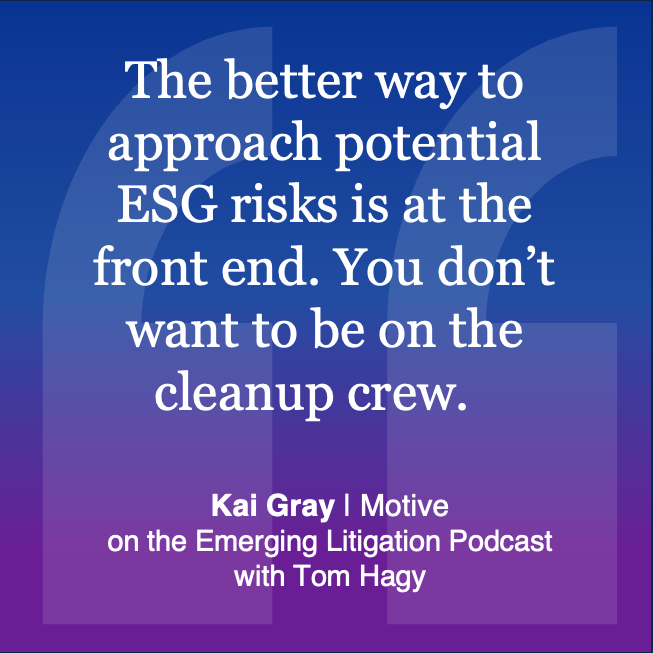
In this episode, we discuss the role of attorneys and in-house counsel in the courageous new world of Environment, Social, and Governance Issues, or ESG. How can law firms themselves adopt ESG practices and what role do they play with clients? How can in-house counsel drive ESG initiatives? What are the pitfalls and risks? And have you ever wondered how rating organizations work? Listen now!

Latest on Software and AI Devices from the United Kingdom’s MHRA by Jackie Mulryne and Eleri Williams
In this article, the authors discuss new updates from the UK’s Medicines and Healthcare products Regulatory Agency on how software and artificial intelligence medical devices will be regulated in the United Kingdom after Brexit. Read and learn more!
Natural Gas Bans and Bans on Bans
The Ninth Circuit Court of Appeals recently struck down Berkeley, California's ban on natural gas infrastructure in new buildings as a violation of federal law. As we will continue to see more such bans, our guest shares insights on how similar cases may be treated -- and much more.

Pixel Litigation Tests Old Privacy Law
New litigation alleging violations of the Video Privacy Protection Act -- which came well before online video streaming -- demonstrates how plaintiff attorneys are creatively applying traditional causes of action to litigate modern privacy issues in the absence of a federal law. Listen now for insights.
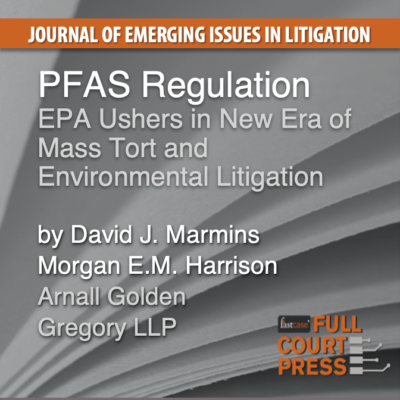
PFAS Regulation: EPA Ushers in Next Era of Mass Tort and Environmental Litigation
PFAS claims are the next frontier of mass tort and environmental litigation. With the EPA poised to finally enact the first regulation of these chemicals, that frontier is ripe for exploration. This article explores PFAS and the origin of litigation around the substances as well as the state of PFAS litigation and regulation today. It concludes with some thoughts on what to expect when it comes to PFAS litigation going forward.
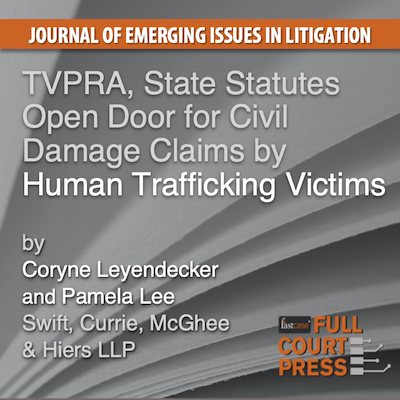
TVPRA, State Statutes Open Door for Civil Damage Claims by Human-Trafficking Victims
Since 2003, when Congress opened the door for human-trafficking victims to sue for civil damages under the Trafficking Victims Protection Act of 2000 (TVPRA), the TVPRA and similarly drafted state statutes have allowed for human-trafficking victims to seek civil damages against any party that has benefited from their trafficking. Given this expansive inclusion of third-party liability, more and more businesses, especially those in the hospitality industry, are ultimately the ones left to pay for the criminal acts of human traffickers. In this article, the authors, Coryne Leyendecker and Pamela Lee discuss the evolving litigation around human-trafficking claims and offer guidance on how businesses can build a foundation for their own defense while simultaneously helping prevent human-trafficking crimes from occurring in the first place.
Spotting the Risk, Reaping Rewards: Avoiding Increased Antitrust Scrutiny
The Authors Katie has favorably represented antitrust clients in matters involving monopolization, conspiracy, price fixing, exclusive dealing, and other competition-related disputes, including trade secrets and non-compete actions. She has extensive knowledge of the regulatory hurdles and obligations her clients face. Katie earned her J.D. from the New York University School of Law, cum laude. Natalie West represents sophisticated clients in complex commercial disputes. She regularly serves as the lead brief writer in antitrust cases, employment and consumer class actions, and appellate matters. Natalie graduated with high honors from the University of Texas School of Law, where she served as a member of the Texas Law Review and was elected to the Order of the Coif. Interviews with leading attorneys and other subject matter experts on new twists in the law and how the law is responding to new twists in the world. Avoiding Antitrust Scrutiny Spotting the Risk, Reaping Rewards The increase in aggressive antitrust enforcement has certainly received significant attention. For the moment, juries are not rewarding the prosecutors. That said, even an unsuccessful government investigation is itself costly and can motivate plaintiffs’ lawyers. Best practices involve not only following the law but also maintaining solid optics to avoid the need for an expensive, if ultimately successful, defense. Abstract: A decade ago, few lawyers across the country spent significant time thinking about antitrust law. But, since then, there has been an onslaught of antitrust attacks on businesses and executives across all sectors of the economy. Enforcement efforts have skyrocketed following President Biden’s July 2021 executive order directing a “whole of government” crackdown on competition abuses—and the trend shows no sign of letting up. Today, no matter the industry or the size of the business, everyone needs [...]
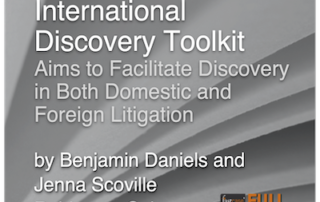
International Discovery Tool Kit Aims to Facilitate Discovery in Both Domestic and Foreign Litigation
The Authors Benjamin Daniels advises financial institutions and global corporations about litigation and dispute resolution. As a member of the Business Litigation Group, Ben provides creative and ardent advocacy during litigation, enforcement actions, investigations, crisis management, and white-collar defense matters. Ben’s clients often face complex, cross-border disputes. He has deep experience with the interplay between domestic and international courts, including discovery disputes and Hague convention proceedings. He also represents clients in international arbitrations and mediations. Jenna Scoville is a member of the firm’s Business Litigation Group. She focuses her practice on all aspects of general business litigation and dispute resolution, as well as government enforcement matters, and appellate work. She helps companies respond to a variety of business disputes, including claims for breach of contract, unfair trade practices and fraud. Jenna also has extensive appellate experience. Prior to joining the firm, she clerked for the Honorable Peter W. Hall of the U.S. Court of Appeals for the Second Circuit. Interviews with leading attorneys and other subject matter experts on new twists in the law and how the law is responding to new twists in the world. International Discovery Tool Kit Aims to Facilitate Discovery in Both Domestic and Foreign Litigation "At a time when litigants have increasingly relied on U.S. federal courts to obtain otherwise unobtainable evidence from entities located within the United States, the U.S. Supreme Court has decisively closed the door to U.S.-style discovery in private arbitrations abroad. That means U.S. companies will no longer face the time, exposure, and expense of U.S.-style discovery that § 1782 had injected into those proceedings." Abstract: Business knows no borders. Every year companies increase their global reach and open new offices both domestically and abroad. The COVID-19 pandemic accelerated [...]

The Use—and Abuse—of Rule 41(a) to Destroy Federal Question Jurisdiction Post-Removal
The Authors John defends manufacturers in product liability litigation involving a range of products, e.g., ATVs, RVs, institutional chemicals, medical devices, and pharmaceuticals. From single cases to mass tort litigation and class actions, John has defended clients in courtrooms around the country. Michael is General Counsel of Thor Motor Coach Inc., a final-stage manufacturer of motor homes headquartered in Elkhart, Indiana. He is also an adjunct professor of commercial law at the Notre Dame Law School. Taryn focuses her practice on litigation. She has experience dealing with products liability, discovery issues, corporate structure and governance, wealth management, private and commercial lending, real estate, and Indian affairs for lobbying both on state and federal levels. Taryn contributed valuable research to this article. Interviews with leading attorneys and other subject matter experts on new twists in the law and how the law is responding to new twists in the world. The Use—and Abuse—of Rule 41(a) to Destroy Federal Question Jurisdiction Post-Removal "A plaintiff seeking to divest the court of subject matter jurisdiction post-removal should at least comply with the requirements of the rule they have relied on. Glossing over those requirements undermines the purpose and intent of both the rule and removal statutes. The case should stay put in federal court in the absence of compliance." Abstract: Defendants in civil litigation can level the often uneven state court playing field by removing cases to federal court through federal question removal. In those cases in which the plaintiff has alleged a claim grounded in federal law, the defendant may remove the case to an often more impartial federal forum. Once removed, the plaintiff has few options for defeating removal. About the only option available to the plaintiff is to forgo [...]
Hair Relaxer Injury Litigation
Last year the Aylstock, Witkin, Kreis & Overholtz law firm filed the first class action against L’Oréal and Softsheen-Carson for injuries, primarily to Black women, allegedly caused by hair relaxers and straighteners. Now, many cases are consolidated in multidistrict litigation. Listen for unique insights from a leading plaintiff attorney.
















The Light and Dark Sides of Auto-GPT
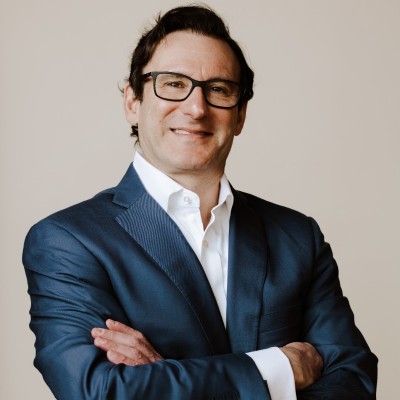
Businesses must understand how Auto-GPT technologies use data, the potential for biased results, and how to responsibly leverage these powerful technologies. Listen to my interview with Jason I. Epstein, Partner at Nelson Mullins Riley & Scarborough, as we explore this emerging field.