
Emerging Litigation Podcast
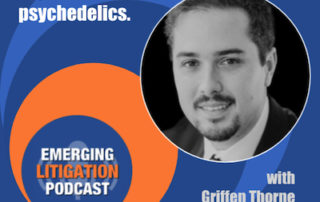
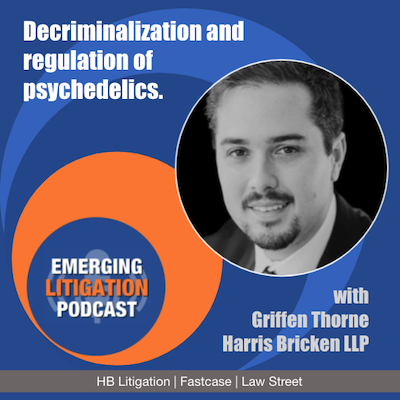
Psychedelics Decriminalization and Regulation with Griffen Thorne
Psychedelics Decriminalization and Regulation with Griffen Thorne Listen to my interview with Griffen Thorne, an attorney in the Los Angeles office of Harris Bricken LLP. He focuses on corporate, transactional, intellectual property, data security, regulatory, and litigation matters across a wide variety of domestic and international industries. As part of Harris Bricken’s corporate cannabis team, he works closely with cannabis and hemp clients, whom he advises on obtaining licenses and permits, regulatory compliance, entity formation and structuring, mergers and acquisitions, corporate governance issues, contract drafting and negotiation, obtaining and protecting intellectual property rights, and administrative appeals and litigation. He also represents clients throughout a wide range of industries regarding compliance with United States, European, and Asian Internet, technology, and data security laws and regulations. We hope you enjoy the interview. Tom Hagy Send questions or comments to Editor@LitigationConferences.com. What does the future hold for psychedelics in America? How are states approaching the ownership and use of these drugs, either for recreational or their controlled therapeutic use?

Employment Law in the COVID-19 Era with Stefani Schwartz
Employment Law in the COVID-19 Era with Stefani Schwartz Joining me to discuss this important subject is Stefani Schwartz, co-founder of the woman-owned employment-and-labor boutique Hatfield Schwartz in New Jersey. Stefani has devoted her legal career to representing employers in all aspects of employment law, including discrimination, harassment, retaliation, and wrongful termination matters. Stefani will be featured in the next issue of the Journal on Emerging Issues in Litigation, a collaborative project between HB and the Fastcase legal research family, which includes Full Court Press, Law Street Media, Docket Alarm and, most recently, Judicata. If you have comments or wish to participate in one our projects, or want to tell me how awesome Stefani is, drop me a note at Editor@LitigationConferences.com. We hope you enjoy the interview, and a guest appearance by Benny, her Portuguese Water Dog, you know, because she's working from home. Stefani also shares one retail customer's quick fix for forgetting her face mask. More of us are working from home and, given it often has advantages, it's an arrangement that is likely to continue for many of us. This raised the general question: Is your home officially "the office," with all the attendant rules and norms? What new risks do employers face? What new ways can employees find themselves in trouble? We're also getting vaccinated. But many are not. Can companies required employees to get the shot? Studies reveal that we're not all bearing the burden of remote working evenly. Who is carrying more of the load? Given these dramatic changes, should employers adjust their policies?
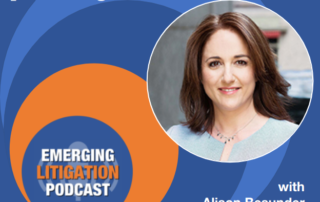
COVID-19 and the Courtroom with Alison Besunder
COVID-19 and the Courtroom with Alison Besunder Joining me is Alison Besunder on this timely and evolving subject. It’s based on her article — Crisis is the Mother of Change: How a Pandemic Sparked Progress in Courtroom Efficiency — which will be featured in the January 2021 issue of the Journal on Emerging Issues in Litigation. Alison brings extensive experience counseling clients on matters ranging from the simple to complex, helping them prevent future disputes through proactive planning and to resolve disputes that proceed to litigation. She is a frequent speaker on topics such as Estate Planning During Divorce, End of Life Decision Making, Cyber-Security for Lawyers, and Social Media and Ethics. She operated her own firm for several years and in 2019 joined Goetz Fitzpatrick LLP. The Journal is a collaborative project between HB and the Fastcase legal research family, which includes Full Court Press, Law Street Media, Docket Alarm and, most recently, Judicata. If you have comments or wish to participate in one our projects, or want to tell me how awesome Alison is, drop me a note at Editor@LitigationConferences.com. We hope you enjoy the interview. What efficiencies have been foisted upon our nation's courts as a result of the COVID-19 pandemic? What has worked and what has not? Are we going to see permanent implementation of things like webcam hearings and virtual trials?
A Shameless Plug for Our Content Services
Your content marketing is everything you’ve ever dreamed of. Right?
 Sara is marketing director at a boutique law firm. When we asked her how their blog was going, she made a sad face. But then, we made Sara smile.*
Critical Legal Content was founded by Tom Hagy, former Editor & Publisher of Mealey’s Litigation Reports and VP at LexisNexis, founder of HB, current litigation podcaster and editor-in-chief. CLC’s mission is to help smaller firms and service providers not only create content — blogs, articles, papers, webinars, podcasts (like the stuff on this site) — but also to get it out there. How? Via social media, this website, your website, and potential via our podcast and journal which we publish in collaboration with vLex Fastcase and Law Street Media. The goal is to attract readers and dizzy them with your brilliance.
*Inspired by actual events.
Create content like a real legal publisher.
Emerging Litigation Journal
 Can we rely on shareholders to compel corporations to meaningfully act on ESG issues? | By Rebecca Boon and John Rizio-Hamilton | Bernstein Litowitz Berger & Grossmann Gallery
Can we rely on shareholders to compel corporations to meaningfully act on ESG issues? | By Rebecca Boon and John Rizio-Hamilton | Bernstein Litowitz Berger & Grossmann

Can we rely on shareholders to compel corporations to meaningfully act on ESG issues? | By Rebecca Boon and John Rizio-Hamilton | Bernstein Litowitz Berger & Grossmann
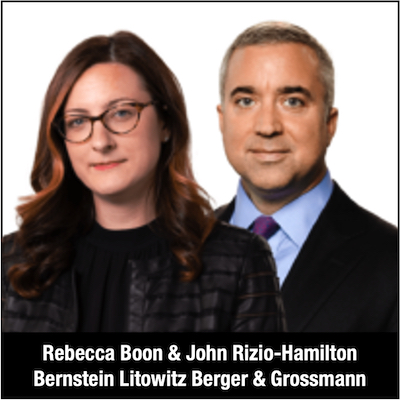
The Authors Rebecca Boon has been litigating securities fraud and shareholder rights actions for over a decade, recovering more than $1.5 billion for the firm’s institutional investor clients. Her work at the firm expands beyond litigation. Rebecca has advanced equality in the workplace by co-founding the Beyond #MeToo working group and leading landmark recoveries that have resulted in hundreds of millions of dollars back to investors and important social change among industries. Contact: rebecca.Boon@blbglaw.com John Rizio-Hamilton is one of America’s top shareholder litigators. He works on the most complex and high-stakes securities class action cases, and has recovered billions of dollars on behalf of institutional investor clients. John led the trial team that recovered $240 million for investors in In re Signet Jewelers Limited Securities Litigation, a precedent-setting case that marks the first successful resolution of a securities fraud class action based on allegations of sexual harassment. Contact: johnr@blbglaw.com Can we rely on shareholders to compel corporations to meaningfully act on ESG issues? By Rebecca Boon and John Rizio-Hamilton This article was first published in the Responsible Investor, Aug., 10th, 2021. Posted with permission of the authors. Copyright 2021 by Rebecca Boon & John Rizio-Hamilton. All rights reserved. There is an ongoing debate about the role that regulators should take regarding corporate obligations and accountability for ESG issues. Earlier this year, the Ontario Capital Markets Modernization Taskforce weighed in with its long-anticipated recommendation on diversity quotas for corporate boards. After receiving significant industry feedback, the Ontario Taskforce changed its initial recommendation from a requirement that public companies meet specific diversity targets, to allowing companies to set their own targets, report them, and develop a timeline for implementation. This ‘market-based’ framework for diversity would rely on investors to push corporations and hold them accountable. There was significant backlash when the Ontario Taskforce changed its initial recommendation. It was [...]

7th Circuit: Is Each Transmission of Biometric Data a BIPA Violation? | By Jennifer M. Oliver | MoginRubin LLP
7th Circuit: Is Each Transmission of Biometric Data a BIPA Violation? By Jennifer M. Oliver The outcome of this case will have a dramatic impact on statutory damages. The Seventh Circuit U.S. Court of Appeals has certified a question to the Illinois Supreme Court over the accrual of claims under the Illinois Biometric Information Privacy Act (BIPA). The question, posed by the court in Cothron v. White Castle Systems, Inc., reads: “Do section 15(b) and 15(d) claims accrue each time a private entity scans a person’s biometric identifier and each time a private entity transmits such a scan to a third party, respectively, or only upon the first scan and first transmission?” The case was brought by an employee of the White Castle hamburger chain, which requires fingerprint scans for employees to access computer systems. The plaintiff charged that sharing her fingerprints with a third party vendor violated the law. Cothron v. White Castle Sys., No. 20-3202, 2021 U.S. App. LEXIS 37593 (7th Cir. Dec. 20, 2021). An accrual rule based on each collection, opponents to such a finding argue, would pose potentially existential damages — especially in the class action context — since BIPA provides for statutory damages of $1,000 or $5,000 per violation. Parties disagree on whether BIPA damages are mandatory or discretionary, however. Should the court determine that the first scan is the only scan that starts the statute of limitations clock ticking, opponents to that interpretation say, anyone bringing a claim after five years would be out of luck, even if their private biometric data continued to be transmitted more than five years after the first occurrence. Preceding the federal court’s certification of this question by just five days, an Illinois appellate court ruled that, yes, claims under sections 15(a) and (b) accrue with each capture and use of a plaintiff’s biometric information. Watson v. Legacy [...]
- The New Lloyd’s Market Association War, Cyber War and Cyber Operation Exclusions for Cyber Insurance Policies | By Vincent J. Vitkowsky | Gfeller Laurie LLP Gallery
The New Lloyd’s Market Association War, Cyber War and Cyber Operation Exclusions for Cyber Insurance Policies | By Vincent J. Vitkowsky | Gfeller Laurie LLP



The New Lloyd’s Market Association War, Cyber War and Cyber Operation Exclusions for Cyber Insurance Policies | By Vincent J. Vitkowsky | Gfeller Laurie LLP
The Author Vince Vitkowsky is a partner in Gfeller Laurie LLP, resident in New York. He focuses on cyber risks, liabilities, insurance, and litigation. Vince assists insurers and reinsurers in product development, and in all aspects of coverage evaluation and dispute resolution in many lines of business, including cyber, CGL, property, and professional liability. He also assists in complex claim evaluations, and if necessary, the defense of insureds in complex matters. Vince is also a member of the Editorial Advisory Board for the Journal on Emerging Issues in Litigation. Contact: vvitkowsky@gllawgroup.com More from Vince and his colleagues. The New LMA War, Cyber War and Cyber Operation Exclusions for Cyber Insurance Policies By Vincent J. Vitkowsky On November 25, 2021, the Lloyd’s Market Association released four War, Cyber War and Cyber Operation Exclusions (“Exclusions”). The LMA Cyber Business Panel spent well over two years drafting the Exclusions, which are models for use in standalone cyber insurance policies. Lloyd’s has agreed that they meet the requirement that all insurance and reinsurance policies written at Lloyd’s must, except in very limited circumstances, contain a clause which excludes all losses caused by war. The Exclusions address some difficult issues troubling the cyber insurance market for several years, following cyberattacks by nation-states (“states”) and threat actors associated with them. They attempt to reduce uncertainty for both insurers and policyholders. Five interrelated issues. The treatment of collateral damage (borrowing a concept from the traditional Law of Armed Conflict). Some state-sponsored attacks had significant effects on many entities that were not the intended targets. How attribution is to be determined, and whether the insurers have an obligation to make payments while attribution is being determined. The extent to which attacks by non-state actors associated with a state are excluded. The treatment of state and state-sponsored cyberattacks directed at essential services, most [...]
HB Webinars on CeriFi LegalEdge
Content Partners