DARN! Nothing here. Apologies.
Emerging Litigation Podcast

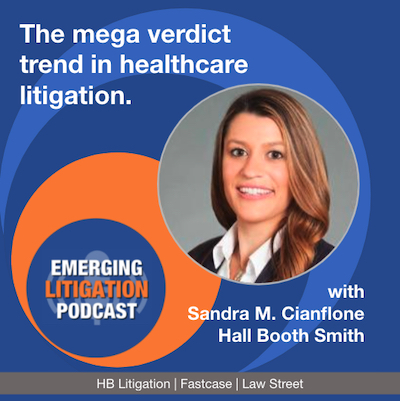
The Mega Verdict Trend in Healthcare Litigation with Sandra Cianflone
The Mega Verdict Trend in Healthcare Litigation with Sandra Cianflone Joining me to discuss this high-stakes litigation is Sandra M. Cianflone of Hall Booth Smith, P.C. Sandie counsels and defends hospitals, physicians, nurses and institutional employees in a broad spectrum of catastrophic injury and medical malpractice cases. She received her Juris Doctorate from Pace University School of Law and her undergraduate degree from Fairleigh Dickinson University. This podcast is the audio companion to the Journal on Emerging Issues in Litigation, a collaborative project between HB Litigation Conferences and the Fastcase legal research family, which includes Full Court Press, Law Street Media, Docket Alarm and, most recently, Judicata. If you have comments or wish to participate in one our projects, or want to tell me how insightful and informative Sandie is, please drop me a note at Editor@LitigationConferences.com. This podcast is based on an article she wrote for the forthcoming issues of the Journal. Note that in my introduction I have created the phrase "badly wrong," which is, itself, badly wrong. Listen to the bitter end when Sandie and I discuss working from home, and how we really feel about family and co-workers. Feel free to scold me at the email address provided. I hope you enjoy the interview and this professional's practical insights into defending healthcare providers. Tom Hagy Damage awards against physicians, hospitals, and other healthcare providers have been coming in bigger and bigger, with juries awarding more than $20 million in a string of cases that should send chills down the spines of defendants and counsel. What are the factors behind this trend? Besides the severe (or even alarming) nature of the harm alleged, what is fueling these mega verdicts? What can defense attorneys do, knowing they are facing a well-organized, well-funded plaintiffs bar? For that matter, what can defense attorneys learn from their opponents? What strategies can defense employ early in [...]
Data Security for Small Law Firms with Ondrej Krehel and Gaspare Marturano
Data Security for Small Law Firms with Ondrej Krehel and Gaspare Marturano Joining me to discuss this important issue is Ondrej Krehel, CEO & Founder of LIFARS, a New York-based incident response and digital forensics firm specializing in cybersecurity protection. Ondrej is recognized for his digital forensic expertise and ethical hacking skills. He participates in high-profile engagements around the world using his proprietary methodology to achieve the most rapid root-cause analysis and remediation. He is a former lecturer at FBI Training Academy who has led forensic investigations and cybersecurity involving the U.S. government, including military cyber special operations. He holds a Ph.D. in Computer Forensics from Police Academy in Bratislava, Slovakia, an M.S. degree in Mathematical Physics from Comenius University in Bratislava, and an Engineering Diploma from Technical University in Zvolen, Slovakia. Joining Ondrej and me is Gaspare J. Marturano, Chief Marketing Officer at LIFARS. Gaspare is a former Director of Information Systems for a large Connecticut law firm and has consulted on these issues with a number of other law firms. This podcast is the audio companion to the Journal on Emerging Issues in Litigation, a collaborative project between HB Litigation Conferences and the Fastcase legal research family, which includes Full Court Press, Law Street Media, and Docket Alarm. If you have comments or wish to participate in one our projects, or want to tell me how insightful and informative Ondrej and Gaspare are, please drop me a note at Editor@LitigationConferences.com. I particularly enjoyed hearing about what one kid was doing at 17, an age when I was certain I would be sought out for my rock drumming artistry. Of course, that kid was operating a criminal enterprise. I was just trying to impress girls. Tom Hagy Law firms are sweet targets for hackers given the rich data they store, from intellectual property to confidential merger details to personal and health [...]
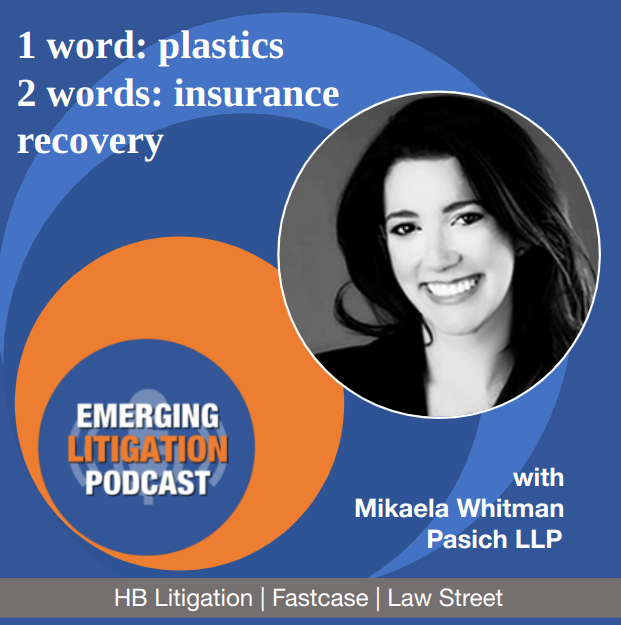
Plastics-Related Liabilities and Insurance Recovery with Mikaela Whitman
Plastics-Related Liabilities and Insurance Recovery with Mikaela Whitman Joining me to discuss this important civil statute is Mikaela Whitman for what was an informative and insightful podcast on this potentially enormous area of litigation. It’s based on her article — One Word: Plastics. Two Words: Pollution Exclusion. Why CGL Policies Should Cover Plastics-Related Liabilities — which will be featured in the inaugural issue of the Journal on Emerging Issues in Litigation in January 2021. Mikaela (mwhitman@pasichllp.com) is a partner in Pasich LLP’s New York office and a member of the firm’s insurance recovery practice. Her practice focuses on the representation of insureds in all phases of insurance coverage recovery, from pre-suit negotiations through alternative dispute resolution and litigation. The Journal and Podcast are part of a collaborative project between HB and the Fastcase legal research family, which includes Full Court Press, Law Street Media, Docket Alarm and, most recently, Judicata. If you have comments or wish to participate in one our projects, or want to tell me how awesome Mikaela is, drop me a note at Editor@LitigationConferences.com. We hope you enjoy the interview. As we see liability actions relating to plastics creeping into the nation's dockets, what types of claims will survive? How much more of this might we see? And if it really hits the fan, how will insurance companies respond? Will policyholders find protection in their comprehensive general liability policies? Their directors and officers policies? Other policies?
A Shameless Plug for Our Content Services
Your content marketing is everything you’ve ever dreamed of. Right?
 Sara is marketing director at a boutique law firm. When we asked her how their blog was going, she made a sad face. But then, we made Sara smile.*
Critical Legal Content was founded by Tom Hagy, former Editor & Publisher of Mealey’s Litigation Reports and VP at LexisNexis, founder of HB, current litigation podcaster and editor-in-chief. CLC’s mission is to help smaller firms and service providers not only create content — blogs, articles, papers, webinars, podcasts (like the stuff on this site) — but also to get it out there. How? Via social media, this website, your website, and potential via our podcast and journal which we publish in collaboration with vLex Fastcase and Law Street Media. The goal is to attract readers and dizzy them with your brilliance.
*Inspired by actual events.
Create content like a real legal publisher.
Emerging Litigation Journal

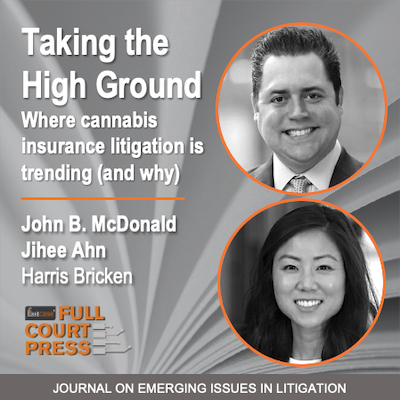
Taking the High Ground: Where Cannabis Insurance Litigation Is Trending (and Why)
The Authors John B. McDonald is an experienced litigator practicing in the Seattle and New York offices of Harris Bricken, where he represents clients in complex commercial, insurance, and partnership matters. Jihee Ahn is an experienced complex commercial litigator with Harris Bricken. She also chairs the firm’s Dispute Resolution/Litigation practice. Interviews with leading attorneys and other subject matter experts on new twists in the law and how the law is responding to new twists in the world. Taking the High Ground: Where Cannabis Insurance Litigation Is Trending (and Why) "Absent a choice of law provision, the location where most of the insured activity took place will likely dictate which law applies. But how have federal courts reacted to applying cannabis-friendly state law in a forum where federal law arguably addresses underlying state concerns? The answer is: inconsistently." Abstract: The use and possession of cannabis remains illegal under the federal Controlled Substances Act. But a patchwork of state laws is bringing the country closer to some form of legalization. Some states allow its use for medical purposes, others have made it legal for recreational purposes, and others have decriminalized it. But when cannabis is involved in disputes that lead to litigation, and that litigation leads to policyholder–insurer disputes, that state law patchwork and the illegality of cannabis under federal law is when things get complicated. This tension plays out in several other aspects of running a cannabis business, such as banking and interstate transportation of goods. In this article, the authors discuss how it is up to litigators to frame their cases in ways that will determine the outcome of important disputes over insurance coverage. Introduction: Like several other litigation issues presented by the (legal) emerging cannabis market in the United States, insurance disputes between cannabis policyholders and their insurers remain [...]


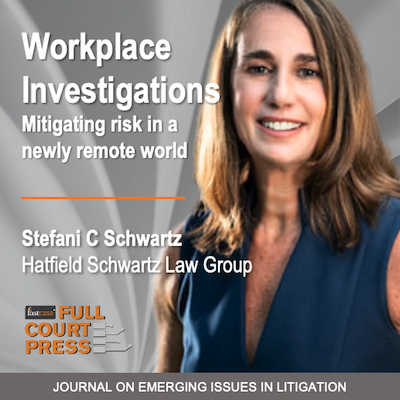
Workplace Investigations: Proactive Assessments Mitigate the Risk of Costly Litigation in a Newly Remote Environment
The Author Stefani C Schwartz is Senior Managing Partner at the Hatfield Schwartz Law Group LLC. She has devoted her career to representing and advising employers in the complete spectrum of employment law, including discrimination, harassment, retaliation, and wrongful termination. Stefani is a member of the Editorial Advisory Board of the Journal of Emerging Issues in Litigation. Interviews with leading attorneys and other subject matter experts on new twists in the law and how the law is responding to new twists in the world. Workplace Investigations: Proactive Assessments Mitigate the Risk of Costly Litigation in a Newly Remote Environment "Investigations are a straightforward, efficient, and effective way to combat the risk of litigation because they reflect the best aspects of the employer–employee relationship: understanding, respect, communication, and shared goals." Abstract: “Bullying, discrimination, sexual harassment and other forms of workplace misconduct can create a crisis for any company—and trying to ignore or cover it up will make a bad situation worse.” That’s the warning from a December 2021 article for Forbes, which goes on to say that in addition the damage to an employer’s reputation, a study by workplace misconduct reporting service Vault Platform found that workplace misconduct cost U.S. businesses more than $20 billion in 2021. In this article, the author discusses how proactively conducting workplace investigations can reduce an employer’s risk of winding up in court and paying the considerable tangible and intangible costs of misconduct, a risk further complicated by an increasingly home-based workforce. Excerpt: During the past two years, the COVID-19 pandemic has introduced new factors in the ever-shifting area of employer liability: large-scale layoffs and furloughs, the introduction and/or expansion of possibilities for remote work, the drive for a safe return to the physical workplace, and the dual needs for vaccination and accommodation of religious objectors [...]
 Analysis of Target Decision that Loss-of-Use Damages Included Card Replacement Costs Post-Data Breach | By Joshua Mooney, Judy Selby, and Tracey Kline | Kennedys Law Gallery
Analysis of Target Decision that Loss-of-Use Damages Included Card Replacement Costs Post-Data Breach | By Joshua Mooney, Judy Selby, and Tracey Kline | Kennedys Law

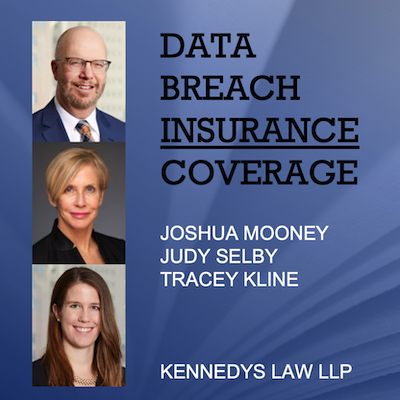
Analysis of Target Decision that Loss-of-Use Damages Included Card Replacement Costs Post-Data Breach | By Joshua Mooney, Judy Selby, and Tracey Kline | Kennedys Law
A Significant Deviation: Target v. Ace Finds Loss-of-Use Damages Included Post-Breach Card Replacement Analysis On March 22, 2022, the United States District Court for the District of Minnesota ruled that two ACE insurers were obligated to indemnify Target Corporation (“Target”) for the amounts it paid to settle claims related to replacement of payment cards impacted in a data breach, vacating an earlier decision in which the court found that Target was not entitled to coverage. Target Corp. v. ACE Am. Ins. Co., No. 19-CV-2916 (WMW/DTS), 2022 WL 848095 (D. Minn. Mar. 22, 2022), vacating 517 F. Supp. 3d 798 (D. Minn. 2021). The new decision deviates from how other courts have evaluated general liability coverage for damages because of “loss of use of tangible property that is not physically injured.” Insurers would do well to take notice. Background In 2013, Target was the victim of a massive data breach that occurred after hackers installed malicious software on its computer network, which enabled them to steal the payment card data and personal contact information of an estimated 110 million individuals with Target payment cards (the “Data Breach”). Multiple lawsuits were brought against Target, including suits by financial institutions (the “Issuing Banks”) that had issued debit and credit cards (the “Payment Cards”) affected by the Data Breach. The Issuing Banks filed class action lawsuits against Target, which were consolidated, along with various consumer suits, in the United States District Court for the District of Minnesota, in In re: Target Corporation Customer Data Security Breach Litigation, All Financial Institutions Cases, MDL No. 14-2522 (the “Issuing Banks Litigation”). In their Consolidated Class Action Complaint, the Issuing Banks asserted various causes of action against Target, including a claim for negligence by which they alleged that Target breached its duty to implement adequate technical systems or security practices that could have prevented the loss of customers’ sensitive personal and financial [...]
HB Webinars on CeriFi LegalEdge
Content Partners