Emerging Litigation Podcast

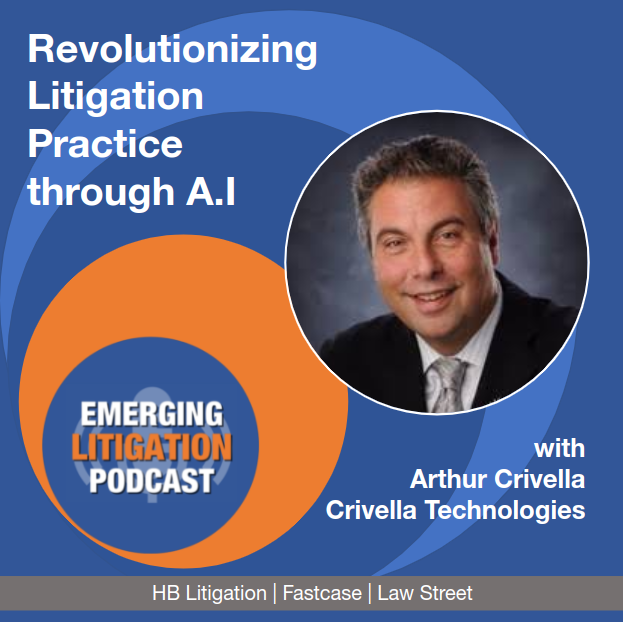
How Artificial Intelligence is Changing Litigation and Even Preventing it with Arthur Crivella
How Artificial Intelligence is Changing Litigation and Even Preventing it with Arthur Crivella Artificial intelligence has the capability to truly revolutionize how litigators work, and also how companies can avoid litigation in the first place. It can not only do the work of hundreds of people in mere seconds but can be used to predict liabilities before they become liabilities, and outcomes when disputes arise. Joining me to discuss the incredible present-day applications of AI in law and business, as well as the potential to do much more if humans will let it, is Arthur Crivella of Crivella Technologies Limited. For decades Art has been a leader in developing and applying advanced software engineering, systems engineering and AI methodologies, and holds numerous foundation patents in the field. Art has helped create nationally recognized engineering achievements in weaponry as well as in the metals, rubber and food industries. He was principal design engineer in developing advanced weapons direction systems and wrap-around simulation systems for naval guided missiles. Crivella Tech supports corporations in managing risk and law firms in assessing liabilities. The company also supports law firms in class action and mass tort litigation. This podcast is the audio companion to the Journal on Emerging Issues in Litigation, a collaborative project between HB Litigation Conferences and the Fastcase legal research family, which includes Full Court Press, Law Street Media, Docket Alarm and, most recently, Judicata. If you have comments or wish to participate in one our projects, or want to tell me how insightful and informative Art is, please drop me a note at Editor@LitigationConferences.com. I hope you enjoy the interview, particularly my observation that you cannot hurt a robot's feelings. --Tom Hagy

The Age of Social Disparagement with Charlie Kingdollar
The Age of Social Disparagement with Charlie Kingdollar It was my pleasure to interview Charlie Kingdollar for our first episode of the Emerging Litigation Podcast. Charlie spent more than four decades with General Reinsurance, three-quarters of which as the company’s Emerging Issues Officer. One colleague described him as “one of the most prescient and gifted industry futurists I have met in my 36 year professional career within the insurance industry. Entertaining and insightful, his ability to digest and communicate complex issues, many before they are readily apparent, is both a gift and a talent.” This interview is based on his article on social disparagement coming out in the inaugural issue of the Journal on Emerging Issues in Litigation in January 2021. The Journal is a collaborative project between HB and Fastcase. If you have comments or wish to participate in one our projects, or want to tell me how awesome Charlie is, drop me a note at Editor@LitigationConferences.com. We hope you enjoy the interview. Are the risks posed by social media — which has added jet fuel to one person’s ability to smear another — adequately addressed by the insurance market?
Offshore Wind Power Initiatives with Jack Smith
Offshore Wind Power Initiatives with Jack Smith Joining me to discuss this important subject is Jack Smith, a partner with Nelson Mullins in Charleston, South Carolina. Jack's practice includes hazardous waste site management and remediation, contaminated property liability negotiation, litigation, redevelopment and related regulatory counseling. He has also worked for several state and federal government environmental agencies. Jack earned his JD from the University of South Carolina School of Law and a BS in Psychology, also from the University of South Carolina. This podcast is the audio companion to the Journal on Emerging Issues in Litigation, a collaborative project between HB Litigation Conferences and the Fastcase legal research family, which includes Full Court Press, Law Street Media, Docket Alarm and, most recently, Judicata. If you have comments or wish to participate in one our projects, or want to tell me how insightful and informative Jack is, please drop me a note at Editor@LitigationConferences.com. This interview is based in part on an article Jack is writing for the Journal. I hope you enjoy the interview, and especially my solution for preventing birds from flying into windmills. I'm going to be rich. --Tom Hagy President Biden has called for the doubling of offshore wind energy capacity by 2030. To say the process for getting such projects up and running is complex is an understatement. There will be plenty of obstacles to the administration's lofty goal. Where will these impediments to development arise? What role will states play? How will NGOs react to this ambitious ramp-up?
A Shameless Plug for Our Content Services
Your content marketing is everything you’ve ever dreamed of. Right?
 Sara is marketing director at a boutique law firm. When we asked her how their blog was going, she made a sad face. But then, we made Sara smile.*
Critical Legal Content was founded by Tom Hagy, former Editor & Publisher of Mealey’s Litigation Reports and VP at LexisNexis, founder of HB, current litigation podcaster and editor-in-chief. CLC’s mission is to help smaller firms and service providers not only create content — blogs, articles, papers, webinars, podcasts (like the stuff on this site) — but also to get it out there. How? Via social media, this website, your website, and potential via our podcast and journal which we publish in collaboration with vLex Fastcase and Law Street Media. The goal is to attract readers and dizzy them with your brilliance.
*Inspired by actual events.
Create content like a real legal publisher.
Emerging Litigation Journal

The Shifting Gun Liability Landscape: Plaintiffs Say Companies are Marketing Illegally, Insurers End Up Paying
The Author Charlie spent more than four decades with General Reinsurance, three-quarters of which as the company’s Emerging Issues Officer. One colleague described him as “one of the most prescient and gifted industry futurists I have met in my 36 year professional career within the insurance industry. Entertaining and insightful, his ability to digest and communicate complex issues, many before they are readily apparent, is both a gift and a talent.” Charlie is also a member of the Editorial Board of Advisors for the Journal on Emerging Issues in Litigation. The Shifting Gun Liability Landscape: Plaintiffs Say Companies are Marketing Illegally, Insurers End Up Paying By Charlie Kingdollar On Feb. 15, 2022, Remington Arms, manufacturer of the Bushmaster AR15-style rifle agreed to pay $73 million to settle a lawsuit filed by the families of nine of the victims of the Dec. 14, 2012, Sandy Hook Elementary School shooting. The $73 million will be paid by four of Remington’s insurers (and likely their reinsurers).[i] Why is this a big deal? Insurers and reinsurers providing liability coverage for gun manufacturers did so believing that federal law protected gun manufacturers from liability arising from shootings under the federal Protection of Lawful Commerce in Arms Act (PLCAA). It seems likely that policy terms and conditions as well as pricing of the risk reflected that perceived liability protection. Things have changed. The Connecticut plaintiffs filed their suit under the Connecticut Fair Trade Practices Act. The plaintiffs alleged that the Bushmaster was a combat weapon and that Remington improperly marketed it to civilians – particularly trying to reach young men. In 2019, the Connecticut Supreme Court ruled that the federal PLCAA did have some carve-outs for state laws and subsequently declined Remington’s request to dismiss the lawsuit. It seems a safe bet that the families of other Connecticut gun violence victims [...]
Going Viral or Going Nuclear: Social Inflation’s Impact on Jury Verdicts …
The Authors All three authors are with the law firm of Hall Booth Smith, P.C., and concentrate on various aspects of healthcare defense. Lindsay A. Nishan (lnishan@hallboothsmith.com) is an Associate in the HBS Charleston office. Samantha Bowen Myers (smyers@hallboothsmith.com) is an Associate in their West Palm Beach, Florida, office. Sandra Mekita Cianflone (scianflone@hallboothsmith.com) is a Partner in the firm’s Atlanta office. She is also a member of the Editorial Board of Advisors for the Journal on Emerging Issues in Litigation, and a frequent contributor to the Emerging Litigation Podcast. Going Viral or Going Nuclear: Social Inflation’s Impact on Jury Verdicts and How to Safeguard Against It By Lindsay A. Nishan, Samantha B. Myers and Sandra M. Cianflone A juror’s perception of companies and healthcare providers is increasingly colored by TV and social media. The same is true for their understanding of the practice law or medicine, which may be as wrong as it is immovable. “Social inflation” refers to rising litigation costs and the resulting higher insurance payouts which drive up the cost of insurance. In this article the authors, each of whom represents parties in the healthcare industry, discuss the evolving social trends that lead jurors to render “nuclear verdicts,” and what attorneys should consider in mitigating the effects of this phenomenon. Social media feeds today are crammed with flashy advertisements from lawyers promising big-dollar settlements against “rich insurance companies.” The number of these commercials has spiked since the 1970s as the phenomenon known as "social inflation" has taken root in the legal system. Social inflation is a term of art that refers to rising litigation costs, the impact those costs have on insurance claim payouts, and how much the average policyholder is expected to pay for basic coverage. Recently, the term social inflation has taken on a new meaning as it has [...]
 Can we rely on shareholders to compel corporations to meaningfully act on ESG issues? | By Rebecca Boon and John Rizio-Hamilton | Bernstein Litowitz Berger & Grossmann Gallery
Can we rely on shareholders to compel corporations to meaningfully act on ESG issues? | By Rebecca Boon and John Rizio-Hamilton | Bernstein Litowitz Berger & Grossmann


Can we rely on shareholders to compel corporations to meaningfully act on ESG issues? | By Rebecca Boon and John Rizio-Hamilton | Bernstein Litowitz Berger & Grossmann
The Authors Rebecca Boon has been litigating securities fraud and shareholder rights actions for over a decade, recovering more than $1.5 billion for the firm’s institutional investor clients. Her work at the firm expands beyond litigation. Rebecca has advanced equality in the workplace by co-founding the Beyond #MeToo working group and leading landmark recoveries that have resulted in hundreds of millions of dollars back to investors and important social change among industries. Contact: rebecca.Boon@blbglaw.com John Rizio-Hamilton is one of America’s top shareholder litigators. He works on the most complex and high-stakes securities class action cases, and has recovered billions of dollars on behalf of institutional investor clients. John led the trial team that recovered $240 million for investors in In re Signet Jewelers Limited Securities Litigation, a precedent-setting case that marks the first successful resolution of a securities fraud class action based on allegations of sexual harassment. Contact: johnr@blbglaw.com Can we rely on shareholders to compel corporations to meaningfully act on ESG issues? By Rebecca Boon and John Rizio-Hamilton This article was first published in the Responsible Investor, Aug., 10th, 2021. Posted with permission of the authors. Copyright 2021 by Rebecca Boon & John Rizio-Hamilton. All rights reserved. There is an ongoing debate about the role that regulators should take regarding corporate obligations and accountability for ESG issues. Earlier this year, the Ontario Capital Markets Modernization Taskforce weighed in with its long-anticipated recommendation on diversity quotas for corporate boards. After receiving significant industry feedback, the Ontario Taskforce changed its initial recommendation from a requirement that public companies meet specific diversity targets, to allowing companies to set their own targets, report them, and develop a timeline for implementation. This ‘market-based’ framework for diversity would rely on investors to push corporations and hold them accountable. There was significant backlash when the Ontario Taskforce changed its initial recommendation. It was [...]
HB Webinars on CeriFi LegalEdge
Content Partners