DARN! Nothing here. Apologies.
Emerging Litigation Podcast

High-Asset Divorce Litigation with Robert D. Boyd and Kimberli C. Withrow
High-Asset Divorce Litigation Let's assume this is good news. The divorce rate appears to be coming down. Either people are more committed to these unions or have succumbed to lifetimes of misery. But the common belief -- that "50% of all marriages end in divorce" -- doesn't enjoy statistical support. Six percent of people who divorce get back together, so that's something, too. According to Monster.com, the rate is higher among people working in fading industries, like certain machine operators. Despite frequent coverage of Hollywood breakups, they don't mention entertainers, other than dancers and choreographers, who don't fare well in marriage. Lawyers, in general, do not have a particularly high divorce rate. For insights into high-asset divorces, listen to my interview with Robert D. Boyd and Kimberli C. Withrow of Boyd Collar Nolen Tuggle & Roddenbery. Bob Boyd is a widely recognized leader in the practice of high-net-worth divorce litigation and contested custody cases. He is a former prosecutor and a U.S. Army Ranger and Paratrooper. Education: J.D., West Virginia University (Editor-in-Chief, West Virginia Law Review); B.A., United States Military Academy at West Point. Kimberli Withrow has 16 years’ experience representing clients in family law matters. She has served as trial counsel and hearings involving divorce, child custody, and child support matters. Education: J.D., Emory University School of Law; B.A., Duke University.Speaking of which, this podcast is the audio companion to the Journal on Emerging Issues in Litigation. The Journal is a collaborative project produced by HB Litigation Conferences and the Fastcase legal research family, which includes Full Court Press, Law Street Media, and Docket Alarm. The podcast itself is a joint effort between HB and our friends at Law Street Media. If you have comments or wish to participate in one our projects, or want to tell me how much you learned today – or if you’d like a copy of John’s and [...]
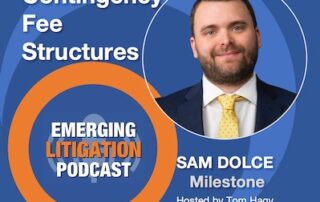
Attorney Fees and Settlement Funds with Sam Dolce
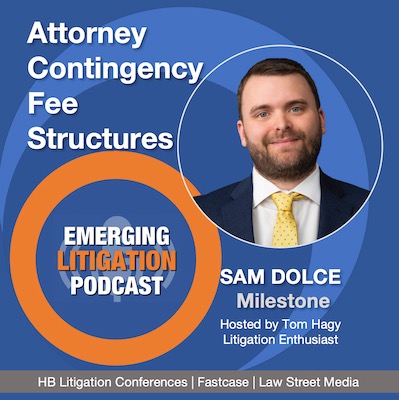
Our Guest As an attorney at Milestone, Sam Dolce provides in-depth, comprehensive consultations with attorneys about qualified settlement funds, fee deferral, and settlement planning. He also oversees the establishment of QSFs. Sam received a Bachelor of Arts in History from Macalester College, followed by a Juris Doctor from SUNY Buffalo Law School. He served as a participant in the New York State Pro Bono Scholar Program and has received multiple acknowledgements and awards for his dedication to pro bono service and social justice. As a subject matter expert, Sam is a regular speaker and presenter at academic and legal conferences regarding post-settlement strategies. Attorney Fees and Settlement Funds with Sam Dolce Uncle Sam has created a way for you keep more of your hard-won settlement or award, but there is much to consider and new information to weigh. When a contingency fee case reaches a verdict or settlement, it’s a big day for a plaintiff attorney. You have worked hard and shouldered litigation costs -- often for years without compensation -- to achieve the best outcome for your client. In this episode I get to speak with a financial management professional who specializes in advising trial attorneys how they can take full advantage of attorney fee structures. The concept of fee deferral arrangements may be familiar to you, but the landscape continues to evolve. My guest is Sam Dolce, an attorney with Milestone, a financial firm that optimizes settlement funds for trial attorneys and plaintiffs. Sam consults with legal professionals about about Qualified Settlement Funds, fee deferrals, and settlement planning. Sam received his B.A. from Macalester College and his J.D. from SUNY Buffalo Law School. Thanks to Sam for sharing his insights. On a previous episode you can hear Sam's colleague, Erin Waas, who heads up the Milestone Foundation, a non-profit organization that provides [...]
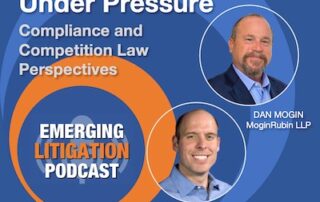
Under Pressure: How’s the Integrity of Your Supply Chain? — with Dan Mogin and Travis Miller
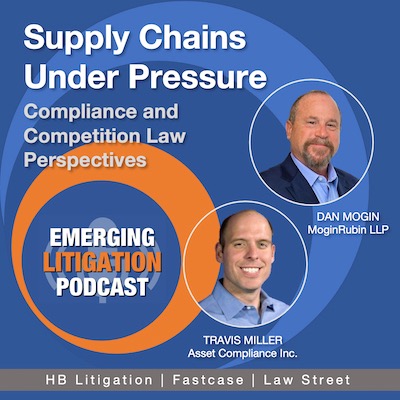
Our Guests Travis is an international trade and compliance attorney who specializes in ITAR/EAR/sanctions, global anti-corruption and anti-slavery, codes of conduct, environmental health and safety, product stewardship, and corporate social responsibility. Travis manages Assent’s worldwide legal activities, advises the Board of Directors on legal matters, and oversees corporate compliance, governance initiatives, and other commercial transactions. Before coming to Assent, he served in various high-level counsel positions with companies such as Microchip Technology, Foresite Group, and St. Jude Medical. Dan Mogin is co-founding and managing partner of MoginRubin LLP, a leading boutique law firm that focuses on antitrust law and other complex business disputes. A true thought leader in the field, Dan has served as lead counsel in numerous large antitrust cases, chaired the Antitrust Section of the California Bar, taught antitrust law, and was editor-in-chief of a leading competition law treatise. Under Pressure: How's the Integrity of Your Supply Chain? -- with Dan Mogin and Travis Miller Pressure builds when budgets are cut and fewer resources are available to maintain the necessary vigilance to remain compliant with often complex and changing regulations. Corporate risk can be caused by laxity, inattention, misconduct, unethical behavior, or even illegal activities by people and organizations in your supply chain. Often these things are what happen when people are under pressure. They may feel pressure to bend rules to hit sales targets, or they feel significant competitive pressure. Listen to my interview in two acts with Travis Miller, General Counsel at Assent Compliance Inc. and Dan Mogin is co-founding and managing partner of MoginRubin LLP, a leading boutique law firm that focuses on antitrust law and other complex business disputes. In Act 1 we discuss the conduct of a fictitious airline that is marketing itself as a green company and its competitors are crying foul, and by [...]
A Shameless Plug for Our Content Services
Your content marketing is everything you’ve ever dreamed of. Right?
 Sara is marketing director at a boutique law firm. When we asked her how their blog was going, she made a sad face. But then, we made Sara smile.*
Critical Legal Content was founded by Tom Hagy, former Editor & Publisher of Mealey’s Litigation Reports and VP at LexisNexis, founder of HB, current litigation podcaster and editor-in-chief. CLC’s mission is to help smaller firms and service providers not only create content — blogs, articles, papers, webinars, podcasts (like the stuff on this site) — but also to get it out there. How? Via social media, this website, your website, and potential via our podcast and journal which we publish in collaboration with vLex Fastcase and Law Street Media. The goal is to attract readers and dizzy them with your brilliance.
*Inspired by actual events.
Create content like a real legal publisher.
Emerging Litigation Journal
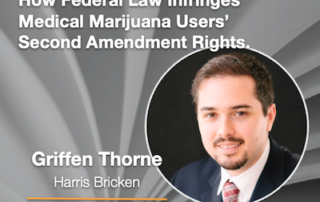
Unarmed or Unwell: How Federal Law Infringes Medical Marijuana Users’ Second Amendment Rights
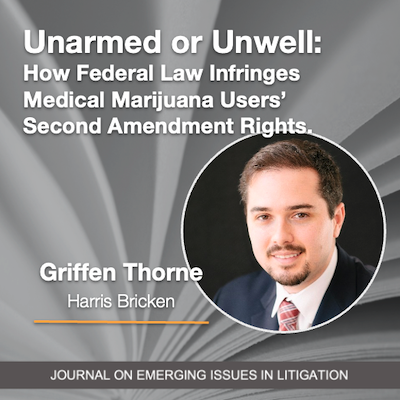
The Author Griffen Thorne (griffen@harrisbricken.com) is an attorney in the Los Angeles office of Harris Bricken Sliwoski LLP, an international emerging markets law firm. He represents clients in highly regulated emerging industries, such as cannabis, in corporate and commercial transactions. Interviews with leading attorneys and other subject matter experts on new twists in the law and how the law is responding to new twists in the world. Unarmed or Unwell: How Federal Law Infringes Medical Marijuana Users’ Second Amendment Rights As Justice Amy Coney Barrett noted while on the Seventh Circuit, “legislatures have the power to prohibit dangerous people from possessing guns. But that power extends only to people who are dangerous.” In the coming years, the government’s ability to write off all medical marijuana users as dangerous is likely to be curtailed, even if the Controlled Substances Act continues to make marijuana use a federal crime. Abstract: In the wake of the 2022 U.S. Supreme Court case New York State Rifle & Pistol Association, Inc. v. Bruen, federal courts have reached opposite outcomes on whether federal prohibitions on marijuana users’ rights to own or possess firearms are constitutional. As a result, there is a high likelihood of a circuit split that results in the overturning of those federal laws. The author discusses Bruen and several other cases at the intersection of drug laws and gun laws. Download the article now!


Digital Health Care Companies, Beware: Federal Agencies Are Tracking Your Use of Online Tracking Technologies
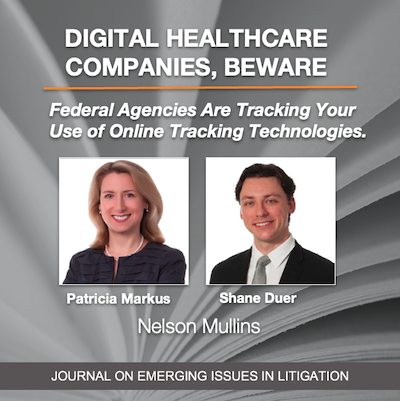
The Authors Patricia A. Markus (trish.markus@nelsonmullins.com) represents health care providers and health technology companies across the country on wide-ranging regulatory compliance, reimbursement, licensure, and operational matters, with a special focus on issues surrounding health information privacy, security, and technology. Shane Duer (shane.duer@nelsonmullins.com) focuses his practice on healthcare regulatory and corporate matters, with an emphasis on data privacy, cyber security, and information management concerns within and beyond the health care industry. Interviews with leading attorneys and other subject matter experts on new twists in the law and how the law is responding to new twists in the world. Digital Health Care Companies, Beware Federal Agencies Are Tracking Your Use of Online Tracking Technologies. Abstract: Health care industry stakeholders have regularly used online tracking technologies to help improve patient experience. However, growing scrutiny by the Office for Civil Rights, which enforces the Health Insurance Portability and Accountability Act of 1996 (HIPAA), requires covered entities and business associates to proceed cautiously in their use of such technologies. In addition, recent enforcement actions by the Federal Trade Commission make clear that a wide range of digital health companies, whether or not regulated by HIPAA, must tread carefully when collecting and disclosing personal information related to health, especially where consumers’ location data is to be used for a company’s advertising purposes, as they may be held accountable for failing to maintain the privacy and security of individuals’ protected and individually identifiable health information. The increasing number of lawsuits and news articles regarding use of these technologies demonstrates that third-party technology tracking vendors who receive PHI often are not operating under Business Associate Agreements (BAAs). The vendors in most instances disavow any need to collect PHI and accordingly instruct users to avoid sending PHI or other personally identifiable information. Under HIPAA, covered entities and business associates generally may [...]
 Government Involvement in Personal Medical Care Decisions During Outbreaks of Disease: How Far Is Too Far? by Bryce McColskey and Sandra M. Cianflone Gallery
Government Involvement in Personal Medical Care Decisions During Outbreaks of Disease: How Far Is Too Far? by Bryce McColskey and Sandra M. Cianflone
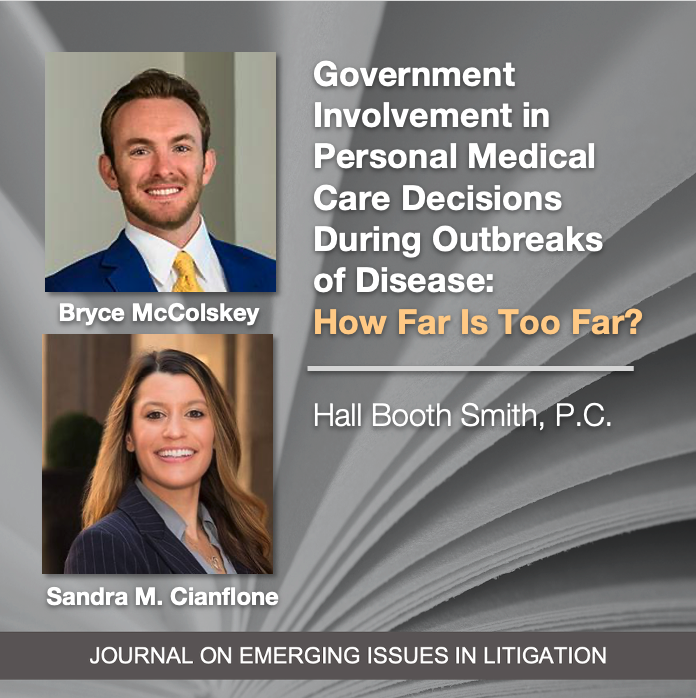
Government Involvement in Personal Medical Care Decisions During Outbreaks of Disease: How Far Is Too Far? by Bryce McColskey and Sandra M. Cianflone
The Authors Bryce McColskey (bmccolskey@hallboothsmith.com) is an attorney with Hall Booth Smith, P.C., based in Jacksonville, Florida, where he focuses on medical malpractice and professional liability law. Sandra M. Cianflone (scianflone@hallboothsmith.com) is a partner in the Atlanta office of Hall Booth Smith, where she concentrates on a variety of aspects of healthcare defense and chairs the firm’s Coronavirus Task Force. She is also a member of the Editorial Board of Advisors of the Journal of Emerging Issues in Litigation. Interviews with leading attorneys and other subject matter experts on new twists in the law and how the law is responding to new twists in the world. Government Involvement in Personal Medical Care Decisions During Outbreaks of Disease: How Far Is Too Far? "Breakthroughs in technologies, our knowledge of diseases and mutations, and advances in treatment options have been remarkable and have drastically reduced fatality rates from disease outbreaks. However, regardless of medical achievements, rapid changes in any field open the door to renewed debates over different laws and individual rights." Abstract: The coronavirus pandemic is the latest health issue to raise the question of government’s involvement (or interference) with an individual’s control over their own healthcare and medical treatment. In this article, the authors, two health care and professional liability attorneys, discuss the intersection of law and medicine with a review of medical mandates, the impact of advances in science and medicine, and where role of government to protect public health intersects (or collides) with personal healthcare choices. Their focus is on governmental response to the coronavirus pandemic, and not the recent landmark case dealing with choice. But add to the equation the Supreme Court’s ruling on abortion in Dobbs v. Jackson Women’s Health, the “government as healthcare decision maker” is an issue that will be on the front burner for courts, [...]
HB Webinars on CeriFi LegalEdge
Content Partners