Emerging Litigation Podcast

Insurance Coverage for PFAS Claims
PFAS Insurance Coverage with Robert D. Chesler of Anderson Kill Listen to my interview with Anderson Kill's Robert D. Chesler, a preeminent expert on insurance coverage law especially in the context of highly complex long-tail claims scenarios involving multiple parties and events that can span decades and always cost many millions of dollars. Considered by many to be an insurance guru on these cases -- as well as on D&O, cyber and privacy, and intellectual property insurance -- Bob holds a Ph.D. and masters degree from Princeton University, and a J.D. (cum laude) from Harvard Law School. This podcast is the audio companion to the Journal on Emerging Issues in Litigation, and Bob is one of our most valued editorial advisors. The Journal is a collaborative project between HB Litigation Conferences and the Fastcase legal research family, which includes Full Court Press, Law Street Media, and Docket Alarm. The podcast itself is a joint effort between HB and our friends at Law Street Media. If you have comments or wish to participate in one our projects, or want to tell me how much you learned from Bob, please drop me a note at Editor@LitigationConferences.com. Tom Hagy Host and Litigation Enthusiast P.S. The fact that I make myself laugh during these interviews probably has less to do with the subject matter (most definitely, is more precise) or my sense of humor, and more to do with cabin fever. Or I'm just nuts. The PFAS family of chemicals is one stubborn bunch. They are a class of man-made products dubbed "forever chemicals," because of the difficulty of removing them from the environment, humans, and other animals. They are also at the center of sprawling litigation around the country involving alleged property damage, water contamination, and bodily injury. More than 1,500 cases are consolidated in closely-watched multi-district litigation in federal court in South Carolina. Listen to [...]


The Impact of Sanctions on Russia on Global Financial Markets with Brad Rustin
The Impact on Global Financial Systems of U.S. Sanctions on Russia with Brad Rustin But what risks do American corporations and financial institutions face in light of these measures? What difficult reverberations will companies feel across the world? What should global businesses and FinTechs be doing right now to avoid, among other things, violating the restrictions imposed by the U.S. Treasury Department’s Office of Foreign Assets Control (OFAC)? What role will cryptocurrency play in all of this? Also, do institutions whose data are stored in Russia and Ukraine face an additional risk as a parallel (albeit less horrific) battle rages on in cyberspace? Listen to my interview with Brad Rustin, a partner with Nelson Mullins Riley & Scarborough LLP and chair of the firm’s Financial Services Regulatory Practice. Brad is a highly regarded FinTech law and industry expert. This will be apparent when you listen. Brad is also on the Editorial Advisory Board of the Journal on Emerging Issues in Litigation. This is a special rapid-release episode given we feel the insights Brad shares are insights business and FinTech’s -- and their attorneys -- urgently need to hear. This podcast is the audio companion to the Journal on Emerging Issues in Litigation, a collaborative project between HB Litigation Conferences and the Fastcase legal research family, which includes Full Court Press, Law Street Media, and Docket Alarm. The podcast itself is a joint effort between HB and our friends at Law Street Media. If you have comments or wish to participate in one our projects, or want to tell me how much you learned from Brad, please drop me a note at Editor@LitigationConferences.com. Tom Hagy Host and Litigation Enthusiast P.S. We did not get to discuss Russia’s retaliatory sanctions against President Biden, his son, Hunter, and Hillary Clinton. No word on sanctions against the Biden dogs. Oh! This just in from People magazine: “Hillary Clinton Thanks Russia for 'Lifetime Achievement [...]



Social Inflation’s Impact on Jury Verdicts
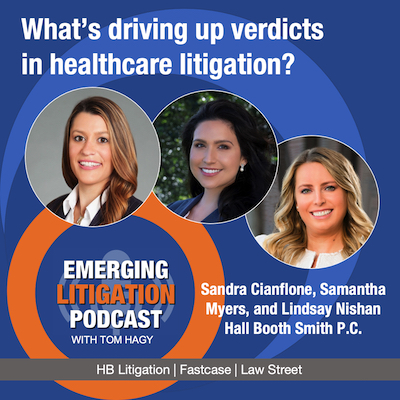
Social Inflation's Impact on Jury Verdicts in Healthcare Litigation Our guests wrote in the Journal on Emerging Issues in Litigation: “These outsize awards are often driven by myriad factors including sympathetic jurors, societal conceptions about income and wealth of corporations, the use of emotion-driven ‘Reptile Theory’ tactics by plaintiff attorneys, the media spotlight on ‘bad apple’ physicians, and numerous other social factors. A new factor that influences elevated jury verdicts is the increasing volume of information—whether true or false—that is exchanged on social media platforms.” Listen to my interview with Hall Booth Smith P.C. attorneys Sandra Cianflone, Samantha Myers, and Lindsay Nishan, each of whom represents members of the healthcare industry, as they discuss what drives large verdict and what attorneys should consider in mitigating the effects of this phenomenon. In keeping with tradition, we may have strayed a bit from the topic. One guest’s Aunt Lulu made an appearance. It turns out Covid lockdowns may have produced more enthusiastic jurors. And I added another reason why writing and podcasting, and not the practice of law, was a better career path for me. (Apparently lawyers aren’t supposed to laugh in people’s faces. Noted.) This podcast is the audio companion to the Journal on Emerging Issues in Litigation, a collaborative project between HB Litigation Conferences and the Fastcase legal research family, which includes Full Court Press, Law Street Media, and Docket Alarm. The podcast itself is a joint effort between HB and our friends at Law Street Media. If you have comments or wish to participate in one our projects, or want to tell me how much you learned from Sandie, Sam, Lindsay, or Aunt Lulu, please drop me a note at Editor@LitigationConferences.com. Tom Hagy Litigation Enthusiast Host of the Emerging Litigation Podcast Jurors' perceptions of big corporations, insurance companies, drug companies, physicians and other healthcare providers is increasingly colored by TV and social media. [...]
A Shameless Plug for Our Content Services
Your content marketing is everything you’ve ever dreamed of. Right?
 Sara is marketing director at a boutique law firm. When we asked her how their blog was going, she made a sad face. But then, we made Sara smile.*
Critical Legal Content was founded by Tom Hagy, former Editor & Publisher of Mealey’s Litigation Reports and VP at LexisNexis, founder of HB, current litigation podcaster and editor-in-chief. CLC’s mission is to help smaller firms and service providers not only create content — blogs, articles, papers, webinars, podcasts (like the stuff on this site) — but also to get it out there. How? Via social media, this website, your website, and potential via our podcast and journal which we publish in collaboration with vLex Fastcase and Law Street Media. The goal is to attract readers and dizzy them with your brilliance.
*Inspired by actual events.
Create content like a real legal publisher.
Emerging Litigation Journal

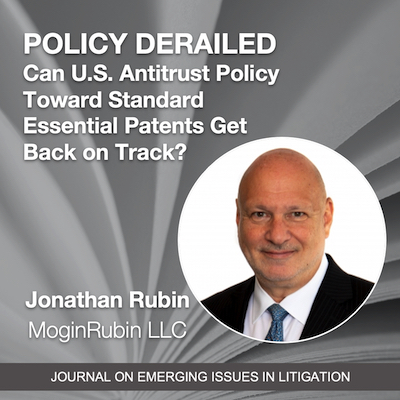
Policy Derailed: Can U.S. Antitrust Policy Toward Standard Essential Patents Get Back on Track by Jonathan Rubin
The Author Jonathan Rubin (jrubin@moginrubin.com) is Co-Founder and Partner of MoginRubin LLP, a boutique antitrust, mergers and acquisitions, and class action law firm. Since 2001, he has focused his legal practice exclusively on antitrust and competition law and policy. As a litigator he has led trial teams in major antitrust cases in courts throughout the country. Rubin is a member of the Editorial Board of Advisors for the Journal of Emerging Issues in Litigation. Interviews with leading attorneys and other subject matter experts on new twists in the law and how the law is responding to new twists in the world. Policy Derailed: Can U.S. Antitrust Policy Toward Standard Essential Patents Get Back on Track? "The failure to appropriately adjust the patent system to accommodate the competitive circumstances created when patents are incorporated into standards undermines the purposes of the standard-setting enterprise and impairs the utility and proliferation of standardized technologies. Without a course correction among the judiciary, the United States risks finding itself as a less desirable jurisdiction for pro-growth and pro-competitive patenting and standard-setting activities." Abstract: A consensus at the intersection of patent and anti-trust law was achieved after a series of decisions finding that in some circumstances owners of standard essential patents (SEPs) have an antitrust duty to deal with willing licensees. Beginning in 2017, however, the Department of Justice derailed U.S. policy by undermining the role and usefulness of antitrust for policing abuses of the standard setting process. This article traces the emergence of the consensus, its abrogation by the DOJ, and the resulting effects and prospects for the future. Download the article now! Explore more from MoginRubin LLP! Blog: Emboldened by New Resources and Expanded Authority, Feds Continue 10-Year Look Back at Chinese Investment. By Dan Mogin, Jonathan Rubin, Jennifer Oliver, and Timothy LaComb. List [...]
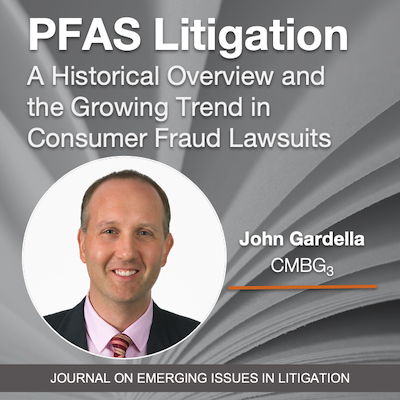
 PFAS Litigation—A Historical Overview and the Growing Trend in Consumer Fraud Lawsuits: What Are the Legal and Business Risks to Companies by John Gardella Gallery
PFAS Litigation—A Historical Overview and the Growing Trend in Consumer Fraud Lawsuits: What Are the Legal and Business Risks to Companies by John Gardella
PFAS Litigation—A Historical Overview and the Growing Trend in Consumer Fraud Lawsuits: What Are the Legal and Business Risks to Companies by John Gardella
The Author John P. Gardella (jgardella@cmbg3.com) is a shareholder and Chief Services Officer at CMBG3 Law, where he also chairs the firm’s PFAS, Environmental, Risk Management and Consulting and ESG practice groups. John is the latest addition to the Editorial Board of Directors for the Journal on Emerging Issues in Litigation. Interviews with leading attorneys and other subject matter experts on new twists in the law and how the law is responding to new twists in the world. PFAS Litigation A Historical Overview and the Growing Trend in Consumer Fraud Lawsuits "It is of the utmost importance that businesses along the whole supply chain in the consumer goods sector evaluate their PFAS risk and fully understand the legal arguments that plaintiffs could make against companies in litigation." Abstract: Per- and polyfluoroalkyl substances (PFAS) are a class of over 12,000 man-made compounds. Most people would recognize the brand names Teflon, produced by DuPont, and Scotchgard, produced by 3M. They also go by the nickname “forever chemicals” because they are highly persistent and mobile in the environment and the human body. In addition to bodily injury and environmental pollution litigation, plaintiffs are also bringing suits against companies for claiming their products and the making of their products are safe and green. This article explains why PFAS are of concern to citizens, media, and legislators; what legal risks they pose to corporations; and the recent surge in consumer fraud litigation. The article examines the legal theories at issue in the PFAS consumer fraud cases, as well as the potential damages that can stem from the cases to corporations. Questions addressed include: What do state and federal regulations say about PFAS in drinking water? If your company doesn't use the two original types of PFAS, are you at less risk of litigation? Which [...]

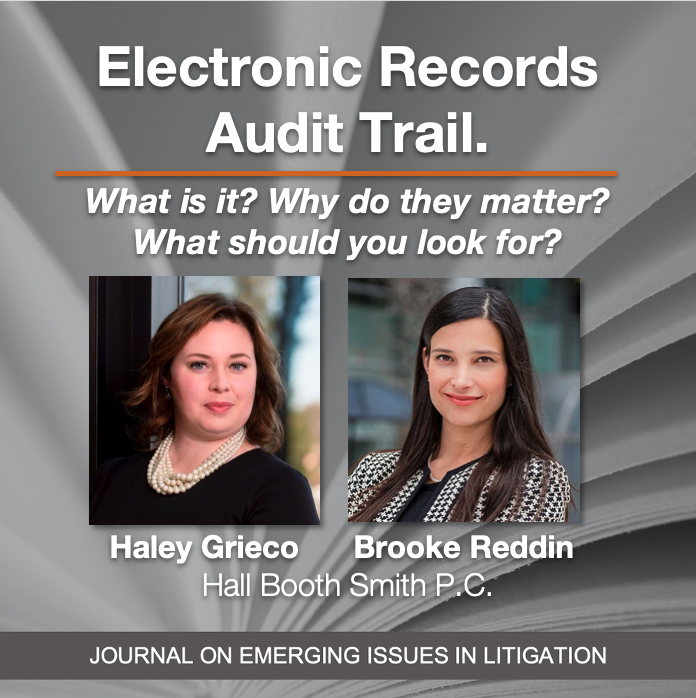
EMR Audit Trail—What Is It? Why Do They Matter? What Should You Look For? by Haley K. Grieco and Brooke E. Reddin
The Authors Haley K. Grieco (hgrieco@hallboothsmith.com) is a partner in the Paramus, New Jersey, office of Hall Booth Smith, where she defends physicians, hospitals, and other healthcare providers in a wide range of medical malpractice litigation. Brooke E. Reddin (breddin@hallboothsmith.com) is an associate with the firm, where she focuses her practice on healthcare, medical malpractice, and aging services litigation. Interviews with leading attorneys and other subject matter experts on new twists in the law and how the law is responding to new twists in the world. EMR Audit Trail—What Is It? Why Do They Matter? What Should You Look For? "As the healthcare industry becomes increasingly digitized, it is imperative that attorneys appreciate the impact it may have on their clients and their practice. In medical malpractice matters, discovery requests for metadata—specifically, the production of the EMR audit trail—has steadily increased over the past few years." Abstract: Maintaining electronic medical records, or EMRs, is now a nearly universal best practice among medical providers from small physician practices to large hospital networks. Unlike handwritten or typed records, these digital documents carry with them much more data than meets the eye. In this article, the authors—two medical malpractice attorneys— discuss what attorneys need to know about EMRs in the litigation context and the metadata bread crumb trail they leave behind. They discuss the types of data involved, federal requirements, discovery considerations, privacy implications, and the pros and cons and risks of using these records in defending healthcare providers. During the past ten years electronic medical records (EMR) have all but rendered obsolete handwritten medical records. Medical providers have had to learn computer systems, programs, software, hardware, and forms like never before. When hospitals, facilities, and medical offices change EMR systems, the process of learning the new system starts over. But what about [...]
HB Webinars on CeriFi LegalEdge
Content Partners