Emerging Litigation Podcast


Cannabis Coverage Litigation with John McDonald and Jihee Ahn
Our Guests John B. McDonald is an experienced litigator practicing in the Seattle and New York offices of Harris Bricken, where he represents clients in complex commercial, insurance, and partnership matters. Prior to joining Harris Bricken, John spent two years in Seattle with the Office of Chief Counsel, U.S. Customs and Border Protection (a component agency of the Department of Homeland Security), and five years in New York City at O’Melveny & Myers LLP, where he managed several cases. John graduated from the University of Miami School of Law, where he was an editorial member of the University of Miami Law Review. He also served as a research assistant for Professor Charlton Copeland on civil procedure and constitutional issues. Jihee is an experienced complex commercial litigator and chair of Harris Bricken’s Dispute Resolution/Litigation practice. She primarily represents clients in business, intellectual property, and real estate matters for both domestic and international clients. Having worked extensively in both federal and state courts, Jihee advises her clients from case intake through arbitration and trial. Over the course of her career, she has successfully prepared and argued numerous procedural and substantive motions, regularly conducted and defended depositions, and mediated disputes when appropriate for her clients. Prior to joining Harris Bricken, Jihee worked at Baker & Hostetler in Los Angeles, where she served as the lead attorney on several cases and mentored junior associates. Jihee graduated from the UCLA School of Law with a Business Law and Policy Specialization, and she served as a research assistant to Professor Sung Hui Kim on securities regulation issues throughout her third year of law school. Prior to relocating to Buffalo, Erin spent the bulk of her career to-date in Boston, where she worked in stewardship at Harvard University and as a consultant for nonprofits of all sizes. Cannabis Coverage Litigation: [...]
Takeaways from the SEC’s $100M Fine Against FinTech Lender BlockFi
Our Guest Brad is a partner in the Greenville, South Carolina, office of Nelson Mullins Riley and Scarborough where he chairs the firm’s Financial Services Regulatory Practice, leading a team of attorneys in a national practice representing clients in financial regulatory and FinTech matters. He is a valued member of the Editorial Board of Advisors for the Journal on Emerging Issues in Litigation, a companion to this podcast. Takeaways from the SEC's $100M Fine Against FinTech Lender BlockFi So, apparently this is true: Running a lending operation without registering with the SEC makes them crabby. Spoiler Alert: On Valentine’s Day this year the SEC announced a $100 million fine against retail crypto lender BlockFi Lending. Nothing says "will you be mine?" like a nine-figure bill -- for that special someone who has everything. The company agreed to put an end to some of its offers and sales, and to get to work bringing itself into compliance with, you know, the law, like the Securities Act of 1933 and the Investment Company Act of 1940. So, what does the SEC want companies to do? What remedies does the SEC have for unregistered securities offerings? What impact will this have on private litigation? Is there a risk that BlockFi Interest Account investors will have claims against BlockFi? Want to find out? Listen to my interview with attorney Brad Rustin. Brad is a partner in the Greenville, South Carolina, office of Nelson Mullins Riley and Scarborough where he chairs the firm’s Financial Services Regulatory Practice, leading a team of attorneys in a national practice representing clients in financial regulatory and FinTech matters. This is Brad’s third appearance on the podcast! He spoke on one episode about the Impact of the Russia Sanctions on Global Financial Markets, and on another popular episode on the Gamification of Stock Trading. Brad is [...]
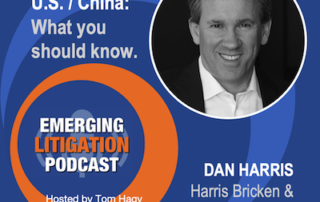


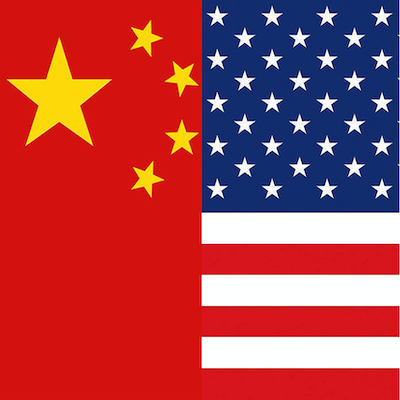
What Businesses and Lawyers Should Know About the U.S./China Relationship
Our Guest Dan Harris is a leading authority on the legal and strategic aspects of conducting business in emerging markets. He is co-founder of the international practice of Seattle-based HarrisBricken, which has offices across the U.S., as well as in China, Spain, Mexico, and Brazil. His China Law Blog was named, and with good reason, to the ABA Journal’s “Blawg Hall of Fame.” Forbes, Business Week, Fortune, The BBC, The Wall Street Journal, The Washington Post, The Economist, CNBC, The New York Times, and many other major media players have looked to him for his perspective on international law issues. Dan writes and speaks extensively on international law with a focus on protecting businesses in their foreign operations and he has had the rare honor of being designated a “Super Lawyer.” He is also a member of the Editorial Board of Advisors for the Journal on Emerging Issues in Litigation and the Emerging Litigation Podcast. What Businesses and Lawyers Should Know About the U.S. / China Relationship “Americans mistakenly believe that China operates as a rational economic actor and that economics is their highest priority. It’s not and it never has been. Their highest priority is whatever is good for the Chinese Communist Party.” “Chinese companies view American and EU companies as very risky, in large part because so many American and EU companies are looking to move their manufacturing out of China.” A major potential avalanche of risks are those that would shake the business world should – as some expect it will – trade relations between China, and America and EU, come to an end. China is America’s largest trading partner, a relationship responsible for $600B a year in commerce, according to the Office of the U.S. Trade Representative. By comparison, U.S. / European Union trade exceeds $1T. The trade [...]
A Shameless Plug for Our Content Services
Your content marketing is everything you’ve ever dreamed of. Right?
 Sara is marketing director at a boutique law firm. When we asked her how their blog was going, she made a sad face. But then, we made Sara smile.*
Critical Legal Content was founded by Tom Hagy, former Editor & Publisher of Mealey’s Litigation Reports and VP at LexisNexis, founder of HB, current litigation podcaster and editor-in-chief. CLC’s mission is to help smaller firms and service providers not only create content — blogs, articles, papers, webinars, podcasts (like the stuff on this site) — but also to get it out there. How? Via social media, this website, your website, and potential via our podcast and journal which we publish in collaboration with vLex Fastcase and Law Street Media. The goal is to attract readers and dizzy them with your brilliance.
*Inspired by actual events.
Create content like a real legal publisher.
Emerging Litigation Journal
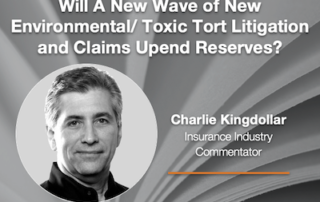
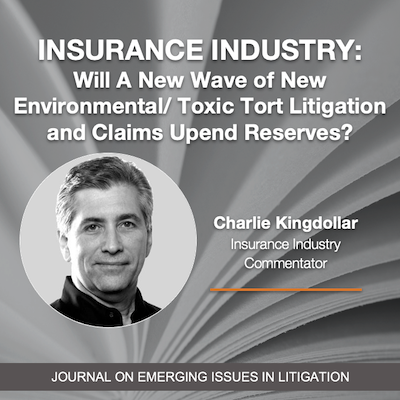
Will a New Wave of New Environmental/Toxic Tort Litigation and Claims Upend Insurance Industry Environmental Reserves?
The Author Charlie Kingdollar spent his career as emerging issues officer for a major global insurance company, tracking hundreds of future risks like those discussed in this article. Charlie is also a valued member of the Editorial Board of Advisors for the Journal of Emerging Issues in Litigation. Interviews with leading attorneys and other subject matter experts on new twists in the law and how the law is responding to new twists in the world. Will a New Wave of New Environmental/Toxic Tort Litigation and Claims Upend Insurance Industry Environmental Reserves? "PFAS chemicals are commonly called “forever chemicals,” because once released into the environment they can take hundreds or even thousands of years to break down." "Estimates that the ultimate costs of [these and other] environmental claims will land between $45 billion and $55 billion is terribly low. Maybe I’m missing something (always a possibility). If not, the insurance industry is in for a rude awakening." Abstract: To remain profitable and viable, the insurance and reinsurance industry must rely on estimated forecasts of potential claims many years out to establish an appropriate level of reserves. They rely on data from rating agencies and, based on these estimates, ratchet their reserves up or down accordingly. In past years, major and once unforeseen developments like massive asbestos and environmental litigation provided urgent reasons to cast an especially critical eye on the adequacy of industry reserves. In this article, the author explains why it is that time again. In light of several potentially calamitous emerging global liabilities he reviews here, particularly if they land with the impact he fears they might, the author believes the insurance industry and its policyholders may be in for a jolt a few short years from now. Download the article now!
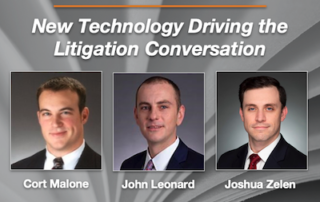
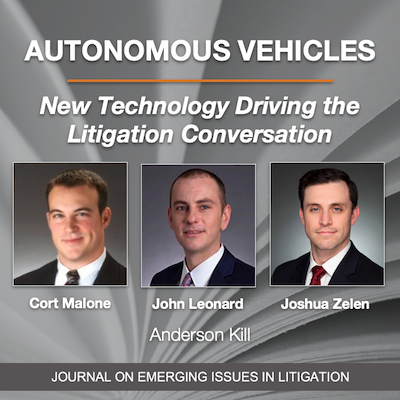
Autonomous Vehicles: The New Technology Driving the Litigation Conversation
The Authors Cort T. Malone (cmalone@andersonkill.com) is a shareholder in the New York and Stamford offices of Anderson Kill and practices in the Insurance Recovery and the Corporate and Commercial Litigation Departments. An experienced litigator, he focuses on insurance coverage litigation and dispute resolution, with an emphasis on commercial general liability insurance, directors and officers insurance, employment practices liability insurance, advertising injury insurance, and property insurance issues. John M. Leonard (jleonard@andersonkill.com) is a shareholder in Anderson Kill’s New York, New York, office, where he handles a full spectrum of insurance coverage matters, such as business interruption losses, D&O and E&O, commercial general liability, environmental liability. Joshua A. Zelen (jzelen@andersonkill.com) is a law clerk pending admission in Anderson Kill’s New York office. He focuses his practice on insurance recovery. Interviews with leading attorneys and other subject matter experts on new twists in the law and how the law is responding to new twists in the world. Autonomous Vehicles: The New Technology Driving the Litigation Conversation "The AEV Act requires a policyholder’s insurance company to cover third-party damage caused by a self-driving automated vehicle. A policy may not exclude such damages, except for damages suffered as a direct result of software alterations made without the policyholder’s knowledge, or failure to install safety-critical software updates." Abstract: So far, Congress has not been able to pass regulations governing the emergence of self-driving or autonomous vehicles. Twenty-one states and the United Kingdom are leading the way. As more of these vehicles take to the highway implications will emerge for the insurance industry. Auto insurance policies will have to determine how to insure against losses caused by nonhuman operators, commercial general liability policies will be affected when technology developers and car makers are sued for bodily injury and property damage arising from malfunctioning technology, and cyber policies [...]
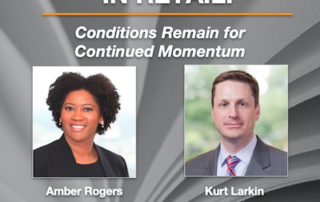
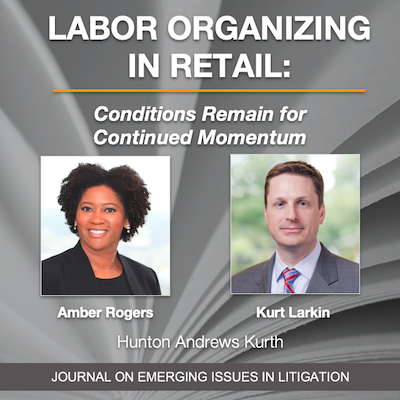
Labor Organizing in Retail: Conditions Remain for Continued Momentum
The Authors Amber is Board Certified in Labor & Employment Law by the Texas Board of Legal Specialization, and is a trial lawyer who has extensive experience representing and advising clients in traditional labor relations, such as collective bargaining, representation elections, decertification elections, unfair labor practice charges, arbitrating grievances, contract administration and interpretation, and union avoidance strategies. Amber’s litigation experience includes regularly representing clients in wage and hour collective and class actions, trade secrets and post-employment restrictive covenant disputes, and complex employment discrimination. As a part of Amber’s partnership with clients to avoid litigation, she frequently conducts and coordinates sensitive corporate investigations, and provides training presentations for clients on a multitude of topics. Kurt helps businesses of all sizes solve their complex labor and employment challenges. He counsels clients on all aspects of labor-management relations, including representation elections, collective bargaining and strikes and lockouts, and also advises clients in strategic employment and human relations matters. Kurt litigates labor and employment cases in federal and state trial and appellate courts around the country and before the NLRB and EEOC. Kurt is a recognized thought leader in the area of traditional labor-management relations. He has been recognized as a leader in Labor and Employment by Chambers USA Virginia and as a 2022 Top 10 Labor Lawyer by Benchmark Litigation. Interviews with leading attorneys and other subject matter experts on new twists in the law and how the law is responding to new twists in the world. Labor Organizing in Retail: Conditions Remain for Continued Momentum "The political and social issues of the past few years, inflation, the looming recession, job security, wages, and pandemic-related frustration/unhappiness are just a few of the countless reasons cited for the boom in union support/approval." Abstract: In 2022, labor organizing was in the spotlight with workers organizing at a [...]
HB Webinars on CeriFi LegalEdge
Content Partners