
HB Partner Webinars on the West LegalEdcenter
Take these CLE webinars on the West LegalEdcenter platform. Each program features leading litigators in their respective fields on emerging subjects. Speakers and topics are handpicked by HB. Your organization may have already subscribed to the platform, but each session is also available for individual purpose. For questions or if you wish to propose a webinar, write to us at: Webinars@LitigationConferences.com.


ESG Programs and the Lawyer’s Role
In this episode, we discuss the role of attorneys and in-house counsel in the courageous new world of Environment, Social, and Governance Issues, or ESG. How can law firms themselves adopt ESG practices and what role do they play with clients? How can in-house counsel drive ESG initiatives? What are the pitfalls and risks? And have you ever wondered how rating organizations work? Listen now!

Latest on Software and AI Devices from the United Kingdom’s MHRA by Jackie Mulryne and Eleri Williams
In this article, the authors discuss new updates from the UK’s Medicines and Healthcare products Regulatory Agency on how software and artificial intelligence medical devices will be regulated in the United Kingdom after Brexit. Read and learn more!

Natural Gas Bans and Bans on Bans
The Ninth Circuit Court of Appeals recently struck down Berkeley, California's ban on natural gas infrastructure in new buildings as a violation of federal law. As we will continue to see more such bans, our guest shares insights on how similar cases may be treated -- and much more.

Pixel Litigation Tests Old Privacy Law
New litigation alleging violations of the Video Privacy Protection Act -- which came well before online video streaming -- demonstrates how plaintiff attorneys are creatively applying traditional causes of action to litigate modern privacy issues in the absence of a federal law. Listen now for insights.
PFAS Regulation: EPA Ushers in Next Era of Mass Tort and Environmental Litigation
PFAS claims are the next frontier of mass tort and environmental litigation. With the EPA poised to finally enact the first regulation of these chemicals, that frontier is ripe for exploration. This article explores PFAS and the origin of litigation around the substances as well as the state of PFAS litigation and regulation today. It concludes with some thoughts on what to expect when it comes to PFAS litigation going forward.
TVPRA, State Statutes Open Door for Civil Damage Claims by Human-Trafficking Victims
Since 2003, when Congress opened the door for human-trafficking victims to sue for civil damages under the Trafficking Victims Protection Act of 2000 (TVPRA), the TVPRA and similarly drafted state statutes have allowed for human-trafficking victims to seek civil damages against any party that has benefited from their trafficking. Given this expansive inclusion of third-party liability, more and more businesses, especially those in the hospitality industry, are ultimately the ones left to pay for the criminal acts of human traffickers. In this article, the authors, Coryne Leyendecker and Pamela Lee discuss the evolving litigation around human-trafficking claims and offer guidance on how businesses can build a foundation for their own defense while simultaneously helping prevent human-trafficking crimes from occurring in the first place.

Spotting the Risk, Reaping Rewards: Avoiding Increased Antitrust Scrutiny
The Authors Katie has favorably represented antitrust clients in matters involving monopolization, conspiracy, price fixing, exclusive dealing, and other competition-related disputes, including trade secrets and non-compete actions. She has extensive knowledge of the regulatory hurdles and obligations her clients face. Katie earned her J.D. from the New York University School of Law, cum laude. Natalie West represents sophisticated clients in complex commercial disputes. She regularly serves as the lead brief writer in antitrust cases, employment and consumer class actions, and appellate matters. Natalie graduated with high honors from the University of Texas School of Law, where she served as a member of the Texas Law Review and was elected to the Order of the Coif. Interviews with leading attorneys and other subject matter experts on new twists in the law and how the law is responding to new twists in the world. Avoiding Antitrust Scrutiny Spotting the Risk, Reaping Rewards The increase in aggressive antitrust enforcement has certainly received significant attention. For the moment, juries are not rewarding the prosecutors. That said, even an unsuccessful government investigation is itself costly and can motivate plaintiffs’ lawyers. Best practices involve not only following the law but also maintaining solid optics to avoid the need for an expensive, if ultimately successful, defense. Abstract: A decade ago, few lawyers across the country spent significant time thinking about antitrust law. But, since then, there has been an onslaught of antitrust attacks on businesses and executives across all sectors of the economy. Enforcement efforts have skyrocketed following President Biden’s July 2021 executive order directing a “whole of government” crackdown on competition abuses—and the trend shows no sign of letting up. Today, no matter the industry or the size of the business, everyone needs [...]
International Discovery Tool Kit Aims to Facilitate Discovery in Both Domestic and Foreign Litigation
The Authors Benjamin Daniels advises financial institutions and global corporations about litigation and dispute resolution. As a member of the Business Litigation Group, Ben provides creative and ardent advocacy during litigation, enforcement actions, investigations, crisis management, and white-collar defense matters. Ben’s clients often face complex, cross-border disputes. He has deep experience with the interplay between domestic and international courts, including discovery disputes and Hague convention proceedings. He also represents clients in international arbitrations and mediations. Jenna Scoville is a member of the firm’s Business Litigation Group. She focuses her practice on all aspects of general business litigation and dispute resolution, as well as government enforcement matters, and appellate work. She helps companies respond to a variety of business disputes, including claims for breach of contract, unfair trade practices and fraud. Jenna also has extensive appellate experience. Prior to joining the firm, she clerked for the Honorable Peter W. Hall of the U.S. Court of Appeals for the Second Circuit. Interviews with leading attorneys and other subject matter experts on new twists in the law and how the law is responding to new twists in the world. International Discovery Tool Kit Aims to Facilitate Discovery in Both Domestic and Foreign Litigation "At a time when litigants have increasingly relied on U.S. federal courts to obtain otherwise unobtainable evidence from entities located within the United States, the U.S. Supreme Court has decisively closed the door to U.S.-style discovery in private arbitrations abroad. That means U.S. companies will no longer face the time, exposure, and expense of U.S.-style discovery that § 1782 had injected into those proceedings." Abstract: Business knows no borders. Every year companies increase their global reach and open new offices both domestically and abroad. The COVID-19 pandemic accelerated [...]

The Use—and Abuse—of Rule 41(a) to Destroy Federal Question Jurisdiction Post-Removal
The Authors John defends manufacturers in product liability litigation involving a range of products, e.g., ATVs, RVs, institutional chemicals, medical devices, and pharmaceuticals. From single cases to mass tort litigation and class actions, John has defended clients in courtrooms around the country. Michael is General Counsel of Thor Motor Coach Inc., a final-stage manufacturer of motor homes headquartered in Elkhart, Indiana. He is also an adjunct professor of commercial law at the Notre Dame Law School. Taryn focuses her practice on litigation. She has experience dealing with products liability, discovery issues, corporate structure and governance, wealth management, private and commercial lending, real estate, and Indian affairs for lobbying both on state and federal levels. Taryn contributed valuable research to this article. Interviews with leading attorneys and other subject matter experts on new twists in the law and how the law is responding to new twists in the world. The Use—and Abuse—of Rule 41(a) to Destroy Federal Question Jurisdiction Post-Removal "A plaintiff seeking to divest the court of subject matter jurisdiction post-removal should at least comply with the requirements of the rule they have relied on. Glossing over those requirements undermines the purpose and intent of both the rule and removal statutes. The case should stay put in federal court in the absence of compliance." Abstract: Defendants in civil litigation can level the often uneven state court playing field by removing cases to federal court through federal question removal. In those cases in which the plaintiff has alleged a claim grounded in federal law, the defendant may remove the case to an often more impartial federal forum. Once removed, the plaintiff has few options for defeating removal. About the only option available to the plaintiff is to forgo [...]

Hair Relaxer Injury Litigation
Last year the Aylstock, Witkin, Kreis & Overholtz law firm filed the first class action against L’Oréal and Softsheen-Carson for injuries, primarily to Black women, allegedly caused by hair relaxers and straighteners. Now, many cases are consolidated in multidistrict litigation. Listen for unique insights from a leading plaintiff attorney.

The Light and Dark Sides of Auto-GPT
Businesses must understand how Auto-GPT technologies use data, the potential for biased results, and how to responsibly leverage these powerful technologies. Listen to my interview with Jason I. Epstein, Partner at Nelson Mullins Riley & Scarborough, as we explore this emerging field.

The Plight of the Indirect Purchaser
Consumers and businesses -- indirect purchasers of products whose prices are fixed by those who supply the maker of your purchase may not collect damages in states that -- surprisingly, do not have antitrust laws that give them standing. But what about federal law? Why do some states provide for damages and others do not? Are there alternatives?

The IRS and Rules About Rules
The Administrative Procedures Act outlines the rules of rule making for federal agencies. Lately it has become a focal point in tax litigation, due in large part to the IRS’s record of refusing to comply with the law's notice-and-comment mandate. Listen to learn more about recent trends in tax litigation. Get an article, too.

Does the European Union Commission’s Proposal on AI Liability Act as a Game Changer for Fault-Based Liability Regimes in the EU?
Guest Writer Does the European Union Commission’s Proposal on AI Liability Act as a Game Changer for Fault-Based Liability Regimes in the EU? By Nils Lölfing Abstract: In this article, the author discusses increasing risks that artificial intelligence system providers, developers, and users will face from a liability directive proposed by the European Union Commission. The AI Liability Directive proposed by the European Union Commission puts additional liability risks on providers, developers and users of specifically high-risk artificial intelligence (AI) systems. If enacted, it could become a game changer for fault-based liability regimes in the European Union, as it introduces a presumption of causality to prove fault and a right of access to evidence from companies and suppliers regarding high-risk AI systems. This will help victims enforce non-contractual civil law claims for damages caused by an AI system. What this is about and how it increases the liability risk exposure of actors in the AI systems supply chain will be discussed in this article. Background On September 28, 2022, the EU Commission published its proposal for a Directive to establish new fault-based liability rules for AI systems (AI Liability Directive), along with a reform for the existing rules on the strict liability of manufacturers for defective products. The current article focuses on the draft AI Liability Directive, which complements the AI Act by facilitating fault-based civil liability claims for damages, which the AI Act as specific product safety Regulation does not offer. On June 30, 2021, the EU Commission published an inception impact assessment road map on adapting civil liability rules to the digital age, in particular considering AI (based on the EU Commission’s White Paper on AI of February 19, 2020). With respect to AI in particular, the AI [...]

The Blueprint for an “AI Bill of Rights”
Authors Peter Schildkraut is a co-leader of the firm's Technology, Media & Telecommunications industry team and provides strategic counsel on artificial intelligence, spectrum use, broadband, and other TMT regulatory matters. Mr. Schildkraut helps clients navigate the ever-changing opportunities and challenges of technology, policy, and law to achieve their business objectives at the US Federal Communications Commission (FCC) and elsewhere. He is the author of "AI Regulation: What You Need To Know To Stay Ahead of the Curve. James W. Kim is a nationally recognized expert in procurement law that regularly advises companies that do business with the US government, with a focus on professional services organizations and the life sciences industry. He is a regular speaker and author on procurement and drug pricing matters and his work is regularly featured in nationally-distributed industry print and digital media. Mr. Kim provides clients with strategic counsel related to US government funding and US market access, including assistance with more than $5 billion in procurement and grant awards and regulatory counsel related to more than $40 billion in successful M&A transactions. Marne Marotta works with clients facing complex challenges to develop and implement dynamic government relations strategies. Drawing from her experience in the Senate and the executive branch, she provides clients with strategic guidance and counseling, devises and implements comprehensive advocacy campaigns, and builds coalitions with allied stakeholders. Focused on the intersection between business and public policy, Marne uses a multidisciplinary approach to help clients achieve their legislative and agency goals. James Courtney focuses his work on a variety of policy areas, including technology, national security, education, and energy and environmental. He conducts research and monitors developing policy issues to aid clients and engage with members of Congress and the Executive Branch. Mr. Courtney works closely with and advises [...]

The Rise of Multi-Claimant Litigation in England and How Companies Can Manage Potential Exposure
The Authors Sheila L. Birnbaum Mark S. Cheffo Dorothy Cory-Wright Evan Flowers Jacqueline Harrington Will Sachse Stephen Surgeoner Rachel Leary Caroline Power Julie Witham Interviews with leading attorneys and other subject matter experts on new twists in the law and how the law is responding to new twists in the world. The Rise of Multi-Claimant Litigation in England and How Companies Can Manage Potential Exposure "With the growth in US/English partnerships for bringing multi-claimant actions in England, there may be an increased interest in leveraging US discovery for copycat English claims. The larger mass torts become in the United States, the more likely they are to feed into related multi-claimant actions in England." Abstract: Recent court decisions have signaled the English courts’ willingness to embrace multi-claimant litigation and to broaden the types of questions decided on a collective basis. These developments have led UK-based plaintiffs’ lawyers to expand mass tort filings, including doing so in partnership with US plaintiffs’ lawyers who are actively advertising in England. This article provides an overview of multi-claimant litigation in England, highlights some of the factors that may lead to its increase, and discusses steps that companies operating in the English market can take now to manage potential exposure. Three primary mechanisms for bringing collective actions before an English court: 1) Representative actions, group litigation orders (GLOs), and collective actions before the Competition Appeal Tribunal (CAT). 2) Representative actions, in their current form, and GLOs are products of the general Civil Procedure Rules (CPR). 3) Representative actions originated in the common law and permit a representative claimant or defendant with the “same interest” in a claim to represent that interest on behalf of a class. Download the article [...]

How Companies Seeking to Leave China for Mexico Can Mitigate Their Legal Risks and Protect Against New Ones
The Author Dan Harris (dan@harrisbricken.com) is co-founder of Harris Bricken where he focuses his practice on international law and protecting businesses in their foreign operations. A leading authority on the subject, he is also editor of the highly regarded China Law Blog, and a valued member of the Editorial Board of Advisors for the Journal of Emerging Issues in Litigation. Interviews with leading attorneys and other subject matter experts on new twists in the law and how the law is responding to new twists in the world. How Companies Seeking to Leave China for Mexico Can Mitigate Their Legal Risks and Protect Against New Ones "Chinese manufacturers commonly seek retaliation against foreign buyers that cease buying product from them. For this reason, it is critical that you line up your new suppliers (preferably in a country other than China) and have them ready to go before you even hint to anyone in China that you might cease or reduce production with an existing China supplier." Abstract: The author, one of the leading authorities on the legal issues related to international manufacturing, discusses the risks companies will face if they move their manufacturing out of China, what they should do to mitigate those risks, and what new risks they will face in a new country, such as Mexico. He comments on a variety of concepts, including manufacturing agreements, protection of intellectual property, strategies for a safe departure, potential retaliation tactics, and even personal security matters. Download the article now!
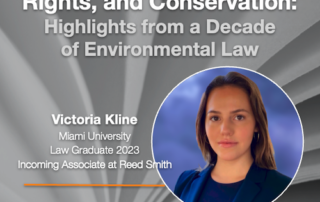
Climate Change, Property Rights, and Conservation: Highlights from a Decade of Environmental Law (2013–2023)
The Author Victoria Kline (linkedin.com/in/victoria-kline) just graduated from the University of Miami School of Law, and is an incoming associate at Jones Day. She focused her studies on environmental law, which also will be her area of practice. (Congratulations to Victoria on her graduation and getting her start at Reed Smith!) Interviews with leading attorneys and other subject matter experts on new twists in the law and how the law is responding to new twists in the world. Climate Change, Property Rights, and Conservation: Highlights from a Decade of Environmental Law (2013–2023) Abstract: The author discusses nine recent decisions—all but one handed down by the Supreme Court—that demonstrate the ongoing debate over responsibility for the effects of climate change, how the courts are essentially asked to strike a balance between environmental protection and economic development, the intersection of property rights and conservation, and how litigants fared with their arguments over different aspects of this important and, many would say, existential dilemma. The author concludes with an update from the United Nations Framework Convention on Climate Change and the establishment of a loss and damage fund for countries harmed by climate change. "The past decade has seen numerous legal challenges and landmark rulings in environmental law, reflecting the growing recognition of the critical importance of protecting the environment for current and future generations. From the Supreme Court’s decision in Michigan v. EPA to the recent Juliana v. United States case, the judicial branch has dramatically changed the way litigation can be used to protect the interests of the earth and its inhabitants." Download the article now!

Procedural Challenges to the IRS’s Compliance With the APA and Its Impact on Tax Litigation
The Author Jeffrey S. Luechtefeld (jeff.luechtefeld@chamberlainlaw.com) is a tax controversy and litigation attorney with Chamberlain, Hrdlicka, White, Williams, and Aughtry (Atlanta, Georgia) where he focuses his practice on resolving tax disputes with the Internal Revenue Service, administratively or through litigation. Jeff previously was a Special Trial Attorney for the IRS Office of Chief Counsel as well as a director in the tax controversy practice of a big four accounting firm. Interviews with leading attorneys and other subject matter experts on new twists in the law and how the law is responding to new twists in the world. Procedural Challenges to IRS Compliance With the APA and Its Impact on Tax Litigation Abstract: The Administrative Procedure Act (APA) places specific requirements on agencies of the federal government when engaged in a “rule making” that has the force and effect of law. Recently, the APA has become a focal point in tax litigation, due in large part to the IRS’s history of refusing to comply with the process mandated by the APA. This article focuses on procedural challenges to the IRS’s compliance with the APA based on the IRS’s history of non-compliance with the APA’s notice-and-comment requirement. It highlights recent trends in tax litigation and considers the future of APA challenges in this area. "IRS’s level of APA non-compliance matters significantly ... "APA challenges predicated on the IRS’s failure to adequately follow the APA’s notice-and-comment process are inherently fact-intensive endeavors ... "The challenging party should gauge the usefulness of the relief requested and balance that against the cost required to prevail ... "Ultimately, APA challenges are important, and may be necessary for a taxpayer to get to argue the merits of their case, but they do not often end the dispute with [...]
 Ohio Supreme Court Ruling Sends Important Reminder: Long-Standing, Fundamental Principles of Insurance Policy Construction and Law Are Applicable to Cyber Claims Gallery
Ohio Supreme Court Ruling Sends Important Reminder: Long-Standing, Fundamental Principles of Insurance Policy Construction and Law Are Applicable to Cyber Claims
Ohio Supreme Court Ruling Sends Important Reminder: Long-Standing, Fundamental Principles of Insurance Policy Construction and Law Are Applicable to Cyber Claims
The Authors Judy Selby (judy.selby@kennedyslaw.com) is a Partner at Kennedys (New York) where she focuses her practice primarily on insurance coverage matters with a concentration in coverage for exposures arising out of emerging technology, digital, and compliance risks. Tracey M.Kline (tracey.kline@kennedyslaw.com) is an Associate at Kennedys (Philadelphia) where she focuses her practice primarily on insurance coverage litigation and cyber matters. Interviews with leading attorneys and other subject matter experts on new twists in the law and how the law is responding to new twists in the world. Ohio Supreme Court Ruling Sends Important Reminder: Long-Standing, Fundamental Principles of Insurance Policy Construction and Law Are Applicable to Cyber Claims Abstract: On December 27, 2022, the Ohio Supreme Court unanimously ruled that a business owner’s property insurance policy issued by Owners Insurance Co. to EMOI Services, LLC did not afford coverage for losses sustained in a ransomware attack because computer software is “entirely intangible” and “cannot experience ‘direct physical loss or physical damage.’” EMOI Servs., LLC. v. Owners Ins. Co., 2022-Ohio-4649 (Ohio 2022). In doing so, the court reversed an attention-getting split decision by the lower appellate court. This article takes an in-depth look at the case and discusses its significant implications. The Ohio Supreme Court’s decision was based on its commonsense conclusions that software (as intangible property) cannot suffer physical damage, and that coverage for restoration of information under the Electronic Equipment Endorsement could not be triggered absent the threshold requirement of “direct physical loss or damage” to the media on which the information was stored. Although claims involving cyber events may be relatively new, this decision is an important reminder that long-standing, fundamental principles of insurance policy construction and law are applicable to cyber claims. Download the [...]
Unarmed or Unwell: How Federal Law Infringes Medical Marijuana Users’ Second Amendment Rights
The Author Griffen Thorne (griffen@harrisbricken.com) is an attorney in the Los Angeles office of Harris Bricken Sliwoski LLP, an international emerging markets law firm. He represents clients in highly regulated emerging industries, such as cannabis, in corporate and commercial transactions. Interviews with leading attorneys and other subject matter experts on new twists in the law and how the law is responding to new twists in the world. Unarmed or Unwell: How Federal Law Infringes Medical Marijuana Users’ Second Amendment Rights As Justice Amy Coney Barrett noted while on the Seventh Circuit, “legislatures have the power to prohibit dangerous people from possessing guns. But that power extends only to people who are dangerous.” In the coming years, the government’s ability to write off all medical marijuana users as dangerous is likely to be curtailed, even if the Controlled Substances Act continues to make marijuana use a federal crime. Abstract: In the wake of the 2022 U.S. Supreme Court case New York State Rifle & Pistol Association, Inc. v. Bruen, federal courts have reached opposite outcomes on whether federal prohibitions on marijuana users’ rights to own or possess firearms are constitutional. As a result, there is a high likelihood of a circuit split that results in the overturning of those federal laws. The author discusses Bruen and several other cases at the intersection of drug laws and gun laws. Download the article now!

Law Firm Technology Directors? Yes.
In this episode we talk about the advantages of having technology and software development capabilities inside your law firm. Can you imagine? And we’re not just talking about someone who is adept at unjamming the printer.

Digital Health Care Companies, Beware: Federal Agencies Are Tracking Your Use of Online Tracking Technologies
The Authors Patricia A. Markus (trish.markus@nelsonmullins.com) represents health care providers and health technology companies across the country on wide-ranging regulatory compliance, reimbursement, licensure, and operational matters, with a special focus on issues surrounding health information privacy, security, and technology. Shane Duer (shane.duer@nelsonmullins.com) focuses his practice on healthcare regulatory and corporate matters, with an emphasis on data privacy, cyber security, and information management concerns within and beyond the health care industry. Interviews with leading attorneys and other subject matter experts on new twists in the law and how the law is responding to new twists in the world. Digital Health Care Companies, Beware Federal Agencies Are Tracking Your Use of Online Tracking Technologies. Abstract: Health care industry stakeholders have regularly used online tracking technologies to help improve patient experience. However, growing scrutiny by the Office for Civil Rights, which enforces the Health Insurance Portability and Accountability Act of 1996 (HIPAA), requires covered entities and business associates to proceed cautiously in their use of such technologies. In addition, recent enforcement actions by the Federal Trade Commission make clear that a wide range of digital health companies, whether or not regulated by HIPAA, must tread carefully when collecting and disclosing personal information related to health, especially where consumers’ location data is to be used for a company’s advertising purposes, as they may be held accountable for failing to maintain the privacy and security of individuals’ protected and individually identifiable health information. The increasing number of lawsuits and news articles regarding use of these technologies demonstrates that third-party technology tracking vendors who receive PHI often are not operating under Business Associate Agreements (BAAs). The vendors in most instances disavow any need to collect PHI and accordingly instruct users to avoid sending PHI [...]

Big Tech’s Race to Develop Superior Artificial Intelligence Technology
Big Tech’s Race to Develop Superior Artificial Intelligence Technology Will A.I. Compromise Free Enterprise, Disclosure and Security? America’s Big Five tech companies – Amazon, Apple, Facebook, Google and Microsoft – are racing to develop technology they claim will change the world -- again. The tech Goliaths have more than 33,000 researchers at their disposal to create artificial intelligence (A.I.) technology with an obvious and perpetual prize: revenue. It's the talk of the world. NBC Nightly News recently predicted the impacts that A.I. will have on society in the coming years. A.I. tech was also the center of attention at the 2023 Davos Economic Summit. Prominent tech leaders such as Elon Musk and the CEO of OpenAI, Sam Altman, heralded that A.I. will improve virtually everyone’s lives, but with some risks involved. Andrew Perlman, dean of Suffolk University Law School, says there is nothing "future" about it. In The Implications of ChatGPT for Legal Services and Society, he wrote, "The disruptions from AI's rapid development are no longer in the distant future. They have arrived ..." And for the legal industry, he said, "ChatGPT may portend an even more momentous shift than the advent of the internet." Just one legal application out there today is the use of A.I. technology (GPT-3) by Docket Alarm, a popular court docket search service. Docket Alarm allows users to see A.I.-generated summaries of filings without even opening them. Michael Sander, VP of analytics with Docket Alarm owner Fastcase, told legal technology enthusiast Bob Ambrogi that the feature is experimental and should be relied upon with some healthy caution. [Disclosure: HB collaborates with Fastcase in creating litigation content, e.g., the Journal of Emerging Issues in Litigation and the Emerging Litigation Podcast.] As non-attorney and comic book hero Spiderman famously said, “With [...]














Intellectual Property Trial Team Diversity with Tara Trask
Intellectual Property Trial Team Diversity with Tara Trask Diversity and inclusion initiatives aren’t just valuable for checking off compliance boxes and writing marketing copy. Those benefits are a distant second and third to the genuine value team diversity has on the success of a company or a project. That also means law firms and trials. A recent article published by the American Bar Association Tort and Insurance Practice Section hailed diversity of perspectives for how they improve a team’s ability to resolve legal issues, innovate solutions, and introduce factors homogeneous teams may miss. The National Association for Law Placement reported that women and people of color are making great progress at major law firms. Nearly half of associates are women and, based on summer associate statistics, women are expected to break the 50% as early as this year or next. Black associates made impressive gains, but there remains room for improvement. At the partner level, however, Black and Latinx women and men remain stuck in the low single digits. In this episode we drill down even further to examine trial teams in the intellectual property arena. I was thrilled to speak with Tara Trask, one of the nation’s leading experts on IP trials and juries, having directly worked on or observed more of these proceedings than just about anyone. Tara has championed research on this topic as part of her work and presentations for the American Intellectual Property Law Association. The diversity spark lit up for Tara when she and her panelists enjoyed an enthusiastic reaction to an AIPLA conference session she moderated titled, “Perspectives on Diversity: Views on Trial Teams From the Bench, The Boardroom, and the Jury Box.” Listen to Tara’s insights based on analysis of her own cases, analysis of related studies, and expanded fact-gathering [...]