HB Partner Webinars on the West LegalEdcenter
Take these CLE webinars on the West LegalEdcenter platform. Each program features leading litigators in their respective fields on emerging subjects. Speakers and topics are handpicked by HB. Your organization may have already subscribed to the platform, but each session is also available for individual purpose. For questions or if you wish to propose a webinar, write to us at: Webinars@LitigationConferences.com.

Lien Resolution: Government & Private Plans Get Aggressive (Against Attorneys)
Includes Nearly 75 minutes of insights from experienced professionals. CLE credit: 1+ (subject to bar rules). For CLE questions: CLE@LitigationConference.com The complete Power Point presentation. Continued access to the complete recording for later use. Answers to your questions via email to the presenters or write to HB and we will be sure to contact the speakers. What can you do to settle personal injury suits cleanly and avoid costly litigation and penalties? What recent cases can inform you about protecting your settlements and, as attorneys, yourselves, from post-settlement federal lawsuits? How can your firm set itself up to meet government expectations? What role might experts play in navigating these pitfalls? Medicare Advantage (42 USC § 1395w-22) Federal Medical Care Recovery Act (FMCRA) (42 USC § 2651) Armed Forces Act (10 USC §1095) Veterans’ Benefits (38 USC §1729) Third-Party Collection Rules (32 CFR 537.24; 38 CFR 17.101, etc.) Set-Asides under the Medicare Secondary Payer Act (42 USC § 1395y(b)(2)] On Demand Registration Lien Resolution Government & Private Plans Get Aggressive (Against Attorneys!) On Demand | Recorded September 2020 It is increasingly common these days. Personal injury attorneys settle a case, only to find themselves sued by a U.S. Attorney for failing to reimburse Medicare for conditional payments as required by the Medicare Secondary Payer Act. In some cases the attorney may be required to pay fines in addition to the reimbursements and interest, a costly proposition. Are you up to speed on issues surrounding Medicare Advantage, TRICARE, veterans’ claims, and Medicare set-asides? Join nationally recognized healthcare lien and resolution expert Franklin P. Solomon and go-to lien resolution provider Brett Newman as they offer a practical, in-depth CLE presentation. Franklin P. Solomon, Esq. Attorney & Founder, Solomon Law Firm A [...]

Telepsychiatry: Mitigating the Risks
REGISTER Registration Includes Nearly 90 minutes of insights from experienced professionals. CLE credit: 1+ (subject to bar rules). For CLE questions: CLE@LitigationConference.com The complete Power Point presentation. Continued access to the complete recording for later use. Answers to your questions via email to the presenters or write to HB and we will be sure to contact the speakers. Understand the risks associated with telepsychiatry and how to manage them. Telemedicine has emerged as an important solution for healthcare in general and psychiatric medicine specifically during the current global pandemic. Remote access for sub-practices including addiction counseling have been commonly used. Our panel of psychiatric professionals who have served as expert witnesses and attorneys who counsel and represent physicians have prepared a 90-minute session to share insights with attorneys, physicians, healthcare providers, risk professionals, and more. Agenda Examining procedures and best practices that exist for ensuring confidentiality in a telemedicine practice How do you draft a telepsychiatric consent form? What is the emerging standard of care for telemedicine? Will the standard of care for telemedicine become a national standard? (Should it?) Review the case law addressing telemedicine or telepsychiatry How do the HIPAA regulations and HITECH privacy laws impact telemedicine? How have the HIPAA regulations and HITECH privacy laws been relaxed during the pandemic? Will the relaxed HIPAA and HITECH regulations impacting telemedicine continue past the pandemic? Which technical platforms are preferred? Which ones to avoid? Panelists Mark Levy, M.D., Medical Director at fpamed David Kan, M.D., UCSF Psychiatry Department and the California Society for Substance Abuse Medicine Ayesha Ashai, M.D., associated with fpamed Stephen M. Fatum, J.D., Partner, Barnes & Thornburg LLP Angela W. Russell, J.D., Partner, Wilson Elser Moskowitz Edelman & Dicker LLP Meet our physician [...]
Maximizing Insurance as Climate Change Intensifies
HB presents an Anderson Kill webinar on-demand MAXIMIZING INSURANCE RECOVERY AS CLIMATE CHANGE INTENSIFIES As weather-induced disasters continue to intensify, maximizing insurance coverage after major storms, floods, wildfires, and other natural cataclysms is an essential survival skill for any business. In this session, attorneys who have successfully litigated property, business interruption and contingent business interruption claims from Hurricanes Katrina through Ida, along with wildfire and other major disaster claims, walk participants through all phases of insurance recovery, from buying the right policies to pursuing claims with persistence and awareness of pitfalls, to litigating successfully when necessary. Specific lessons from Hurricanes Sandy (2012), Harvey (2017) and Maria and Irma (2020) will be addressed. Topics: Developing a pre-storm preparedness plan, including mitigation efforts, assembly of a claims team, and insurance coverage review; Moving quickly to protect property from further damage, performing all emergency repairs, and documenting all losses in detail; Preparing and presenting well-supported property damage claims; Recognizing and including business interruption losses and extra expense outlays; Highlighting policy interpretation issues that affect the scope of available coverage; Outlining strategies for pursuing claims and incentivizing the insurance company to resolve them with due speed. On-Demand Registration Includes 1+ CLE credits (subject to bar rules). CLE codes are embedded in the video. CLE questions? Insights from experienced professionals. The complete PowerPoint presentation. Continued access to the complete recording for later use. Answers to your questions via email to the presenters, or write to HB. Meet the Panel Finley Harckham Anderson Kill Finley is a senior litigation shareholder in the New York office of Anderson Kill and serves on the firm's Executive Committee. Finley regularly represents and advises corporate policyholders and other entities [...]
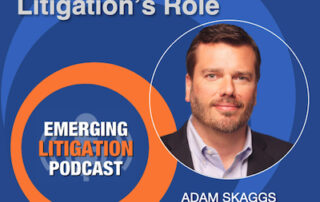
Litigation’s Role in Gun Safety Advocacy with Adam Skaggs
We’re closing in on 400 million guns in America, weapons that have been used to kill 1.5 million Americans between 1968 and 2017. Can litigation be an effective tool in curbing this loss of life? In 2020 alone there were more than 45,000 gun deaths. The beyond tragic and senseless mass shootings at schools has become all too routine. Most Americans want stricter gun laws which they believe will reduce the senseless killing in our country, which leads the world in both the number of privately owned firearms and gun-related deaths. The Supreme Court, of course, didn't take public opinion into account when it struck down a more than century old New York City ban on concealed firearms. Politicians do, however, pay close attention to polls. At the federal level, President Joe Biden signed a bipartisan law designed to make Americans safer in our gun-toting nation. Hailed as a "great start" and a rare but welcome exercise in reaching across the aisle, the law will result in safer citizens, but didn't include much of what gun advocates say is really needed to effect meaningful change. In California, Governor Gavin Newsom signed a new law that gives citizens incentives to pursue gun manufacturers and dealers who sell illegal firearms. In New York, Democratic leaders, undaunted by the Supreme Court, have pushed through new gun restrictions at vulnerable locations like schools, malls, and stadiums. But what can lawyers and lawsuits do about it? Plenty. What reasonable measurers can be put into place that will not infringe on Second Amendment rights? Several. Are we seeing litigation over these issues? You bet. For more specifics, listen to my interview with Adam Skaggs, chief counsel and policy director at leading gun safety advocacy group Giffords Law Center, co-founded by former Congresswoman Gabby Giffords. Prior to Giffords Law [...]
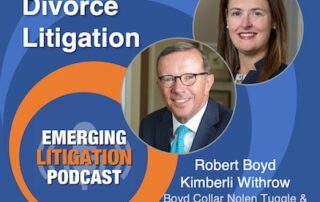
High-Asset Divorce Litigation with Robert D. Boyd and Kimberli C. Withrow
High-Asset Divorce Litigation Let's assume this is good news. The divorce rate appears to be coming down. Either people are more committed to these unions or have succumbed to lifetimes of misery. But the common belief -- that "50% of all marriages end in divorce" -- doesn't enjoy statistical support. Six percent of people who divorce get back together, so that's something, too. According to Monster.com, the rate is higher among people working in fading industries, like certain machine operators. Despite frequent coverage of Hollywood breakups, they don't mention entertainers, other than dancers and choreographers, who don't fare well in marriage. Lawyers, in general, do not have a particularly high divorce rate. For insights into high-asset divorces, listen to my interview with Robert D. Boyd and Kimberli C. Withrow of Boyd Collar Nolen Tuggle & Roddenbery. Bob Boyd is a widely recognized leader in the practice of high-net-worth divorce litigation and contested custody cases. He is a former prosecutor and a U.S. Army Ranger and Paratrooper. Education: J.D., West Virginia University (Editor-in-Chief, West Virginia Law Review); B.A., United States Military Academy at West Point. Kimberli Withrow has 16 years’ experience representing clients in family law matters. She has served as trial counsel and hearings involving divorce, child custody, and child support matters. Education: J.D., Emory University School of Law; B.A., Duke University.Speaking of which, this podcast is the audio companion to the Journal on Emerging Issues in Litigation. The Journal is a collaborative project produced by HB Litigation Conferences and the Fastcase legal research family, which includes Full Court Press, Law Street Media, and Docket Alarm. The podcast itself is a joint effort between HB and our friends at Law Street Media. If you have comments or wish to participate in one our projects, or want to tell me how much you learned today – or [...]
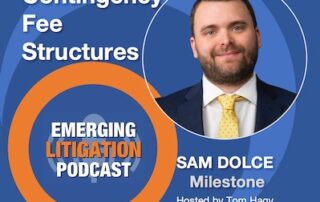
Attorney Fees and Settlement Funds with Sam Dolce
Our Guest As an attorney at Milestone, Sam Dolce provides in-depth, comprehensive consultations with attorneys about qualified settlement funds, fee deferral, and settlement planning. He also oversees the establishment of QSFs. Sam received a Bachelor of Arts in History from Macalester College, followed by a Juris Doctor from SUNY Buffalo Law School. He served as a participant in the New York State Pro Bono Scholar Program and has received multiple acknowledgements and awards for his dedication to pro bono service and social justice. As a subject matter expert, Sam is a regular speaker and presenter at academic and legal conferences regarding post-settlement strategies. Attorney Fees and Settlement Funds with Sam Dolce Uncle Sam has created a way for you keep more of your hard-won settlement or award, but there is much to consider and new information to weigh. When a contingency fee case reaches a verdict or settlement, it’s a big day for a plaintiff attorney. You have worked hard and shouldered litigation costs -- often for years without compensation -- to achieve the best outcome for your client. In this episode I get to speak with a financial management professional who specializes in advising trial attorneys how they can take full advantage of attorney fee structures. The concept of fee deferral arrangements may be familiar to you, but the landscape continues to evolve. My guest is Sam Dolce, an attorney with Milestone, a financial firm that optimizes settlement funds for trial attorneys and plaintiffs. Sam consults with legal professionals about about Qualified Settlement Funds, fee deferrals, and settlement planning. Sam received his B.A. from Macalester College and his J.D. from SUNY Buffalo Law School. Thanks to Sam for sharing his insights. On a previous episode you can hear Sam's colleague, Erin Waas, who heads [...]
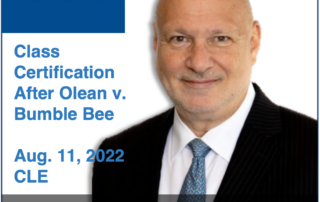
Class Certification After Olean v. Bumble Bee with Jonathan Rubin of MoginRubin LLP
Featured Speaker Jonathan focuses his practice exclusively on antitrust and competition law and policy. As a litigator, he has led trial teams in major antitrust cases in courts throughout the country. As a thought-leader in competition law, he has published in influential academic journals and has spoken to numerous professional groups, including the Directorate General for Competition of the European Commission, the Antitrust Section of the American Bar Association, the University of Wisconsin, and the American Antitrust Institute. Jonathan has also made several appearances before congressional committees. More About Rubin For more information please email Tom Hagy Explore more from MoginRubin LLP! Blog: Emboldened by New Resources and Expanded Authority, Feds Continue 10-Year Look Back at Chinese Investment. By Dan Mogin, Jonathan Rubin, Jennifer Oliver, and Timothy LaComb. List OnDemand CLE Webinar: The Antitrust Case Against Google. Dan Mogin, Jonathan Rubin, Jennifer Oliver, Timothy LaComb, John Newman, Dr. Alan Grant Blog: FTC’s Case Against Facebook Will Test the Flexibility of U.S. Antitrust Law.Authors: Jonathan Rubin and Jennifer Oliver, MoginRubin LLP Blog: Full Ninth Circuit Removes Unwarranted Hurdles to Class Certification. Journal: Policy Derailed: Can U.S. Antitrust Policy Toward Standard Essential Patents Get Back on Track by Jonathan Rubin Webinar: Class Certification After Olean v. Bumble Bee with Jonathan Rubin, James Bogan lll, Jonathan Cohn, Bradley Hamburger. Journal: FTC v. Amazon: Market Definitions and Section 5 of the FTC Act Podcast: Algorithmic Software Facilitated Price Fixing with Jonathan Rubin Plus, additional insights from the MoginRubin Blog. Class Certification After Olean v. Bumble Bee Expert Testimony, Uninjured Class Members, and Article III Standing This CLE course will discuss the ramifications arising from the Ninth Circuit’s en banc decision in Olean Wholesale Grocery v. Bumble Bee Foods, 31 F.4th 651 (9th Cir. 2022) (en banc), addressing numerous important class certification issues. [...]
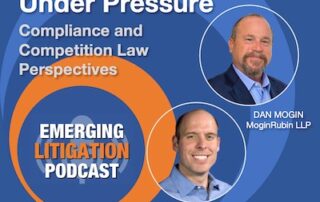
Under Pressure: How’s the Integrity of Your Supply Chain? — with Dan Mogin and Travis Miller
Our Guests Travis is an international trade and compliance attorney who specializes in ITAR/EAR/sanctions, global anti-corruption and anti-slavery, codes of conduct, environmental health and safety, product stewardship, and corporate social responsibility. Travis manages Assent’s worldwide legal activities, advises the Board of Directors on legal matters, and oversees corporate compliance, governance initiatives, and other commercial transactions. Before coming to Assent, he served in various high-level counsel positions with companies such as Microchip Technology, Foresite Group, and St. Jude Medical. Dan Mogin is co-founding and managing partner of MoginRubin LLP, a leading boutique law firm that focuses on antitrust law and other complex business disputes. A true thought leader in the field, Dan has served as lead counsel in numerous large antitrust cases, chaired the Antitrust Section of the California Bar, taught antitrust law, and was editor-in-chief of a leading competition law treatise. Under Pressure: How's the Integrity of Your Supply Chain? -- with Dan Mogin and Travis Miller Pressure builds when budgets are cut and fewer resources are available to maintain the necessary vigilance to remain compliant with often complex and changing regulations. Corporate risk can be caused by laxity, inattention, misconduct, unethical behavior, or even illegal activities by people and organizations in your supply chain. Often these things are what happen when people are under pressure. They may feel pressure to bend rules to hit sales targets, or they feel significant competitive pressure. Listen to my interview in two acts with Travis Miller, General Counsel at Assent Compliance Inc. and Dan Mogin is co-founding and managing partner of MoginRubin LLP, a leading boutique law firm that focuses on antitrust law and other complex business disputes. In Act 1 we discuss the conduct of a fictitious airline that is marketing itself as a green company [...]
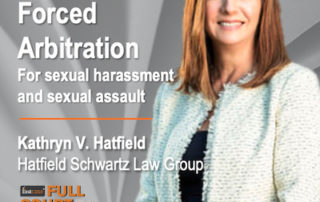
The “Ending Forced Arbitration of Sexual Assault and Sexual Harassment Act of 2021” Finally Levels the Playing Field by Kathryn Hatfield
The Author Kathryn V. Hatfield (khatfield@hatfieldschwartzlaw.com) is a partner in the women-owned law firm of Hatfield Schwartz Law Group LLC where she focuses on advising and representing management in labor and employment law matters. Kathryn is a member of the Editorial Advisory Board for the Journal of Emerging Issues in Litigation. Interviews with leading attorneys and other subject matter experts on new twists in the law and how the law is responding to new twists in the world. The “Ending Forced Arbitration of Sexual Assault and Sexual Harassment Act of 2021” Finally Levels the Playing Field "While arbitration offers privacy and confidentiality, it is for exactly these reasons that the #MeToo movement developed. Moreover, other than perhaps the differences in the speed of the two processes, the advantages of arbitration can be flipped on their head and become disadvantages." Abstract: The Equal Employment Opportunity Center alone receives on average approximately 7,000 sexual harassment claims a year, a figure that does not include claims filed with state and local agencies. The cost of resolving these claims logged by the EEOC averages $63 million a year based on the past four years. On average, there are nearly 464,000 victims (age 12 or older) of rape and sexual assault in the United States each year. The Centers for Disease Control and Prevention reports that nearly 1 in 5 women in America experiences a rape or attempted rape, and nearly 44 percent of women and about 25 percent of all men experience some form of sexual violence in their lifetime. A White House statement called sexual assault a “public health crisis.” But victims of sexual harassment and assault in the workplace have not had open access to the courts due to mandatory arbitration [...]
Alternative Financial Support for Plaintiffs During Litigation with Erin Waas
Our Guest Erin Waas is Executive Director of The Milestone Foundation, a national 501(c)(3) nonprofit that provides financial assistance to people pursuing a personal injury lawsuit. Erin brings nearly two decades of experience working in the public sector and with nonprofits in fundraising and communications, most recently at the University at Buffalo, where she served as senior advancement writer. Prior to relocating to Buffalo, Erin spent the bulk of her career to-date in Boston, where she worked in stewardship at Harvard University and as a consultant for nonprofits of all sizes. Alternative Financial Support for Plaintiffs During Litigation with Erin Waas For an individual, merely navigating litigation can be expensive, time consuming, and at times overwhelming. But when that individual is also unable to work, or cannot function normally because they have been disabled by an injury, that explodes the level of stress on a person and their family. There are companies in the "non-recourse settlement advancement" space that will provide financial support to claimants in litigation. This helps them with their regular daily expenses – plus medical costs – until their case settles or until they receive an award. But most of these companies, as you can imagine, are for-profit entities. As such, their fees can make their support unaffordable and can leave the plaintiff with a substantially diminished payout. Listen to my interview with Erin Waas, Executive Director of The Milestone Foundation, a national 501(c)(3) nonprofit that provides financial assistance to people pursuing a personal injury lawsuit. Erin brings nearly two decades of experience working in the public sector and with nonprofits in fundraising and communications, most recently at the University at Buffalo, where she served as senior advancement writer. Prior to relocating to Buffalo, Erin spent the bulk of her [...]
Antiracism and Antitrust with Eric Cramer
Our Guest Eric Cramer is Chairman of the Firm and Co-Chair of the Firm’s antitrust department. He has a national practice in the field of complex litigation, primarily in the area of antitrust class actions. He is currently co-lead counsel in multiple significant antitrust class actions across the country in a variety of industries and is responsible for winning numerous significant settlements for his clients totaling well over $3 billion. Mr. Cramer is also a frequent speaker at antitrust and litigation related conferences and a leader of multiple non-profit advocacy groups. He was the only Plaintiffs’ lawyer selected to serve on the American Bar Association’s Antitrust Section Transition Report Task Force delivered to the incoming Obama Administration in 2012. Antiracism and Antitrust with Eric Cramer Among the legal and regulatory avenues one might follow to mitigate the impact of racism, most of us would look to various manifestations of discrimination law in employment, lending, real estate, education, healthcare, voting rights, and other categories. When presented in those contexts, the anti-racism objectives are clear. There are several federal laws and many state laws that prohibit anticompetitive behavior. At the top of the heap is the Sherman Antirust Act of 1890, which outlaws illegal monopolies and anticompetitive tactics, conspiracies to restrain trade, cartels and syndicates. But what do wages, including those paid to minorities, have to do with antitrust? What about no-poach agreements, whereby groups of companies agree not to hire employees away from each other? The answer is "quite a lot." Listen to my interview with Eric Cramer, Chairman of Berger Montague and co-chair of the firm's antitrust department, a team that handles antitrust class actions across the country involving a variety of industries. Eric and the firm are responsible for winning numerous significant settlements for [...]

Wildfire Claims and Coverage
The Authors Scott P. DeVries (sdevries@huntonak.com) is a special counsel in the Hunton Andrews Kurth LLP’s Insurance Coverage group in the firm’s San Francisco office where he exclusively represents policyholder clients. An experienced trial and appellate lawyer who has served as lead counsel in landmark appeals in the field of insurance coverage in the California Supreme Court, the Ninth Circuit, and the California Court of Appeal, as well as high-value jury trials, Scott routinely represents clients throughout the country seeking recovery from their insurers on a wide range of insurance issues arising under first-party property policies, comprehensive general liability policies, directors and officers policies, EPLI policies, crime policies, crypto and digital asset policies, and cyber policies. Yosef Itkin is an associate in Hunton Andrews Kurth LLP’s Insurance Coverage group in the firm’s Los Angeles office. His practice focuses on representing and advising corporate policyholders in complex insurance coverage matters. Interviews with leading attorneys and other subject matter experts on new twists in the law and how the law is responding to new twists in the world. Wildfire Claims and Coverage "The wildfires are causing enormous losses for innumerable businesses on the West Coast. Often, you should be able to work with your adjuster to reach a satisfactory resolution. But where needed, you may wish to reach out to policyholder-side lawyers—whether to test what you may be entitled to or to help maximize recovery." Abstract: Wildfires destroy millions of acres a year in the United States, spewing smoke across much of the nation. The cost of damage alone over the past several years soars into the hundreds of billions. When policyholders turn to their insurers many benefit from the coverage they wisely secured. But not all policyholders get the [...]

Biometric Privacy Laws: Companies Will Need Insurance as Protection From New and Expanding Liability
The Authors * Cort T. Malone (cmalone@andersonkill.com) is a shareholder in the New York and Stamford offices of Anderson Kill and practices in the Insurance Recovery and the Corporate and Commercial Litigation Departments. He represents policyholders in insurance coverage litigation and dispute resolution, with an emphasis on commercia general liability insurance, directors and officers insurance, employment practices liability insurance, advertising injury insurance, and property insurance issues. Jade W. Sobh (jsobh@andersonkill.com) is an attorney in Anderson Kill’s New York office. Jade focuses his practice on insurance recovery, exclusively on behalf of policyholders, as well as regulatory and complex commercial litigation matters. Interviews with leading attorneys and other subject matter experts on new twists in the law and how the law is responding to new twists in the world. Biometric Privacy Laws: Companies Will Need Insurance as Protection From New and Expanding Liability "Businesses may look to various types of insurance policies for protection from the sudden and ever-increasing liability under present and soon to pass biometric data privacy laws, including commercial general liability insurance, employment practices liability insurance, cyber insurance, and directors & officers (D&O) insurance." Abstract: As more states follow Illinois in enacting biometric privacy laws, the risk that companies will be hit with lawsuits and extensive damages awards increases. Employers are among the most active collectors of this type of data, collecting fingerprints and deploying facial recognition for timekeeping and security purposes. Several multi-million-dollar settlements have been reported for violations of biometric privacy laws. Meta, formerly Facebook, paid $650 million to resolve claims that it improperly stored face scans of its users. When companies turn to their insurance carriers, policyholders have a good track record of receiving coverage. Now that these claims are becoming more prevalent, [...]
Asymmetrical Combat: Bad Faith Liability in Insurance Recovery Cases
The Author William G. Passannante is co-chair of Anderson Kill’s Insurance Recovery Group and is a nationally recognized authority on policyholder insurance recovery in D&O, E&O, asbestos, environmental, property, food-borne illness, and other insurance disputes, with an emphasis on insurance recovery for corporate policyholders and educational and governmental institutions. Interviews with leading attorneys and other subject matter experts on new twists in the law and how the law is responding to new twists in the world. Asymmetrical Combat: Bad Faith Liability in Insurance Recovery Cases "Insurance policies are a unique product that requires the policyholder perform first—by paying insurance premiums—while the insurance company’s performance—the payment of the claim amount—is delayed until the insurance company determines to do so." Abstract: Policyholder counsel see claims that an insurer violated its duty of good faith and fair dealing is an essential tool in leveling the playing field in policyholder–insurer disputes, especially in high-stakes litigation. Insurance companies write the policies, employ lobbyists, exchange information with each other, and, of course, have more experience handling claims. So, the author writes, bad faith allegations bring more balance to the relationship and provide a disincentive to “the profitable breach of the insurance promise.” He discusses above-policy limits risks for insurers, as well as attorneys’ fees, interest on unpaid claims, punitive damages, and more. Introduction: Bad faith insurance litigation presents high-stakes risks for insurance companies in the unbalanced battle between insurance companies and their policyholders. The asymmetric nature of the insurance claims process—insurance companies draft the insurance policies, lobby legislatures as an industry repeat litigant, exchange superior information among themselves, and have more experience with claims than any policyholder—means that policyholders need a counterbalance. Insurance company liability for bad faith and related above-policy limits liabilities [...]
Episode Three: Karla Gilbride Tells Her Story Behind the Unanimous Pro-Employee Win at the Supreme Court
DietaFit: Lose weight and stay fit - Page 6 | Diet, Fitness and Wellbeing | Page 6 dianabol pills gina fitness nude hentai clips Karla Gilbride Tells Her Story Behind the Unanimous Pro-Employee Win at the Supreme Court The Federal Arbitration Act is clear, Supreme Court Justice Elena Kagan wrote: “[C]ourts are not to create arbitration-specific procedural rules …. Or put conversely, it is a bar on using custom-made rules, to tilt the playing field in favor of (or against) arbitration.” With the support of all eight of her colleagues, Justice Kagan’s opinion in Morgan v. Sundance put an end to the long-running tilt of justice toward employers in the form of judge-made rules that favor arbitration. This important holding clears the way for more workers, consumers, and other individuals harmed by corporate misconduct to pursue their rights in open court. Karla Gilbride, Senior Attorney at Public Justice, argued the case to the high court on behalf of the plaintiff, Robyn Morgan, an hourly employee at a Taco Bell franchise owned by Sundance, Inc. It was not only Gilbride’s first Supreme Court argument, but she was the first blind attorney to do so in the court’s history. Listen to Public Justice’s Ellen Noble — who assisted in the case — as she interviews Gilbride about her remarkable experience. This is a must listen not only for attorneys who represent workers, but for anyone interested in Supreme Court history, or the ongoing need for accommodations for the disabled, or anyone preparing for oral arguments at any level. Gilbride shares the thrill of arguing in the same spot — and directly in front of! — some of her heroes and inspirations. She also shares that, like a music fan who camps out in front of a box office to get tickets for [...]
Taking the High Ground: Where Cannabis Insurance Litigation Is Trending (and Why)
The Authors John B. McDonald is an experienced litigator practicing in the Seattle and New York offices of Harris Bricken, where he represents clients in complex commercial, insurance, and partnership matters. Jihee Ahn is an experienced complex commercial litigator with Harris Bricken. She also chairs the firm’s Dispute Resolution/Litigation practice. Interviews with leading attorneys and other subject matter experts on new twists in the law and how the law is responding to new twists in the world. Taking the High Ground: Where Cannabis Insurance Litigation Is Trending (and Why) "Absent a choice of law provision, the location where most of the insured activity took place will likely dictate which law applies. But how have federal courts reacted to applying cannabis-friendly state law in a forum where federal law arguably addresses underlying state concerns? The answer is: inconsistently." Abstract: The use and possession of cannabis remains illegal under the federal Controlled Substances Act. But a patchwork of state laws is bringing the country closer to some form of legalization. Some states allow its use for medical purposes, others have made it legal for recreational purposes, and others have decriminalized it. But when cannabis is involved in disputes that lead to litigation, and that litigation leads to policyholder–insurer disputes, that state law patchwork and the illegality of cannabis under federal law is when things get complicated. This tension plays out in several other aspects of running a cannabis business, such as banking and interstate transportation of goods. In this article, the authors discuss how it is up to litigators to frame their cases in ways that will determine the outcome of important disputes over insurance coverage. Introduction: Like several other litigation issues presented by the (legal) emerging cannabis [...]


Cannabis Coverage Litigation with John McDonald and Jihee Ahn
Our Guests John B. McDonald is an experienced litigator practicing in the Seattle and New York offices of Harris Bricken, where he represents clients in complex commercial, insurance, and partnership matters. Prior to joining Harris Bricken, John spent two years in Seattle with the Office of Chief Counsel, U.S. Customs and Border Protection (a component agency of the Department of Homeland Security), and five years in New York City at O’Melveny & Myers LLP, where he managed several cases. John graduated from the University of Miami School of Law, where he was an editorial member of the University of Miami Law Review. He also served as a research assistant for Professor Charlton Copeland on civil procedure and constitutional issues. Jihee is an experienced complex commercial litigator and chair of Harris Bricken’s Dispute Resolution/Litigation practice. She primarily represents clients in business, intellectual property, and real estate matters for both domestic and international clients. Having worked extensively in both federal and state courts, Jihee advises her clients from case intake through arbitration and trial. Over the course of her career, she has successfully prepared and argued numerous procedural and substantive motions, regularly conducted and defended depositions, and mediated disputes when appropriate for her clients. Prior to joining Harris Bricken, Jihee worked at Baker & Hostetler in Los Angeles, where she served as the lead attorney on several cases and mentored junior associates. Jihee graduated from the UCLA School of Law with a Business Law and Policy Specialization, and she served as a research assistant to Professor Sung Hui Kim on securities regulation issues throughout her third year of law school. Prior to relocating to Buffalo, Erin spent the bulk of her career to-date in Boston, where she worked in stewardship at Harvard University and as a consultant for nonprofits of [...]
Takeaways from the SEC’s $100M Fine Against FinTech Lender BlockFi
Our Guest Brad is a partner in the Greenville, South Carolina, office of Nelson Mullins Riley and Scarborough where he chairs the firm’s Financial Services Regulatory Practice, leading a team of attorneys in a national practice representing clients in financial regulatory and FinTech matters. He is a valued member of the Editorial Board of Advisors for the Journal on Emerging Issues in Litigation, a companion to this podcast. Takeaways from the SEC's $100M Fine Against FinTech Lender BlockFi So, apparently this is true: Running a lending operation without registering with the SEC makes them crabby. Spoiler Alert: On Valentine’s Day this year the SEC announced a $100 million fine against retail crypto lender BlockFi Lending. Nothing says "will you be mine?" like a nine-figure bill -- for that special someone who has everything. The company agreed to put an end to some of its offers and sales, and to get to work bringing itself into compliance with, you know, the law, like the Securities Act of 1933 and the Investment Company Act of 1940. So, what does the SEC want companies to do? What remedies does the SEC have for unregistered securities offerings? What impact will this have on private litigation? Is there a risk that BlockFi Interest Account investors will have claims against BlockFi? Want to find out? Listen to my interview with attorney Brad Rustin. Brad is a partner in the Greenville, South Carolina, office of Nelson Mullins Riley and Scarborough where he chairs the firm’s Financial Services Regulatory Practice, leading a team of attorneys in a national practice representing clients in financial regulatory and FinTech matters. This is Brad’s third appearance on the podcast! He spoke on one episode about the Impact of the Russia Sanctions on Global Financial Markets, and on another popular [...]

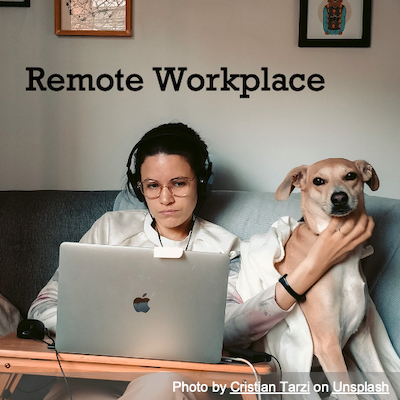
Workplace Investigations: Proactive Assessments Mitigate the Risk of Costly Litigation in a Newly Remote Environment
The Author Stefani C Schwartz is Senior Managing Partner at the Hatfield Schwartz Law Group LLC. She has devoted her career to representing and advising employers in the complete spectrum of employment law, including discrimination, harassment, retaliation, and wrongful termination. Stefani is a member of the Editorial Advisory Board of the Journal of Emerging Issues in Litigation. Interviews with leading attorneys and other subject matter experts on new twists in the law and how the law is responding to new twists in the world. Workplace Investigations: Proactive Assessments Mitigate the Risk of Costly Litigation in a Newly Remote Environment "Investigations are a straightforward, efficient, and effective way to combat the risk of litigation because they reflect the best aspects of the employer–employee relationship: understanding, respect, communication, and shared goals." Abstract: “Bullying, discrimination, sexual harassment and other forms of workplace misconduct can create a crisis for any company—and trying to ignore or cover it up will make a bad situation worse.” That’s the warning from a December 2021 article for Forbes, which goes on to say that in addition the damage to an employer’s reputation, a study by workplace misconduct reporting service Vault Platform found that workplace misconduct cost U.S. businesses more than $20 billion in 2021. In this article, the author discusses how proactively conducting workplace investigations can reduce an employer’s risk of winding up in court and paying the considerable tangible and intangible costs of misconduct, a risk further complicated by an increasingly home-based workforce. Excerpt: During the past two years, the COVID-19 pandemic has introduced new factors in the ever-shifting area of employer liability: large-scale layoffs and furloughs, the introduction and/or expansion of possibilities for remote work, the drive for a safe return to [...]
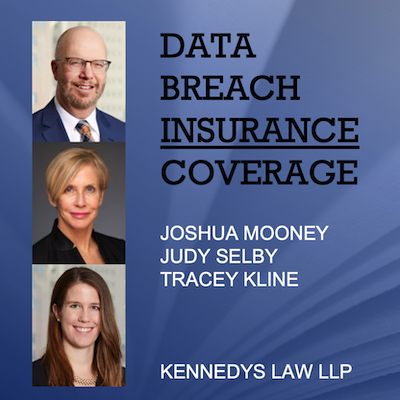
 Analysis of Target Decision that Loss-of-Use Damages Included Card Replacement Costs Post-Data Breach | By Joshua Mooney, Judy Selby, and Tracey Kline | Kennedys Law Gallery
Analysis of Target Decision that Loss-of-Use Damages Included Card Replacement Costs Post-Data Breach | By Joshua Mooney, Judy Selby, and Tracey Kline | Kennedys Law
Analysis of Target Decision that Loss-of-Use Damages Included Card Replacement Costs Post-Data Breach | By Joshua Mooney, Judy Selby, and Tracey Kline | Kennedys Law
A Significant Deviation: Target v. Ace Finds Loss-of-Use Damages Included Post-Breach Card Replacement Analysis On March 22, 2022, the United States District Court for the District of Minnesota ruled that two ACE insurers were obligated to indemnify Target Corporation (“Target”) for the amounts it paid to settle claims related to replacement of payment cards impacted in a data breach, vacating an earlier decision in which the court found that Target was not entitled to coverage. Target Corp. v. ACE Am. Ins. Co., No. 19-CV-2916 (WMW/DTS), 2022 WL 848095 (D. Minn. Mar. 22, 2022), vacating 517 F. Supp. 3d 798 (D. Minn. 2021). The new decision deviates from how other courts have evaluated general liability coverage for damages because of “loss of use of tangible property that is not physically injured.” Insurers would do well to take notice. Background In 2013, Target was the victim of a massive data breach that occurred after hackers installed malicious software on its computer network, which enabled them to steal the payment card data and personal contact information of an estimated 110 million individuals with Target payment cards (the “Data Breach”). Multiple lawsuits were brought against Target, including suits by financial institutions (the “Issuing Banks”) that had issued debit and credit cards (the “Payment Cards”) affected by the Data Breach. The Issuing Banks filed class action lawsuits against Target, which were consolidated, along with various consumer suits, in the United States District Court for the District of Minnesota, in In re: Target Corporation Customer Data Security Breach Litigation, All Financial Institutions Cases, MDL No. 14-2522 (the “Issuing Banks Litigation”). In their Consolidated Class Action Complaint, the Issuing Banks asserted various causes of action against Target, including a claim for negligence by which they alleged that Target breached its duty to implement adequate technical systems or [...]

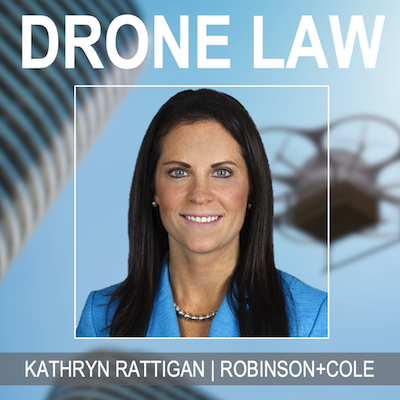
Flying Cameras: Gaps in Drone Regulation and How Courts Can Fill Them … at Least for Now
Authors With deep experience in the law and regulation of unmanned aerial vehicles, Kathryn practices in the Providence, R.I., offices of Robinson+Cole. She is a member of the firm’s groups that focus on business litigation, data privacy and security, and drone compliance. Kathryn is also a member of the Editorial Board of Advisors for the Journal on Emerging Issues in Litigation and the Emerging Litigation Podcast. Blair Robinson is a cybersecurity intern at Robinson+Cole. She will graduate in 2023 with a J.D. from the Roger Williams University School of Law to complement her Masters of Science degree in Cybersecurity also from Roger Williams University. Get CLE Flying Cameras: Gaps in Drone Regulation and How Courts Can Fill Them … at Least for Now Drones have rapidly transformed dozens of industries since hitting the commercial market. International aid groups use medical drones to deliver life-saving medications and vaccines to remote areas. Agricultural drones have revolutionized how farmers tend their fields. Film and television producers embrace drones for their ability to capture once prohibitively expensive or outright impossible camera shots. Hobbyists love the technology for a variety of recreational purposes. However, as drones have become increasingly commonplace, lawmakers and policymakers have struggled with effectively regulating this emerging domain. In addition, no federal law, state law, or industry best practice adequately addresses the unique privacy and cybersecurity risks drone operations pose. Until federal regulation catches up with the technology, lawyers could move courts to mitigate the issue by arguing for strict liability for drone operators and manufacturers. Although drones may seem like traditional aircraft, they actually pose unique privacy concerns. Drone systems rely on real-time and simultaneous data exchanges between the operator, GPS positioning, cloud-based processing and telemetry, and the drone itself. Each facet [...]
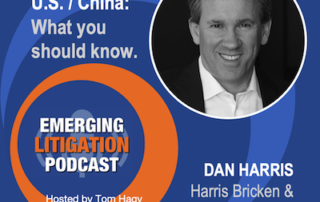


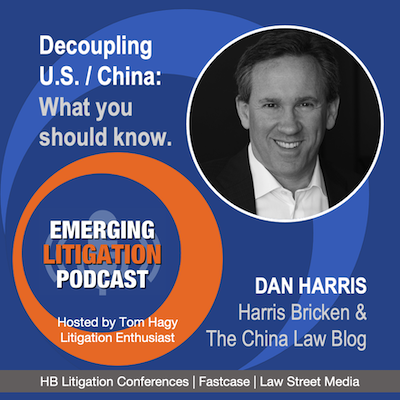
What Businesses and Lawyers Should Know About the U.S./China Relationship
Our Guest Dan Harris is a leading authority on the legal and strategic aspects of conducting business in emerging markets. He is co-founder of the international practice of Seattle-based HarrisBricken, which has offices across the U.S., as well as in China, Spain, Mexico, and Brazil. His China Law Blog was named, and with good reason, to the ABA Journal’s “Blawg Hall of Fame.” Forbes, Business Week, Fortune, The BBC, The Wall Street Journal, The Washington Post, The Economist, CNBC, The New York Times, and many other major media players have looked to him for his perspective on international law issues. Dan writes and speaks extensively on international law with a focus on protecting businesses in their foreign operations and he has had the rare honor of being designated a “Super Lawyer.” He is also a member of the Editorial Board of Advisors for the Journal on Emerging Issues in Litigation and the Emerging Litigation Podcast. What Businesses and Lawyers Should Know About the U.S. / China Relationship “Americans mistakenly believe that China operates as a rational economic actor and that economics is their highest priority. It’s not and it never has been. Their highest priority is whatever is good for the Chinese Communist Party.” “Chinese companies view American and EU companies as very risky, in large part because so many American and EU companies are looking to move their manufacturing out of China.” A major potential avalanche of risks are those that would shake the business world should – as some expect it will – trade relations between China, and America and EU, come to an end. China is America’s largest trading partner, a relationship responsible for $600B a year in commerce, according to the Office of the U.S. Trade Representative. By comparison, U.S. [...]

Full Ninth Circuit Removes Unwarranted Hurdles to Class Certification
The Authors Co-founding partner at MoginRubin LLP, Jonathan Rubin focuses his legal practice exclusively on antitrust and competition law and policy. Based in Washington, DC, he has litigated and led trial teams in major antitrust cases throughout the country. He has published in influential academic journals and has spoken to numerous professional groups, including the Directorate General for Competition of the European Commission, the Antitrust Section of the American Bar Association, and the American Antitrust Institute. Dan Mogin, founding and managing partner of MoginRubin LLP, concentrates his practice on antitrust, unfair competition and complex business litigation. He has served as lead counsel in numerous large antitrust cases, chaired the Antitrust Section of the California Bar, taught antitrust law and was editor-in-chief of a leading competition law treatise. Explore more from MoginRubin LLP! Blog: Emboldened by New Resources and Expanded Authority, Feds Continue 10-Year Look Back at Chinese Investment. By Dan Mogin, Jonathan Rubin, Jennifer Oliver, and Timothy LaComb. List OnDemand CLE Webinar: The Antitrust Case Against Google. Dan Mogin, Jonathan Rubin, Jennifer Oliver, Timothy LaComb, John Newman, Dr. Alan Grant Blog: FTC’s Case Against Facebook Will Test the Flexibility of U.S. Antitrust Law.Authors: Jonathan Rubin and Jennifer Oliver, MoginRubin LLP Blog: Full Ninth Circuit Removes Unwarranted Hurdles to Class Certification. Jonathan Rubin, Dan Mogin. Journal: Policy Derailed: Can U.S. Antitrust Policy Toward Standard Essential Patents Get Back on Track by Jonathan Rubin Webinar: Class Certification After Olean v. Bumble Bee with Jonathan Rubin, James Bogan lll, Jonathan Cohn, Bradley Hamburger. Journal: FTC v. Amazon: Market Definitions and Section 5 of the FTC Act Podcast: Algorithmic Software Facilitated Price Fixing with Jonathan Rubin Plus, additional insights from the MoginRubin Blog. Full Ninth Circuit Removes Unwarranted Hurdles to Class Certification “Nothing in Rule 23 suggests that the presence of more [...]
Overconfidence: A Risky but Pervasive Phenomenon in Litigated Disputes
The Author Jeff Trueman (jt@jefftrueman.com) is an experienced, full-time mediator and arbitrator. He helps parties resolve a wide variety of litigated and pre-suit disputes and interpersonal problems concerning catastrophic injuries, wrongful death, professional malpractice, employment, business dissolution, real property, and domestic relations. Jeff is a past Director of Dispute Resolution for the Circuit Court for Baltimore City where he oversaw over 70 retired judges and senior attorneys conducting over 1,500 mediations, settlement conferences, and neutral evaluations per year. He is a Distinguished Fellow of the International Academy of Mediators, an invitation-only membership organization consisting of some of the most successful commercial mediators in the world. Interviews with leading attorneys and other subject matter experts on new twists in the law and how the law is responding to new twists in the world. Overconfidence: A Risky but Pervasive Phenomenon in Litigated Disputes “Lady Justice symbolizes fairness and impartiality as she oversees the adjudication process. Although she may hold the scales of justice in one hand, she also carries a large sword in her other hand. And she’s blindfolded. Knowing that, how confident should you be?” Abstract: “Overconfidence” may have negative connotations, but it can be beneficial in competitive situations like litigation where parties compete for resources. Nonetheless, posturing and overconfidence of opposing parties and counsel are common frustrations felt by lawyers and claims professionals. Most litigants fail to see themselves as overconfident even though that can result in miscalculations and erroneous risk assessments. Litigants can employ techniques to improve decision making but sometimes going to trial is considered the right decision for reasons that are considered more important than whether the result is better than the last settlement demand or offer. In addition to focusing on legal and financial [...]




Insurance Coverage for PFAS Claims
PFAS Insurance Coverage with Robert D. Chesler of Anderson Kill Listen to my interview with Anderson Kill's Robert D. Chesler, a preeminent expert on insurance coverage law especially in the context of highly complex long-tail claims scenarios involving multiple parties and events that can span decades and always cost many millions of dollars. Considered by many to be an insurance guru on these cases -- as well as on D&O, cyber and privacy, and intellectual property insurance -- Bob holds a Ph.D. and masters degree from Princeton University, and a J.D. (cum laude) from Harvard Law School. This podcast is the audio companion to the Journal on Emerging Issues in Litigation, and Bob is one of our most valued editorial advisors. The Journal is a collaborative project between HB Litigation Conferences and the Fastcase legal research family, which includes Full Court Press, Law Street Media, and Docket Alarm. The podcast itself is a joint effort between HB and our friends at Law Street Media. If you have comments or wish to participate in one our projects, or want to tell me how much you learned from Bob, please drop me a note at Editor@LitigationConferences.com. Tom Hagy Host and Litigation Enthusiast P.S. The fact that I make myself laugh during these interviews probably has less to do with the subject matter (most definitely, is more precise) or my sense of humor, and more to do with cabin fever. Or I'm just nuts. The PFAS family of chemicals is one stubborn bunch. They are a class of man-made products dubbed "forever chemicals," because of the difficulty of removing them from the environment, humans, and other animals. They are also at the center of sprawling litigation around the country involving alleged property damage, water contamination, and bodily injury. More than 1,500 cases are consolidated in closely-watched multi-district litigation in federal [...]