DARN! Nothing here. Apologies.
Emerging Litigation Podcast
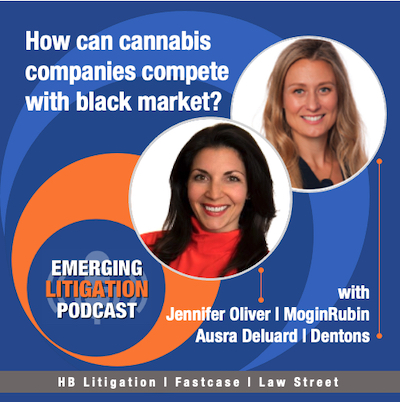
Cannabis Industry Competition Law with Ausra Deluard and Jennifer Oliver
Attorneys Ausra Deluard and Jennifer Oliver on Cannabis Industry Competition Law What can legitimate cannabis companies do to level the playing field, not only against others who walk the straight and narrow, but dealers still thriving on the black market? It was my pleasure to interview Ausra Deluard and Jennifer Oliver for what was an informative and even surprising podcast. It's based on their article -- Clearing the Haze: State Laws and Private Plaintiffs Critical to Preserve Competition in Cannabis -- which will be featured in the inaugural issue of the Journal on Emerging Issues in Litigation, which will release in January 2021. Ausra, who is an attorney with the global law firm Dentons LLP, has spent more than a decade advising clients in a range of antitrust matters including merger investigations, competitor collaborations, and pricing and distribution policies. She works closely with cannabis clients to help them navigate the rapidly evolving cannabis laws and regulations throughout the U.S. Jennifer is a partner at national antitrust boutique MoginRubin LLP, where she litigates and advises clients on competition issues. Her work includes representing classes of plaintiffs in class actions, risk mitigation and regulatory advice in mergers and acquisitions, and other complex business litigation. Check out the MoginRubin Blog. The Journal is a collaborative project between HB and the Fastcase legal research family, which includes Full Court Press, Law Street Media, Docket Alarm and, most recently, Judicata. If you have comments or wish to participate in one our projects, or want to tell me how awesome Ausra and Jennifer are, drop me a note at Question@LitigationConferences.com. We hope you enjoy the interview. Tom Hagy Founder & Managing Director HB Litigation Conferences

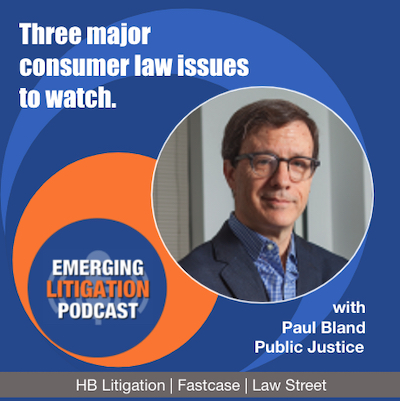
Three Urgent Consumer Class Action Topics with Paul Bland of Public Justice
Three Urgent Consumer Class Action Topics with Paul Bland of Public Justice To discuss these issues, it was my pleasure to interview F. Paul Bland, Jr., Executive Director of Public Justice, an organization that pursues "high impact lawsuits to combat social and economic injustice, protect the Earth’s sustainability, and challenge predatory corporate conduct and government abuses." Paul has argued and won more than 40 cases that led to reported decisions for consumers, employees or whistleblowers, including one victory in the U.S. Supreme Court, and has won one or more cases in six of the U.S. Courts of Appeals and the high courts of 10 different states. This podcast is the audio companion to the Journal on Emerging Issues in Litigation, a collaborative project between HB and the Fastcase legal research family, which includes Full Court Press, Law Street Media, Docket Alarm and, most recently, Judicata. If you have comments or wish to participate in one our projects, or want to tell me how insightful and informative Paul is, please drop me a note at Editor@LitigationConferences.com. We hope you enjoy the interview, and how I slipped in mention of Schrödinger's cat which, as everyone knows (that's sarcasm and self-deprecation), is a thought experiment that illustrates an apparent paradox of quantum superposition. Class actions can be an invaluable tool when consumers need to level the playing field in disputes with corporations. Two important class action cases are currently before the Supreme Court. One case, TransUnion v. Ramirez, involves innocent consumers who were erroneously added to the government's watch list for terrorists and drug smugglers. [Note: We recorded before the Supreme Court handed down its ruling that only plaintiffs concretely harmed by a defendant’s statutory violation have Article III standing to seek damages against that private defendant in federal court.] In the second, Goldman Sachs v. Arkansas Teachers, consumers seek to fend off a decision that could limit securities [...]
Sandra Cianflone on Current and Emerging COVID-19 Litigation
Sandra Cianflone on COVID-19 Litigation in 2021 and Beyond It’s now been more than 18 months since the world was besieged by the novel coronavirus pandemic. In addition to the human toll, it disrupted our lives in ways big and small, new and old, as it raced across continents, first visiting North America in January 2020. There are an estimated 15,000 lawsuits relating to the outbreak, with some 350 filings directed toward the healthcare and medical communities. The number of insurance coverage suits is fast-approaching 1,800. Litigation has been initiated against aging services, hospitals, and healthcare providers, with the next anticipated wave likely to surround vaccines themselves. What will be the basis of these claims? What defenses will we see? And what can healthcare providers do now in anticipation of this onslaught? Joining me to discuss this out-of-the-blue rash of litigation is Sandra M. Cianflone of Hall Booth Smith, P.C. Sandie counsels and defends hospitals, physicians, nurses and institutional employees in a broad spectrum of catastrophic injury and medical malpractice cases. She received her Juris Doctorate from Pace University School of Law and her undergraduate degree from Fairleigh Dickinson University. This podcast is the audio companion to the Journal on Emerging Issues in Litigation, a collaborative project between HB Litigation Conferences and the Fastcase legal research family, which includes Full Court Press, Law Street Media, Docket Alarm and, most recently, Judicata. If you have comments or wish to participate in one our projects, or want to tell me how insightful and informative Sandie is, please drop me a note at Editor@LitigationConferences.com. This podcast is based on an article she wrote for the forthcoming issues of the Journal. I hope you enjoy the interview, and especially a brief story (after we wrap up) about Sandie's experience delivering a baby in the Age of COVID-19. I also mangled a bit of basic Spanish, for which I am ashamed (lo [...]
A Shameless Plug for Our Content Services
Your content marketing is everything you’ve ever dreamed of. Right?
 Sara is marketing director at a boutique law firm. When we asked her how their blog was going, she made a sad face. But then, we made Sara smile.*
Critical Legal Content was founded by Tom Hagy, former Editor & Publisher of Mealey’s Litigation Reports and VP at LexisNexis, founder of HB, current litigation podcaster and editor-in-chief. CLC’s mission is to help smaller firms and service providers not only create content — blogs, articles, papers, webinars, podcasts (like the stuff on this site) — but also to get it out there. How? Via social media, this website, your website, and potential via our podcast and journal which we publish in collaboration with vLex Fastcase and Law Street Media. The goal is to attract readers and dizzy them with your brilliance.
*Inspired by actual events.
Create content like a real legal publisher.
Emerging Litigation Journal

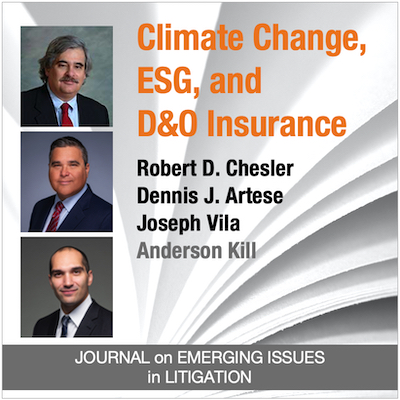
Climate Change, ESG, and D&O Insurance: Collision or Cooperation?
The Authors Robert D. Chesler (rchesler@andersonkill.com) is a shareholder in Anderson Kill’s New Jersey office and is a member of the firm’s Cyber Insurance Recovery Group. Bob represents policyholders in a broad variety of coverage claims against their insurers and advises companies with respect to their insurance programs. Dennis J. Artese (dartese@andersonkill.com) is a shareholder in Anderson Kill’s New York office and chairs the firm’s Climate Change and Disaster Recovery Group. Joseph Vila (jvila@andersonkill.com) is an insurance recovery attorney in Anderson Kill’s New Jersey office. Climate Change, ESG, and D&O Insurance: Collision or Cooperation? By Robert D. Chesler, Dennis J. Artese, and Joseph Villa Abstract: Climate change has been tied to the recent increase in catastrophic weather events. Insurance coverage for often billions of dollars in damage becomes a source of argument between insurers, who want to limit their exposure, and policyholders, who want the coverage they argue the carriers are contractually obligated to pay. The authors discuss the nature of the underlying suits and the potential coverage issues; the types of policies implicated; cases that have addressed these issues; the rising societal concern over climate change that have played a role in the new corporate emphasis on environmental, social, and governance, or ESG, and the insurance industry’s response to this trend. Excerpts: Directors and Officers (D&O) policies [are] directly affected by climate change. Two types of suits are already happening. First, there are at least 1,375 climate change–related suits pending in the United States, about two dozen of which have been filed by local municipalities and states seeking damages because of climate change. For example, the attorneys general of New York, Massachusetts, and the U.S. Virgin Islands launched investigations to determine whether Exxon Mobil Corporation misrepresented to investors the risks of how climate change might impact its business. Although the U.S. Virgin [...]

The Shifting Gun Liability Landscape: Plaintiffs Say Companies are Marketing Illegally, Insurers End Up Paying
The Author Charlie spent more than four decades with General Reinsurance, three-quarters of which as the company’s Emerging Issues Officer. One colleague described him as “one of the most prescient and gifted industry futurists I have met in my 36 year professional career within the insurance industry. Entertaining and insightful, his ability to digest and communicate complex issues, many before they are readily apparent, is both a gift and a talent.” Charlie is also a member of the Editorial Board of Advisors for the Journal on Emerging Issues in Litigation. The Shifting Gun Liability Landscape: Plaintiffs Say Companies are Marketing Illegally, Insurers End Up Paying By Charlie Kingdollar On Feb. 15, 2022, Remington Arms, manufacturer of the Bushmaster AR15-style rifle agreed to pay $73 million to settle a lawsuit filed by the families of nine of the victims of the Dec. 14, 2012, Sandy Hook Elementary School shooting. The $73 million will be paid by four of Remington’s insurers (and likely their reinsurers).[i] Why is this a big deal? Insurers and reinsurers providing liability coverage for gun manufacturers did so believing that federal law protected gun manufacturers from liability arising from shootings under the federal Protection of Lawful Commerce in Arms Act (PLCAA). It seems likely that policy terms and conditions as well as pricing of the risk reflected that perceived liability protection. Things have changed. The Connecticut plaintiffs filed their suit under the Connecticut Fair Trade Practices Act. The plaintiffs alleged that the Bushmaster was a combat weapon and that Remington improperly marketed it to civilians – particularly trying to reach young men. In 2019, the Connecticut Supreme Court ruled that the federal PLCAA did have some carve-outs for state laws and subsequently declined Remington’s request to dismiss the lawsuit. It seems a safe bet that the families of other Connecticut gun violence victims [...]


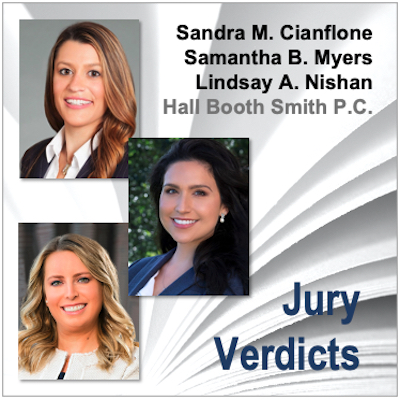
Going Viral or Going Nuclear: Social Inflation’s Impact on Jury Verdicts …
The Authors All three authors are with the law firm of Hall Booth Smith, P.C., and concentrate on various aspects of healthcare defense. Lindsay A. Nishan (lnishan@hallboothsmith.com) is an Associate in the HBS Charleston office. Samantha Bowen Myers (smyers@hallboothsmith.com) is an Associate in their West Palm Beach, Florida, office. Sandra Mekita Cianflone (scianflone@hallboothsmith.com) is a Partner in the firm’s Atlanta office. She is also a member of the Editorial Board of Advisors for the Journal on Emerging Issues in Litigation, and a frequent contributor to the Emerging Litigation Podcast. Going Viral or Going Nuclear: Social Inflation’s Impact on Jury Verdicts and How to Safeguard Against It By Lindsay A. Nishan, Samantha B. Myers and Sandra M. Cianflone A juror’s perception of companies and healthcare providers is increasingly colored by TV and social media. The same is true for their understanding of the practice law or medicine, which may be as wrong as it is immovable. “Social inflation” refers to rising litigation costs and the resulting higher insurance payouts which drive up the cost of insurance. In this article the authors, each of whom represents parties in the healthcare industry, discuss the evolving social trends that lead jurors to render “nuclear verdicts,” and what attorneys should consider in mitigating the effects of this phenomenon. Social media feeds today are crammed with flashy advertisements from lawyers promising big-dollar settlements against “rich insurance companies.” The number of these commercials has spiked since the 1970s as the phenomenon known as "social inflation" has taken root in the legal system. Social inflation is a term of art that refers to rising litigation costs, the impact those costs have on insurance claim payouts, and how much the average policyholder is expected to pay for basic coverage. Recently, the term social inflation has taken on a new meaning as it has [...]
HB Webinars on CeriFi LegalEdge
Content Partners