Emerging Litigation Podcast
The Cyber Insurance Market Has Problems: A Conversation With Tom Johansmeyer
The Cyber Insurance Market Has Problems: A Conversation With Tom Johansmeyer The author of the piece is my guest on our latest episode. He is Tom Johansmeyer, ARM, is head of PCS, a Verisk business. PCS investigates and provide, independent loss estimates on catastrophes and large individual losses to the benefit of the global risk and capital supply chain. Tom has focused on the broad and rapid expansion of PCS, leading the team into Japan, New Zealand, and other APAC regions in 2019 – as well as Mexico. Tom is the architect of the PCS entry into global specialty lines, most recently adding large risk loss reporting to the group’s portfolio. Previously, Tom held insurance industry roles at Guy Carpenter (where he launched the first corporate blog in the reinsurance sector) and Deloitte. Personally, I like his LinkedIn description: "Aspiring cyclist and distance swimmer, former soldier. Leading the global charge at PCS. Haven't driven anything with a motor since 2007." Excellent. This podcast is the audio companion to the Journal on Emerging Issues in Litigation, a collaborative project between HB Litigation Conferences and the legal news folks at Law Street Media, and the Fastcase legal research family, which includes Docket Alarm and Judicata. If you have comments or wish to participate in one our projects, or want to tell me how insightful our guests are, please drop me a note at Editor@LitigationConferences.com. You might notice that I misused a commonly used term, one specifically common in the world of insurance, or maybe you weren't paying that much attention. That would make two of us. Also, Tom J. was just a fun interview and I hope to get him back! I like the way he explained his candor at the end. He suffers from an infliction that I wish were a pandemic. I hope you enjoy it. Tom Hagy Host of the Emerging Litigation Podcast [...]

Putting an AI App to Work to Protect IP with Jan-Diederik Lindemans and Judith Bussé
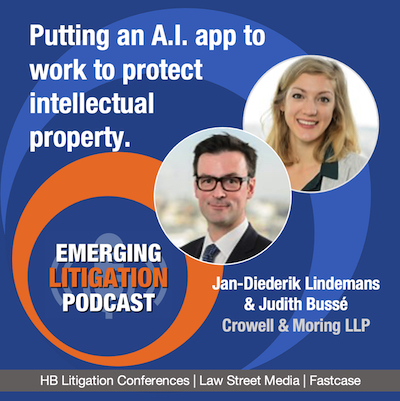
Putting an AI App to Work to Protect IP with Jan-Diederik Lindemans and Judith Bussé They are Crowell & Moring partner Jan-Diederik Lindemans and Judith Bussé, both part of the firm’s Technology & Intellectual Property Department in Brussels. And, working with Neotalogic, they developed an interactive app that takes you through a set of attorney-crafted questions that, depending on your answers, take you to other questions. The app applies a layer of artificial intelligence to enhance the information gathering process. Listen to what these innovators had to say about the Crowell & Moring IP Check-Up application, and take it for a test drive yourself. Or, here is a quick video of someone using the app. This podcast is the audio companion to the Journal on Emerging Issues in Litigation*, a collaborative project between HB Litigation Conferences and the legal news folks at Law Street Media, and the Fastcase legal research family, which includes Docket Alarm and Judicata. If you have comments or wish to participate in one our projects, or want to tell me how insightful our guests are, please drop me a note at Editor@LitigationConferences.com. Tom Hagy Host of the Emerging Litigation Podcast * Highly regarded insurance and reinsurance industry attorney Laura Foggan of Crowell & Moring's Washington, DC, office is on the Editorial Advisory Board. Thanks to Laura for connecting me with J.D. and Judith. An organization’s intellectual property is often its most valuable asset. Whether it’s a patent or a trademark, a graphic design or proprietary market information, or just the unique way they do what they do, organizations must protect their innovations or risk significant damage to their future prospects. Assessing the vulnerabilities of such valuable inventory is as important as it is time-consuming. But a portfolio protection and process review involves answering the same long set of questions posed to any organization, no matter what type. There is the problem. You have a [...]
Wildfire Litigation and Recovery with Ed Diab
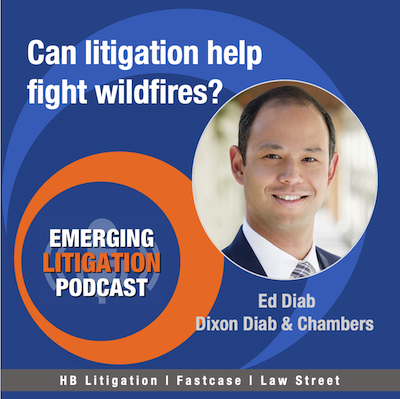
Wildfire Litigation and Recovery with Ed Diab I had the pleasure of interviewing Ed Diab, co-founder of Dixon Diab & Chambers in San Diego, about his firm’s role in the litigation, what the claims are, what defenses they encounter, settlements they have secured, what evidentiary hurdles plaintiffs face, and more. They’ve been successful. Since 2018, Dixon Diab & Chambers has recovered more $1.4 billion in settlements. And there is more to come. The firm represents more than 40 public entities – including some of the largest cities and counties in California – as well as thousands of individuals and families. Ed leads the firm’s mass tort practice which, in addition to wildfire litigation, represents people who allege injuries from defective drugs and medical devices. This podcast is the audio companion to the Journal on Emerging Issues in Litigation, a collaborative project between HB Litigation Conferences and the legal news folks at Law Street Media. If you have comments or wish to participate in one our projects, or want to tell me how insightful our guests are, please drop me a note at Editor@LitigationConferences.com. Thanks to Ed Diab for speaking with me about this fascinating and frightening subject, and to Baron & Budd's Scott Summy for introducing us. For my part, I am sure my suggestion that they install smoke detectors all over the forest is complete nonsense. Also, I spoke with a friend who majored in Latin. Even though I showed zero confidence, I apparently stumbled close to the pronunciation of flammagenitus, Latin for “fire cloud.” I promised you a photo of one. Also called pyrocumulus clouds, they look as terrifying as they sound. Tom Hagy Host Emerging Litigation Podcast Wildfires are causing more destruction in North America than at any time in recorded history. In 2010 they consumed 3.4 million acres, but nearly tripled to devour more than [...]
A Shameless Plug for Our Content Services
Your content marketing is everything you’ve ever dreamed of. Right?
 Sara is marketing director at a boutique law firm. When we asked her how their blog was going, she made a sad face. But then, we made Sara smile.*
Critical Legal Content was founded by Tom Hagy, former Editor & Publisher of Mealey’s Litigation Reports and VP at LexisNexis, founder of HB, current litigation podcaster and editor-in-chief. CLC’s mission is to help smaller firms and service providers not only create content — blogs, articles, papers, webinars, podcasts (like the stuff on this site) — but also to get it out there. How? Via social media, this website, your website, and potential via our podcast and journal which we publish in collaboration with vLex Fastcase and Law Street Media. The goal is to attract readers and dizzy them with your brilliance.
*Inspired by actual events.
Create content like a real legal publisher.
Emerging Litigation Journal

Biometric Privacy Laws: Companies Will Need Insurance as Protection From New and Expanding Liability
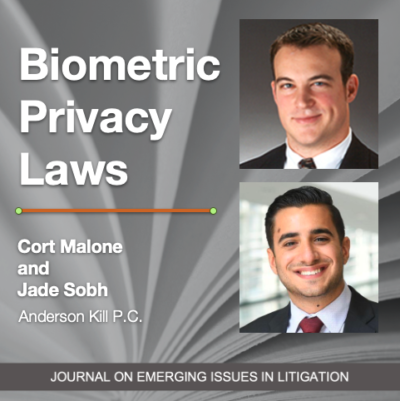
The Authors * Cort T. Malone (cmalone@andersonkill.com) is a shareholder in the New York and Stamford offices of Anderson Kill and practices in the Insurance Recovery and the Corporate and Commercial Litigation Departments. He represents policyholders in insurance coverage litigation and dispute resolution, with an emphasis on commercia general liability insurance, directors and officers insurance, employment practices liability insurance, advertising injury insurance, and property insurance issues. Jade W. Sobh (jsobh@andersonkill.com) is an attorney in Anderson Kill’s New York office. Jade focuses his practice on insurance recovery, exclusively on behalf of policyholders, as well as regulatory and complex commercial litigation matters. Interviews with leading attorneys and other subject matter experts on new twists in the law and how the law is responding to new twists in the world. Biometric Privacy Laws: Companies Will Need Insurance as Protection From New and Expanding Liability "Businesses may look to various types of insurance policies for protection from the sudden and ever-increasing liability under present and soon to pass biometric data privacy laws, including commercial general liability insurance, employment practices liability insurance, cyber insurance, and directors & officers (D&O) insurance." Abstract: As more states follow Illinois in enacting biometric privacy laws, the risk that companies will be hit with lawsuits and extensive damages awards increases. Employers are among the most active collectors of this type of data, collecting fingerprints and deploying facial recognition for timekeeping and security purposes. Several multi-million-dollar settlements have been reported for violations of biometric privacy laws. Meta, formerly Facebook, paid $650 million to resolve claims that it improperly stored face scans of its users. When companies turn to their insurance carriers, policyholders have a good track record of receiving coverage. Now that these claims are becoming more prevalent, will the insurance industry work to limit its exposure in this space? What should [...]
Asymmetrical Combat: Bad Faith Liability in Insurance Recovery Cases
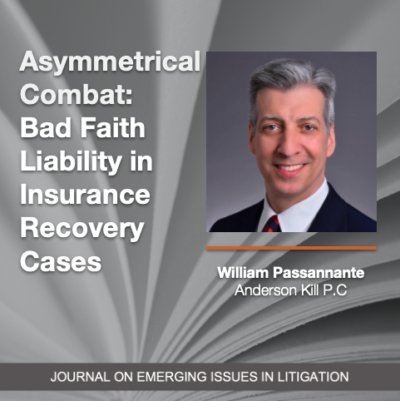
The Author William G. Passannante is co-chair of Anderson Kill’s Insurance Recovery Group and is a nationally recognized authority on policyholder insurance recovery in D&O, E&O, asbestos, environmental, property, food-borne illness, and other insurance disputes, with an emphasis on insurance recovery for corporate policyholders and educational and governmental institutions. Interviews with leading attorneys and other subject matter experts on new twists in the law and how the law is responding to new twists in the world. Asymmetrical Combat: Bad Faith Liability in Insurance Recovery Cases "Insurance policies are a unique product that requires the policyholder perform first—by paying insurance premiums—while the insurance company’s performance—the payment of the claim amount—is delayed until the insurance company determines to do so." Abstract: Policyholder counsel see claims that an insurer violated its duty of good faith and fair dealing is an essential tool in leveling the playing field in policyholder–insurer disputes, especially in high-stakes litigation. Insurance companies write the policies, employ lobbyists, exchange information with each other, and, of course, have more experience handling claims. So, the author writes, bad faith allegations bring more balance to the relationship and provide a disincentive to “the profitable breach of the insurance promise.” He discusses above-policy limits risks for insurers, as well as attorneys’ fees, interest on unpaid claims, punitive damages, and more. Introduction: Bad faith insurance litigation presents high-stakes risks for insurance companies in the unbalanced battle between insurance companies and their policyholders. The asymmetric nature of the insurance claims process—insurance companies draft the insurance policies, lobby legislatures as an industry repeat litigant, exchange superior information among themselves, and have more experience with claims than any policyholder—means that policyholders need a counterbalance. Insurance company liability for bad faith and related above-policy limits liabilities can act as that counterbalance. Insurance company bad faith and related doctrines prove useful [...]

Taking the High Ground: Where Cannabis Insurance Litigation Is Trending (and Why)
The Authors John B. McDonald is an experienced litigator practicing in the Seattle and New York offices of Harris Bricken, where he represents clients in complex commercial, insurance, and partnership matters. Jihee Ahn is an experienced complex commercial litigator with Harris Bricken. She also chairs the firm’s Dispute Resolution/Litigation practice. Interviews with leading attorneys and other subject matter experts on new twists in the law and how the law is responding to new twists in the world. Taking the High Ground: Where Cannabis Insurance Litigation Is Trending (and Why) "Absent a choice of law provision, the location where most of the insured activity took place will likely dictate which law applies. But how have federal courts reacted to applying cannabis-friendly state law in a forum where federal law arguably addresses underlying state concerns? The answer is: inconsistently." Abstract: The use and possession of cannabis remains illegal under the federal Controlled Substances Act. But a patchwork of state laws is bringing the country closer to some form of legalization. Some states allow its use for medical purposes, others have made it legal for recreational purposes, and others have decriminalized it. But when cannabis is involved in disputes that lead to litigation, and that litigation leads to policyholder–insurer disputes, that state law patchwork and the illegality of cannabis under federal law is when things get complicated. This tension plays out in several other aspects of running a cannabis business, such as banking and interstate transportation of goods. In this article, the authors discuss how it is up to litigators to frame their cases in ways that will determine the outcome of important disputes over insurance coverage. Introduction: Like several other litigation issues presented by the (legal) emerging cannabis market in the United States, insurance disputes between cannabis policyholders and their insurers remain [...]
HB Webinars on CeriFi LegalEdge
Content Partners