
HB Partner Webinars on the West LegalEdcenter
Take these CLE webinars on the West LegalEdcenter platform. Each program features leading litigators in their respective fields on emerging subjects. Speakers and topics are handpicked by HB. Your organization may have already subscribed to the platform, but each session is also available for individual purpose. For questions or if you wish to propose a webinar, write to us at: Webinars@LitigationConferences.com.

The Mega Verdict Trend in Healthcare Litigation with Sandra Cianflone
The Mega Verdict Trend in Healthcare Litigation with Sandra Cianflone Joining me to discuss this high-stakes litigation is Sandra M. Cianflone of Hall Booth Smith, P.C. Sandie counsels and defends hospitals, physicians, nurses and institutional employees in a broad spectrum of catastrophic injury and medical malpractice cases. She received her Juris Doctorate from Pace University School of Law and her undergraduate degree from Fairleigh Dickinson University. This podcast is the audio companion to the Journal on Emerging Issues in Litigation, a collaborative project between HB Litigation Conferences and the Fastcase legal research family, which includes Full Court Press, Law Street Media, Docket Alarm and, most recently, Judicata. If you have comments or wish to participate in one our projects, or want to tell me how insightful and informative Sandie is, please drop me a note at Editor@LitigationConferences.com. This podcast is based on an article she wrote for the forthcoming issues of the Journal. Note that in my introduction I have created the phrase "badly wrong," which is, itself, badly wrong. Listen to the bitter end when Sandie and I discuss working from home, and how we really feel about family and co-workers. Feel free to scold me at the email address provided. I hope you enjoy the interview and this professional's practical insights into defending healthcare providers. Tom Hagy Damage awards against physicians, hospitals, and other healthcare providers have been coming in bigger and bigger, with juries awarding more than $20 million in a string of cases that should send chills down the spines of defendants and counsel. What are the factors behind this trend? Besides the severe (or even alarming) nature of the harm alleged, what is fueling these mega verdicts? What can defense attorneys do, knowing they are facing a well-organized, well-funded plaintiffs bar? For that matter, what can defense attorneys learn from their [...]
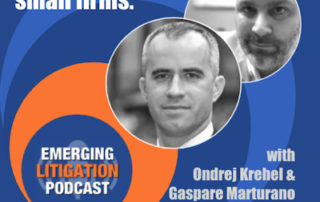
Data Security for Small Law Firms with Ondrej Krehel and Gaspare Marturano
Data Security for Small Law Firms with Ondrej Krehel and Gaspare Marturano Joining me to discuss this important issue is Ondrej Krehel, CEO & Founder of LIFARS, a New York-based incident response and digital forensics firm specializing in cybersecurity protection. Ondrej is recognized for his digital forensic expertise and ethical hacking skills. He participates in high-profile engagements around the world using his proprietary methodology to achieve the most rapid root-cause analysis and remediation. He is a former lecturer at FBI Training Academy who has led forensic investigations and cybersecurity involving the U.S. government, including military cyber special operations. He holds a Ph.D. in Computer Forensics from Police Academy in Bratislava, Slovakia, an M.S. degree in Mathematical Physics from Comenius University in Bratislava, and an Engineering Diploma from Technical University in Zvolen, Slovakia. Joining Ondrej and me is Gaspare J. Marturano, Chief Marketing Officer at LIFARS. Gaspare is a former Director of Information Systems for a large Connecticut law firm and has consulted on these issues with a number of other law firms. This podcast is the audio companion to the Journal on Emerging Issues in Litigation, a collaborative project between HB Litigation Conferences and the Fastcase legal research family, which includes Full Court Press, Law Street Media, and Docket Alarm. If you have comments or wish to participate in one our projects, or want to tell me how insightful and informative Ondrej and Gaspare are, please drop me a note at Editor@LitigationConferences.com. I particularly enjoyed hearing about what one kid was doing at 17, an age when I was certain I would be sought out for my rock drumming artistry. Of course, that kid was operating a criminal enterprise. I was just trying to impress girls. Tom Hagy Law firms are sweet targets for hackers given the rich data they store, from intellectual property [...]

Plastics-Related Liabilities and Insurance Recovery with Mikaela Whitman
Plastics-Related Liabilities and Insurance Recovery with Mikaela Whitman Joining me to discuss this important civil statute is Mikaela Whitman for what was an informative and insightful podcast on this potentially enormous area of litigation. It’s based on her article — One Word: Plastics. Two Words: Pollution Exclusion. Why CGL Policies Should Cover Plastics-Related Liabilities — which will be featured in the inaugural issue of the Journal on Emerging Issues in Litigation in January 2021. Mikaela (mwhitman@pasichllp.com) is a partner in Pasich LLP’s New York office and a member of the firm’s insurance recovery practice. Her practice focuses on the representation of insureds in all phases of insurance coverage recovery, from pre-suit negotiations through alternative dispute resolution and litigation. The Journal and Podcast are part of a collaborative project between HB and the Fastcase legal research family, which includes Full Court Press, Law Street Media, Docket Alarm and, most recently, Judicata. If you have comments or wish to participate in one our projects, or want to tell me how awesome Mikaela is, drop me a note at Editor@LitigationConferences.com. We hope you enjoy the interview. As we see liability actions relating to plastics creeping into the nation's dockets, what types of claims will survive? How much more of this might we see? And if it really hits the fan, how will insurance companies respond? Will policyholders find protection in their comprehensive general liability policies? Their directors and officers policies? Other policies?
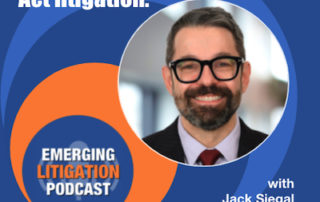
The False Claims Act with Jack Siegal
The False Claims Act with Jack Siegal Joining me to discuss this important civil statute is Jack Siegal of McGlinchey Stafford in Boston. Jack's practice focuses on financial services litigation, complex commercial disputes, government investigations and white-collar defense, securities litigation, regulatory proceedings, and compliance. This podcast is the audio companion to the Journal on Emerging Issues in Litigation, a collaborative project between HB Litigation Conferences and the Fastcase legal research family, which includes Full Court Press, Law Street Media, Docket Alarm and, most recently, Judicata. If you have comments or wish to participate in one our projects, or want to tell me how insightful and informative Jack is , please drop me a note at Editor@LitigationConferences.com. I hope you enjoy the interview, and especially how I managed not to include Jack's answer to whether my dog could be sued for violating the FCA. "Nope. Not a person," he said, with zero hesitation. I want to thank Jack for immediately taking on the role as Shiloh's advocate, and for speaking with me about this important law. --Tom Hagy Unscrupulous contractors have been ripping off the federal government for as long as there has been a federal government. President Lincoln, tired of being sold lame mules and rancid rations, signed the Federal Claims Act into law during The Civil War. In the last two decades the government, with the help of whistleblowers, has raked in more than $20 billion.
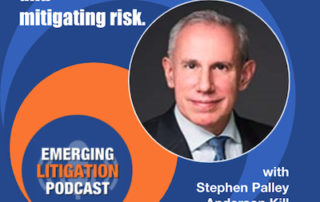
Cryptocurrency with Stephen Palley
Cryptocurrency with Stephen Palley Joining me to discuss this paradigm-shattering model is Anderson Kill Partner Stephen D. Palley, a seasoned trial lawyer and litigator with extensive experience in complex commercial disputes like insurance recovery, securities litigation, and corporate governance. Stephen has significant hands-on software development and design experience. Based in the firm’s D.C. office, he is co-chair of its cross-disciplinary blockchain and virtual currency group. At several points during our conversation I referred to an article co-written by Stephen and his New York colleague Joshua Gold, titled Protecting Cryptocurrency Assets. Stephen earned his J.D. from Washington University, his M.A. from the University of Delaware, and his B.A. (cum laude) from Tufts University (Go Jumbos!). This podcast is the audio companion to the Journal on Emerging Issues in Litigation, a collaborative project between HB Litigation Conferences and the Fastcase legal research family, which includes Full Court Press, Law Street Media, Docket Alarm and, most recently, Judicata. If you have comments or wish to participate in one our projects, or want to tell me how insightful and informative Stephen is, please drop me a note at Editor@LitigationConferences.com. I hope you enjoy the interview, especially when Leo, my cat, knocked over my microphone and when Stephen educated me on the existence of the Weird Beard Festival and other whisker-based celebrations. --Tom Hagy Cryptocurrency assets now exceed $1.5 trillion globally. What a great innovation, as is the magic that makes these transactions possible. Of course, I’m talking about blockchain. The possibilities are endless on both counts. No central authority. No regulators. But (there’s always a but), thanks to the world’s miscreants, desperados and other baddies there is escalating potential for theft of these assets whether they are held in Bitcoin or other forms of digital currency. What should businesses consider if they plan to invest in virtual assets? How might they [...]
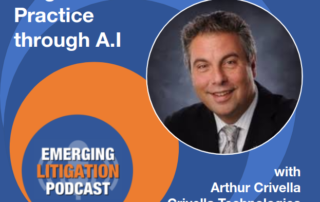
How Artificial Intelligence is Changing Litigation and Even Preventing it with Arthur Crivella
How Artificial Intelligence is Changing Litigation and Even Preventing it with Arthur Crivella Artificial intelligence has the capability to truly revolutionize how litigators work, and also how companies can avoid litigation in the first place. It can not only do the work of hundreds of people in mere seconds but can be used to predict liabilities before they become liabilities, and outcomes when disputes arise. Joining me to discuss the incredible present-day applications of AI in law and business, as well as the potential to do much more if humans will let it, is Arthur Crivella of Crivella Technologies Limited. For decades Art has been a leader in developing and applying advanced software engineering, systems engineering and AI methodologies, and holds numerous foundation patents in the field. Art has helped create nationally recognized engineering achievements in weaponry as well as in the metals, rubber and food industries. He was principal design engineer in developing advanced weapons direction systems and wrap-around simulation systems for naval guided missiles. Crivella Tech supports corporations in managing risk and law firms in assessing liabilities. The company also supports law firms in class action and mass tort litigation. This podcast is the audio companion to the Journal on Emerging Issues in Litigation, a collaborative project between HB Litigation Conferences and the Fastcase legal research family, which includes Full Court Press, Law Street Media, Docket Alarm and, most recently, Judicata. If you have comments or wish to participate in one our projects, or want to tell me how insightful and informative Art is, please drop me a note at Editor@LitigationConferences.com. I hope you enjoy the interview, particularly my observation that you cannot hurt a robot's feelings. --Tom Hagy

The Age of Social Disparagement with Charlie Kingdollar
The Age of Social Disparagement with Charlie Kingdollar It was my pleasure to interview Charlie Kingdollar for our first episode of the Emerging Litigation Podcast. Charlie spent more than four decades with General Reinsurance, three-quarters of which as the company’s Emerging Issues Officer. One colleague described him as “one of the most prescient and gifted industry futurists I have met in my 36 year professional career within the insurance industry. Entertaining and insightful, his ability to digest and communicate complex issues, many before they are readily apparent, is both a gift and a talent.” This interview is based on his article on social disparagement coming out in the inaugural issue of the Journal on Emerging Issues in Litigation in January 2021. The Journal is a collaborative project between HB and Fastcase. If you have comments or wish to participate in one our projects, or want to tell me how awesome Charlie is, drop me a note at Editor@LitigationConferences.com. We hope you enjoy the interview. Are the risks posed by social media — which has added jet fuel to one person’s ability to smear another — adequately addressed by the insurance market?
Offshore Wind Power Initiatives with Jack Smith
Offshore Wind Power Initiatives with Jack Smith Joining me to discuss this important subject is Jack Smith, a partner with Nelson Mullins in Charleston, South Carolina. Jack's practice includes hazardous waste site management and remediation, contaminated property liability negotiation, litigation, redevelopment and related regulatory counseling. He has also worked for several state and federal government environmental agencies. Jack earned his JD from the University of South Carolina School of Law and a BS in Psychology, also from the University of South Carolina. This podcast is the audio companion to the Journal on Emerging Issues in Litigation, a collaborative project between HB Litigation Conferences and the Fastcase legal research family, which includes Full Court Press, Law Street Media, Docket Alarm and, most recently, Judicata. If you have comments or wish to participate in one our projects, or want to tell me how insightful and informative Jack is, please drop me a note at Editor@LitigationConferences.com. This interview is based in part on an article Jack is writing for the Journal. I hope you enjoy the interview, and especially my solution for preventing birds from flying into windmills. I'm going to be rich. --Tom Hagy President Biden has called for the doubling of offshore wind energy capacity by 2030. To say the process for getting such projects up and running is complex is an understatement. There will be plenty of obstacles to the administration's lofty goal. Where will these impediments to development arise? What role will states play? How will NGOs react to this ambitious ramp-up?

Labor Law in 2021 with Kathryn Hatfield
Labor Law in 2021 with Kathryn Hatfield Participation in labor unions is less than half of what it was 40 years ago. It has seen an uptick in the service sector, but a sharp decline in manufacturing. According to economist Heidi Shierholz decline in union rolls is partly responsible for today's yawning income inequality gap. Recently we've seen the formation of a modest union at Google and a movement among Amazon workers. We've also seen how the pandemic has shone a bright light on the fragility of our nation's workforce struggling to survive at the bottom rungs of the pay scale. Joining me to speak about these issues is Kathryn Van Deusen Hatfield, a senior managing partner at Hatfield Schwartz Law Group in New Jersey. Kathy represents private and public sector employers in all aspects of labor and employment law, with expertise in litigating state and federal cases on behalf of employers involving Title VII, the ADA, the ADEA and the New Jersey Law Against Discrimination, and providing legal opinions and advice on personnel, employment and labor issues. Kathy shares her insights on recent developments in the labor movement, some of the causes of its decline, how unions get a bad rap, and how, even though she represents management, she believes unions can be a good thing for everyone -- employees and companies alike. This podcast is the audio companion to the Journal on Emerging Issues in Litigation, a collaborative project between HB Litigation Conferences and the Fastcase legal research family, which includes Full Court Press, Law Street Media, Docket Alarm and, most recently, Judicata. If you have comments or wish to participate in one our projects, or want to tell me how insightful and informative David and Dan are, please drop me a note at Editor@LitigationConferences.com. I hope you enjoy the interview, and [...]

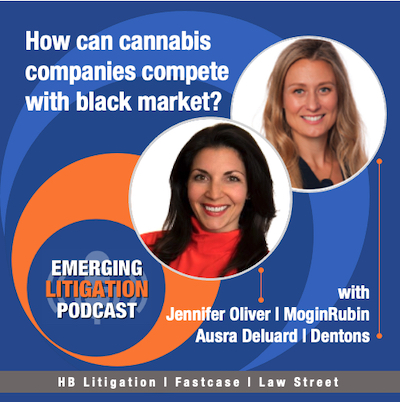
Cannabis Industry Competition Law with Ausra Deluard and Jennifer Oliver
Attorneys Ausra Deluard and Jennifer Oliver on Cannabis Industry Competition Law What can legitimate cannabis companies do to level the playing field, not only against others who walk the straight and narrow, but dealers still thriving on the black market? It was my pleasure to interview Ausra Deluard and Jennifer Oliver for what was an informative and even surprising podcast. It's based on their article -- Clearing the Haze: State Laws and Private Plaintiffs Critical to Preserve Competition in Cannabis -- which will be featured in the inaugural issue of the Journal on Emerging Issues in Litigation, which will release in January 2021. Ausra, who is an attorney with the global law firm Dentons LLP, has spent more than a decade advising clients in a range of antitrust matters including merger investigations, competitor collaborations, and pricing and distribution policies. She works closely with cannabis clients to help them navigate the rapidly evolving cannabis laws and regulations throughout the U.S. Jennifer is a partner at national antitrust boutique MoginRubin LLP, where she litigates and advises clients on competition issues. Her work includes representing classes of plaintiffs in class actions, risk mitigation and regulatory advice in mergers and acquisitions, and other complex business litigation. Check out the MoginRubin Blog. The Journal is a collaborative project between HB and the Fastcase legal research family, which includes Full Court Press, Law Street Media, Docket Alarm and, most recently, Judicata. If you have comments or wish to participate in one our projects, or want to tell me how awesome Ausra and Jennifer are, drop me a note at Question@LitigationConferences.com. We hope you enjoy the interview. Tom Hagy Founder & Managing Director HB Litigation Conferences
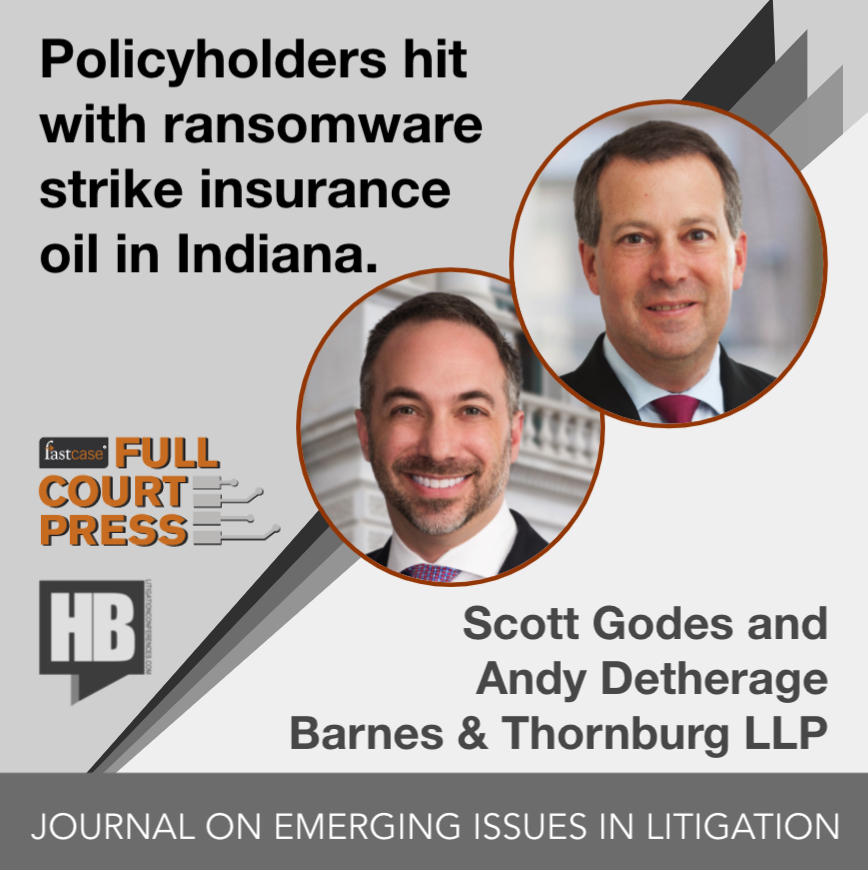
Policyholders Hit With Ransomware, Then Strike Insurance Coverage Oil in Indiana
Policyholders Hit With Ransomware, Then Strike Insurance Coverage Oil in Indiana Abstract The cost of ransomware to businesses is estimated to have doubled since 2019 to $20 billion, according to Coveware. Policyholders turn to their insurance policies to recover losses that average more than $230,000 per incident. In the case discussed, the carrier denied a policyholder’s claim as being outside the computer fraud provisions of the commercial crime portion of the policy. Two lower courts sided with the carrier, but the Indiana Supreme Court ruled in favor of coverage. This is a significant win for policyholders seeking coverage for losses under policies not sold as “cyber insurance.” The article discusses the decision and the precedents cited in an area of litigation that only promises to expand as ransomware and similar digital crimes proliferate. Author Scott Godes and Andy Detherage were counsel to United Policy-holders, which submitted an amicus brief in favor of granting transfer and reversing the lower court decision, in the Indiana Supreme Court decision referenced in this article. Messrs. Godes and Detherage are partners in Barnes & Thornburg LLP. About The Journal on Emerging Issues in Litigation is a co-production of HB, Fastcase, and Law Street Media. You can also hear the complementary (and complimentary) Emerging Litigation Podcast wherever podcasts appear. For questions, contact Tom Hagy, Editor in Chief, at Editor@LitigationConferences.com.
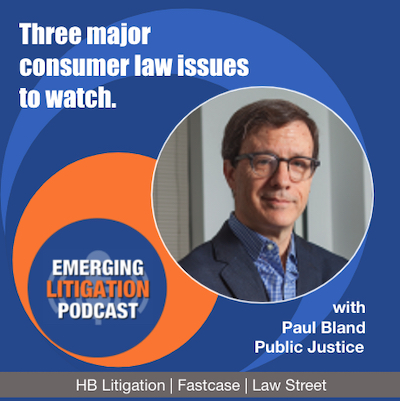
Three Urgent Consumer Class Action Topics with Paul Bland of Public Justice
Three Urgent Consumer Class Action Topics with Paul Bland of Public Justice To discuss these issues, it was my pleasure to interview F. Paul Bland, Jr., Executive Director of Public Justice, an organization that pursues "high impact lawsuits to combat social and economic injustice, protect the Earth’s sustainability, and challenge predatory corporate conduct and government abuses." Paul has argued and won more than 40 cases that led to reported decisions for consumers, employees or whistleblowers, including one victory in the U.S. Supreme Court, and has won one or more cases in six of the U.S. Courts of Appeals and the high courts of 10 different states. This podcast is the audio companion to the Journal on Emerging Issues in Litigation, a collaborative project between HB and the Fastcase legal research family, which includes Full Court Press, Law Street Media, Docket Alarm and, most recently, Judicata. If you have comments or wish to participate in one our projects, or want to tell me how insightful and informative Paul is, please drop me a note at Editor@LitigationConferences.com. We hope you enjoy the interview, and how I slipped in mention of Schrödinger's cat which, as everyone knows (that's sarcasm and self-deprecation), is a thought experiment that illustrates an apparent paradox of quantum superposition. Class actions can be an invaluable tool when consumers need to level the playing field in disputes with corporations. Two important class action cases are currently before the Supreme Court. One case, TransUnion v. Ramirez, involves innocent consumers who were erroneously added to the government's watch list for terrorists and drug smugglers. [Note: We recorded before the Supreme Court handed down its ruling that only plaintiffs concretely harmed by a defendant’s statutory violation have Article III standing to seek damages against that private defendant in federal court.] In the second, Goldman Sachs v. Arkansas Teachers, consumers seek to [...]
Sandra Cianflone on Current and Emerging COVID-19 Litigation
Sandra Cianflone on COVID-19 Litigation in 2021 and Beyond It’s now been more than 18 months since the world was besieged by the novel coronavirus pandemic. In addition to the human toll, it disrupted our lives in ways big and small, new and old, as it raced across continents, first visiting North America in January 2020. There are an estimated 15,000 lawsuits relating to the outbreak, with some 350 filings directed toward the healthcare and medical communities. The number of insurance coverage suits is fast-approaching 1,800. Litigation has been initiated against aging services, hospitals, and healthcare providers, with the next anticipated wave likely to surround vaccines themselves. What will be the basis of these claims? What defenses will we see? And what can healthcare providers do now in anticipation of this onslaught? Joining me to discuss this out-of-the-blue rash of litigation is Sandra M. Cianflone of Hall Booth Smith, P.C. Sandie counsels and defends hospitals, physicians, nurses and institutional employees in a broad spectrum of catastrophic injury and medical malpractice cases. She received her Juris Doctorate from Pace University School of Law and her undergraduate degree from Fairleigh Dickinson University. This podcast is the audio companion to the Journal on Emerging Issues in Litigation, a collaborative project between HB Litigation Conferences and the Fastcase legal research family, which includes Full Court Press, Law Street Media, Docket Alarm and, most recently, Judicata. If you have comments or wish to participate in one our projects, or want to tell me how insightful and informative Sandie is, please drop me a note at Editor@LitigationConferences.com. This podcast is based on an article she wrote for the forthcoming issues of the Journal. I hope you enjoy the interview, and especially a brief story (after we wrap up) about Sandie's experience delivering a baby in the Age of COVID-19. I also mangled a bit of [...]

Charlie Kingdollar on Sexual Abuse Claims
Charlie Kingdollar on Sexual Abuse Claims and Litigation: Their Impact on the Insurance Industry Abstract The statistics surrounding childhood sexual abuse and molestation are staggering. Many make headlines such as the cases brought against clergy, athletic coaches, Boy Scout leaders, and actors and movie producers. This article attempts to size the impact of these cases on the insurance industry, and what measures are being taken that will allow more lawsuits to be filed on behalf of victims years after they were abused or molested. Author Charlie Kingdollar recently retired after 40 years with General Reinsurance Corp., where he was Vice President and Emerging Issues Officer. He is widely considered to be among the best resources for new liability risks, even called by one colleague as a “prescient and gifted industry futurist.” I recommend you follow him on LinkedIn. --Tom Hagy About The Journal on Emerging Issues in Litigation is a co-production of HB, Fastcase, and Law Street Media. You can also hear the complementary (and complimentary) Emerging Litigation Podcast wherever podcasts appear. For questions, contact Tom Hagy, Editor in Chief, at Editor@LitigationConferences.com.
Biotech, Life Sciences, Food & Drug News from NLR
Biotech, Life Sciences, Food & Drug News from National Law Review
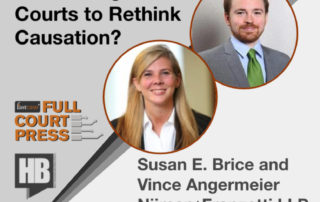
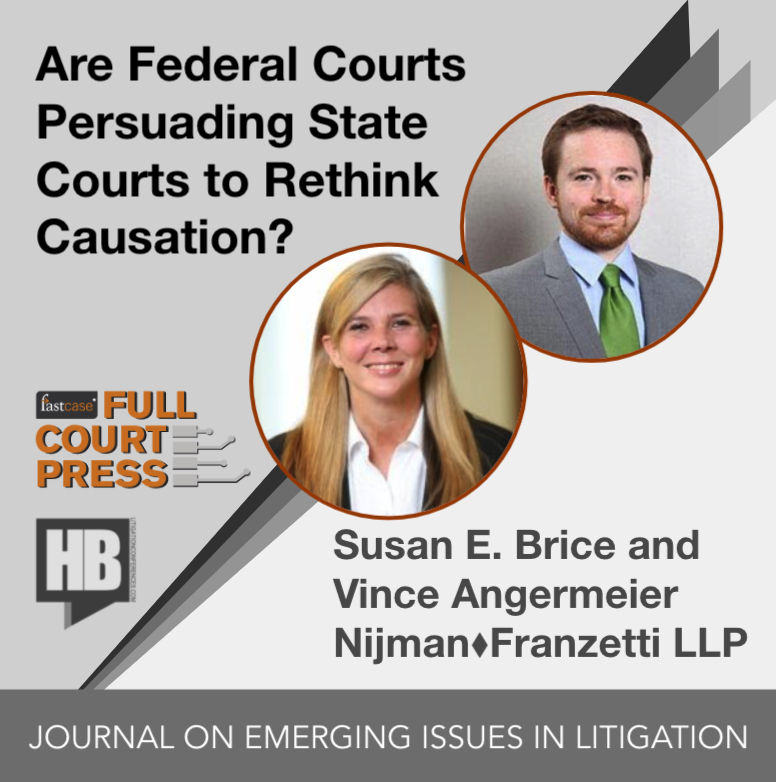
Susan E. Brice and Vince Angermeier on Causation in Toxic Torts
Susan E. Brice and Vince Angermeier on Causation in Toxic Torts Abstract Concepts of “substantial factors,” “any exposure,” and “de minimis” contact have long-supported claims brought by toxic tort plaintiffs against manufacturers. They have furthered tort actions against defendants based on the “cumulative expo-sure” theory, particularly in the asbestos arena, even when a single fiber could not be connected to a specific defendant. But a 2017 Seventh Circuit decision dealing with Illinois law is part of a trend toward tightening up these standards. This article discusses the various cases on this threshold issue as the authors ponder whether this is a movement that needs some pushing. Authors Susan E. Brice (sb@nijmanfranzetti.com) is a partner at Nijman Franzetti, LLP. She has litigated state and federal disputes and has counseled clients on complicated scientific issues arising in environmental law, toxic torts, and product liability. Susan works with scientists on matters in the fields of genomics, toxicology, and epidemiology in industries such as chemical manufacturing, energy production, food, agriculture, and real estate. Vince Angermeier (va@nijmanfranzetti.com) is Of Counsel at Nijman Franzetti, LLP, where he concentrates his work on CERCLA, EPCRA, RCRA, and Clean Water Act matters, a practice enhanced by his environmental engineering experience. Vince has assisted on civil litigation, administrative rulemakings, regulatory and compliance matters involving water, solid waste, and EPCRA reporting issues. About The Journal on Emerging Issues in Litigation is a co-production of HB, Fastcase, and Law Street Media. You can also hear the complementary (and complimentary) Emerging Litigation Podcast wherever podcasts appear. For questions, contact Tom Hagy, Editor in Chief, at Editor@LitigationConferences.com.

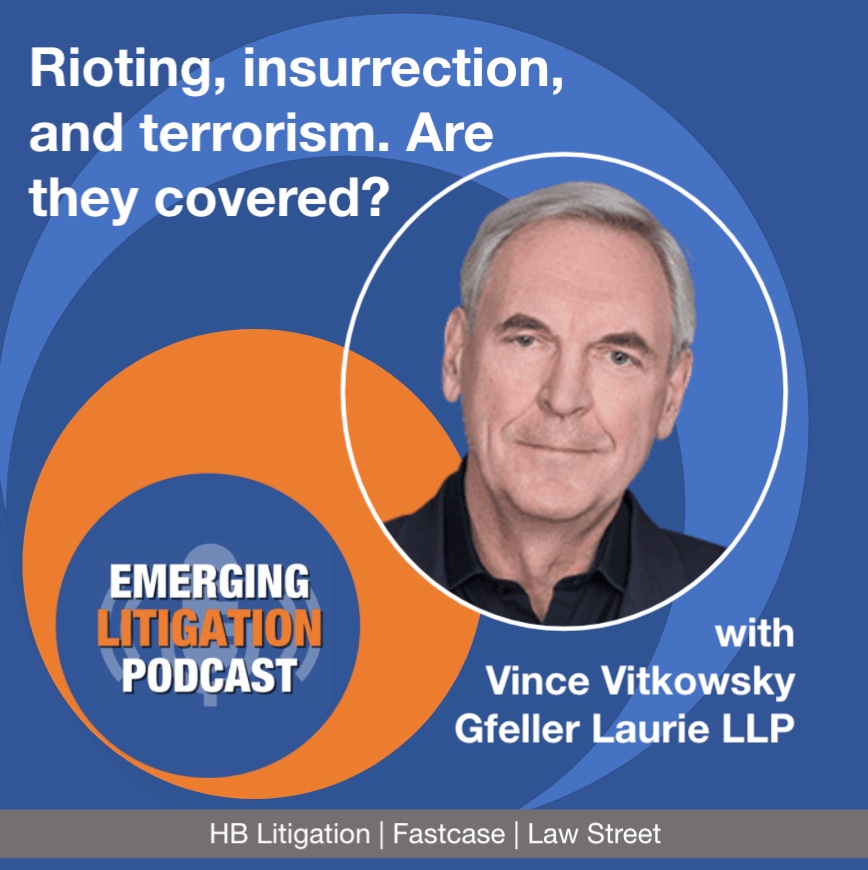
Vince Vitkowsky on Insurance Coverage for Civil Unrest
Vince Vitkowsky on Insurance Coverage for Civil Unrest Civil unrest. Peaceful protests. Massive marches. Riots. Looting. Which of these things are not like the other? Recent social outrage over police shootings of Black people -- these events in particular -- have sent people to the streets by hundreds of thousands. In some cases these constitutionally protected activities are followed by property damage, injury and death. Observers continue to debate who is responsible for the violence. Whatever the answer, as a very practical matter, someone has to pay for the property damage. Join me for my conversation with Vince Vitkowsky of Gfeller Laurie LLP. Vince possesses deep knowledge of insurance coverage matters, representing carriers in a variety of areas, e.g. cyber risk, data privacy, general liability, directors and officers liability, health, and more. He combines his experience as a veteran insurance and reinsurance lawyer with a strong background in terrorism and national security law. This podcast is the audio companion to the Journal on Emerging Issues in Litigation, a collaborative project between HB Litigation Conferences and the Fastcase legal research family, which includes Full Court Press, Law Street Media, Docket Alarm and, most recently, Judicata. If you have comments or wish to participate in one our projects, or want to tell me how insightful and informative Vince is , please drop me a note at Editor@LitigationConferences.com. I hope you enjoy the interview, and how deftly we obscured the fact that Vince lives in New York City.
Kathryn Hatfield on Labor Law in 2021
Kathryn Hatfield on Labor Law in 2021 Participation in labor unions is less than half of what it was 40 years ago. It has seen an uptick in the service sector, but a sharp decline in manufacturing. According to Heidi Shierholz -- former chief economist at the Department of Labor, now senior economist and policy director at the Economic Policy Institute -- decline in union rolls is partly responsible for today's yawning income inequality gap. Recently we've seen the formation of a modest union at Google and a movement among Amazon workers. We've also seen how the pandemic has shone a bright light on the fragility of our nation's workforce struggling to survive at the bottom rungs of the pay scale. Joining me to speak about these issues is Kathryn Van Deusen Hatfield, a senior managing partner at Hatfield Schwartz Law Group in New Jersey. Kathy represents private and public sector employers in all aspects of labor and employment law, with expertise in litigating state and federal cases on behalf of employers involving Title VII, the ADA, the ADEA and the New Jersey Law Against Discrimination, and providing legal opinions and advice on personnel, employment and labor issues. Kathy shares her insights on recent developments in the labor movement, some of the causes of its decline, how unions get a bad rap, and how, even though she represents management, she believes unions can be a good thing for everyone -- employees and companies alike. This podcast is the audio companion to the Journal on Emerging Issues in Litigation, a collaborative project between HB Litigation Conferences and the Fastcase legal research family, which includes Full Court Press, Law Street Media, Docket Alarm and, most recently, Judicata. If you have comments or wish to participate in one our projects, or want to tell me how insightful and informative Kathy is, [...]
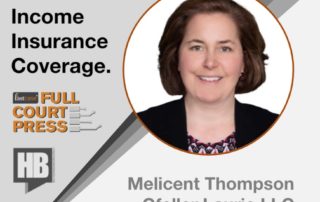
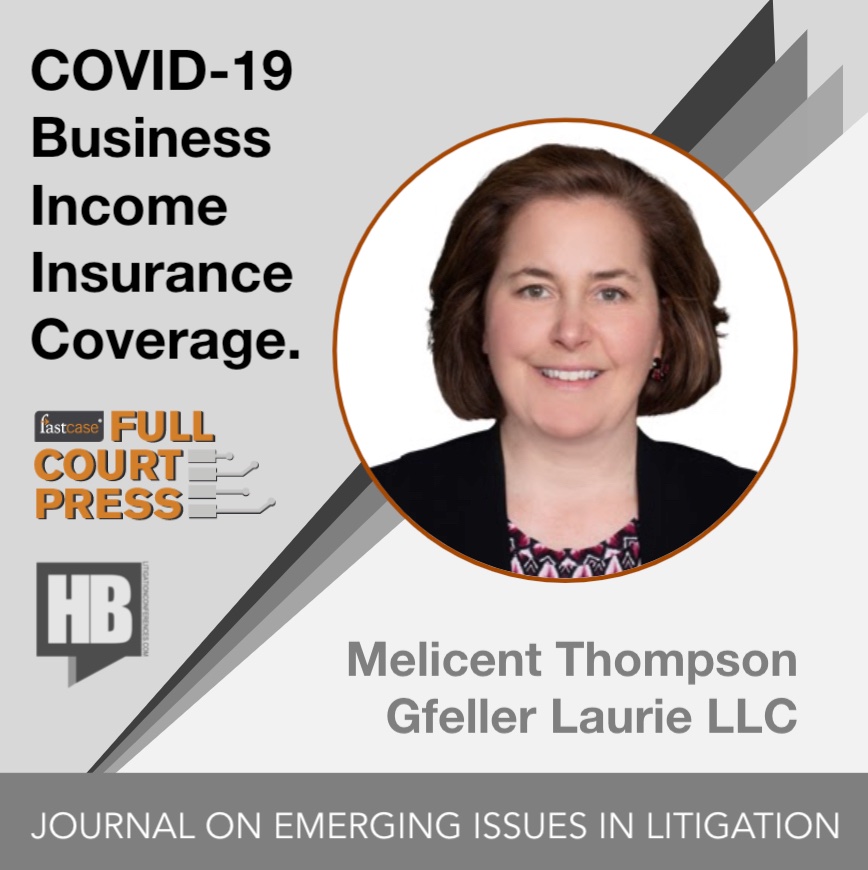
Melicent Thompson on Coverage for Covid-19 Business Income Losses
Melicent B. Thompson on COVID-19 Coverage Abstract COVID-19 indisputably has taken an enormous economic toll. Governmental shutdown orders early in the pandemic and ongoing restrictions on business’ operations have resulted in a flood of claims for insurance coverage for business income losses attributable to those orders and restrictions. This article reviews the litigation and legislative developments directed at attempting to find insurance coverage for such losses and the reasons why those efforts have been unsuccessful for the most part. Author Melicent B. Thompson (mthompson@gllawgroup.com) is a Partner with the law firm Gfeller Laurie, LLP, in West Hartford, Connecticut. She thanks her fellow Gfeller Laurie, LLP attorneys who contributed to this article. Melicent has close to 25 years of experience in litigation and corporate counseling. She actively practices in Connecticut and Georgia courts in insurance coverage, business disputes, professional liability claims, defense of educational and financial institutions and general liability. Her insurance coverage practice encompasses all areas of first and third party claims and related litigation services, including declaratory judgment actions, defense of bad faith claims and reinsurance matters. Melicent has substantial appellate court experience, having briefed and argued appeals before the Second Circuit Court of Appeals and the Connecticut Supreme and Appellate Courts. Her pro bono work includes serving as General Counsel to the Board of Directors of Gifts of Love, a charity providing basic needs to the working poor, based in Avon, Connecticut. She also serves as a member of the Advisory Council of Bay Path University (Longmeadow, Massachusetts). About The Journal on Emerging Issues in Litigation is a co-production of HB, Fastcase, and Law Street Media. You can also hear the complementary (and complimentary) Emerging Litigation Podcast wherever podcasts appear. For questions, contact Tom Hagy, Editor in Chief, at Editor@LitigationConferences.com. [...]

Myriah Jaworski on Arbitration as Defense Against Data Breach Class Actions
Myriah Jaworski on Individual Arbitration as a Defense Strategy Against Data Breach Class Actions Abstract Data privacy class actions are proliferating. Defendant companies may find an effective defense strategy is moving to compel individual arbitration. Not all contracts have the appropriate language, however, and, even if they do, they may not succeed. This article, which will appear in the forthcoming issue of the Journal on Emerging Issues in Litigation, discusses U.S. privacy litigation and case law on compelling arbitration of class claims in the privacy law context, with recommendations for businesses to improve their chances of securing court orders that enforce arbitration language in their agreements. Author Myriah V. Jaworski, Esq. (mjaworski@beckage.com), is a member with the Beckage, a law firm specializing in technology, data security and privacy. She is a Certified Information Privacy Professional, United States (CIPP/US) and Certified Information Privacy Professional, Europe (CIPP/E). She leads Beckage’s Privacy Litigation Practice Group where she represents clients in data breach actions, technology vendor disputes, and the defense of consumer class actions and related regulatory investigations. Myriah is also a former Trial Attorney with the Department of Justice. About The Journal on Emerging Issues in Litigation is a co-production of HB, Fastcase, and Law Street Media. You can also hear the complementary (and complimentary) Emerging Litigation Podcast wherever podcasts appear. For questions, contact Tom Hagy, Editor in Chief, at Editor@LitigationConferences.com.
Charlie Kingdollar on Emerging Issues Facing the Property & Casualty Insurance Industry
Emerging Issues Facing the Property & Casualty Insurance Industry: What Has, What Is, What Will Be Charlie Kingdollar was Emerging Issues Officer for GenRe where he worked for 40 years, much of which was spent monitoring hundreds of new risks at any given time. In this article, Charlie discusses risks that have long-since emerged but continue today, risks that are starting to reveal themselves, and risks just starting to appear on the horizon. Read or download his article published in the latest issue of the Journal on Emerging Issues in Litigation.

Will We See More Antitrust Litigation During Biden Administration?
One Current and One Former FTC Official Weigh in on Outlook for Antitrust Litigation (Excerpt from MoginRubin Blog) FTC Commissioner Noah Phillips and George Washington Law School Competition Law Director William E. Kovacic, who once chaired the agency, appeared on a webinar today (March 16, 2021) hosted by the Information Technology and Innovation Foundation (ITIF). Aurelien Portuese, ITIF’s Director of Antitrust and Innovation Policy, asked the speakers what we might expect from the Biden administration in terms of antitrust law, reform, and enforcement. “I think that the aggressiveness that's going on in court right now will increase," Phillips said. "I think you'll see more litigation. What effects that will have I'm not sure. That can result in more antitrust, if you will, but it can also result in losses and legal rulings that don't favor the agencies. But I do think you'll see more litigation." He went on to predict "an increasing attempt to slow M&A generally." “On litigation," former FTC Chair Kovacic said, "the new leadership in many ways is committed to doing much more and, in an exaggerated way, they have denigrated the significance of what's already on the way. They're going to discover in a hurry how hard it is to bring the matters that are in flight already to a successful landing." Read more at the MoginRubin Blog.
Purdue Oxy Settlement Offer Greeted With WTH
Company Offers to "Pay" Part of Settlement with Addiction Pharmaceuticals While the Sackler family has upped the ante, the settlement is met with some groans and skepticism. Jessica Hartogs, Editor at LinkedIn News: "Purdue Pharma has offered up a $10 billion restructuring plan that would pay $500 million up front to settle approximately 135,000 claims linked to the company's role in the opioid epidemic. The Sackler family would pay more than $4 billion over a decade and also give up domestic ownership of the company, which is alleged to have fueled the deadly national opioid crisis with its OxyContin drug. They would also admit no wrongdoing. Two dozen state attorneys general immediately rejected the plan, reported NPR." Charlie Kingdollar, Retired Emerging Issues Officer at Gen Re: Members of the Sackler family offered roughly $4.3 billion to resolve sprawling opioid litigation, up from $3 billion initially proposed in settlement discussions. Siladitya Ray, Staff Writer, Forbes: "The new settlement plan put forth by the Sacklers is $1.3 billion higher than their original offer and if approved it will be used to reimburse states, local governments, Native American tribes and other plaintiffs who have successfully sued Purdue for its role in fueling the opioid crisis... As part of the proposal, the $4.28 billion from the Sacklers will be paid in installments over a decade and additionally the company would pay around $500 million in cash up front." Jonathan Randles and Sara Randazzo, Wall Street Journal: Purdue’s chapter 11 plan must be approved by a bankruptcy judge and likely will be challenged in court by individuals who have suffered injuries from opioids and state attorneys general who have not signed onto the deal. A final resolution isn’t expected before the summer. “We’re going to keep fighting for the accountability that families [...]
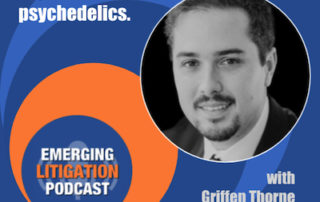



Psychedelics Decriminalization and Regulation with Griffen Thorne
Psychedelics Decriminalization and Regulation with Griffen Thorne Listen to my interview with Griffen Thorne, an attorney in the Los Angeles office of Harris Bricken LLP. He focuses on corporate, transactional, intellectual property, data security, regulatory, and litigation matters across a wide variety of domestic and international industries. As part of Harris Bricken’s corporate cannabis team, he works closely with cannabis and hemp clients, whom he advises on obtaining licenses and permits, regulatory compliance, entity formation and structuring, mergers and acquisitions, corporate governance issues, contract drafting and negotiation, obtaining and protecting intellectual property rights, and administrative appeals and litigation. He also represents clients throughout a wide range of industries regarding compliance with United States, European, and Asian Internet, technology, and data security laws and regulations. We hope you enjoy the interview. Tom Hagy Send questions or comments to Editor@LitigationConferences.com. What does the future hold for psychedelics in America? How are states approaching the ownership and use of these drugs, either for recreational or their controlled therapeutic use?
Couple Pleads Guilty to $1.1 Million COVID-Relief Fraud After Falsely Claiming to Be Farmers
Couple Pleads Guilty to $1.1 Million COVID-Relief Fraud After Falsely Claiming to Be Farmers News From the U.S. Department of Justice A Florida couple pleaded guilty for their participation in a scheme to file four fraudulent loan applications seeking more than $1.1 million in forgivable Paycheck Protection Program (PPP) and Economic Injury Disaster Loans (EIDL) loans guaranteed by the Small Business Administration (SBA) under the Coronavirus Aid, Relief, and Economic Security (CARES) Act. On Aug. 26, 2020, Latoya Stanley, 38, and Johnny Philus, 33, both of Miami, were originally charged via a complaint filed in the Southern District of Florida. In Stanley’s PPP application, she claimed to employ 18 individuals from her company, Dream Gurl Beauty Supply LLC. Philus, meanwhile, stated that he employed 29 individuals at his company, Elegance Auto Boutique LLC. In actuality, Stanley and Philus did not employ anyone at their respective companies. In her EIDL application, Stanley claimed to generate over $800,000 in income and to employ five individuals from a farm based in the yard of her Miami home. In his EIDL application, Philus claimed to generate $400,000 in income and to employ 10 individuals from a farm located in the yard of a small residential home. In actuality, Stanley and Philus employed no one and the farms did not exist. Stanley and Philus worked together to effectuate the fraud and ultimately received over $1 million in fraudulent funds from the fraudulent PPP and EIDL applications before their schemes were uncovered. Sentencing has been scheduled for June 2. Acting Assistant Attorney General Nicholas L. McQuaid of the Justice Department’s Criminal Division; U.S. Attorney Ariana Fajardo Orshan of the Southern District of Florida; Treasury Inspector General for Tax Administration (TIGTA) J. Russell George; Inspector General Hannibal “Mike” Ware of the SBA’s [...]