
HB Partner Webinars on the West LegalEdcenter
Take these CLE webinars on the West LegalEdcenter platform. Each program features leading litigators in their respective fields on emerging subjects. Speakers and topics are handpicked by HB. Your organization may have already subscribed to the platform, but each session is also available for individual purpose. For questions or if you wish to propose a webinar, write to us at: Webinars@LitigationConferences.com.

Despite Relative Inactivity on the Virtual Front in Ukraine, Russia’s Global Cyber-Attacks are Coming
Editor Tom is HB’s Founder and Managing Director. His career in litigation content spans four decades during which he was editor, managing editor, and finally publisher at Mealey’s Litigation Reports. After Mealey’s was acquired by LexisNexis Tom became a vice president involved in creating new content and services at the legal research and services giant. He has always overseen or directly created articles, blogs, conferences, webinars, data collections, and now podcasts — all on litigation. Tom founded HB in 2008, and four years later he founded Custom Legal Content, a boutique content creation shop serving boutique and specialized legal practices and litigation services. In addition to his work at HB and CLC, Tom is Editor in Chief of the Journal on Emerging Issues in Litigation, and host of the Emerging Litigation Podcast. For years he was a leader in an international specialized publishing association, frequently speaking and writing about publishing, and is now active in an open community of content and event producers called Renewd. Sometime during the last millennium Tom proudly graduated with a B.A. in Communications from Bethany College in West Virginia. Interviews with leading attorneys and other subject matter experts on new twists in the law and how the law is responding to new twists in the world. Despite Relative Inactivity on the Virtual Front in Ukraine, Russia’s Global Cyber-Attacks are Coming Since his cyber-war capabilities seem to have worked well for him, why isn’t Vladimir Putin launching more cyber-attacks against Ukraine and its allies? Reports suggest he didn’t think he’d need them, plus they take time to execute. Other reports suggest he is trying to get some cyber damage on the scoreboard. Maybe the actual disruption to Ukraine from tanks and bombs, even though the Ukrainians aren’t giving [...]
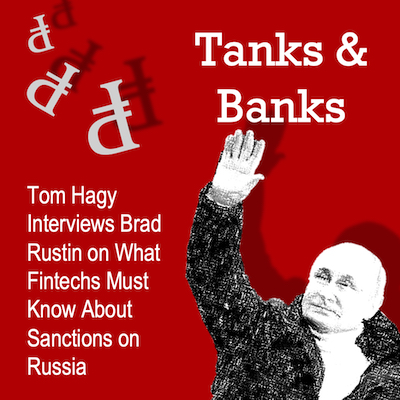
Tanks and Banks: What Fintechs Must Know About Sanctions on Russia
The Guest A highly regarded attorney and much-sought-after speaker for his expertise on the laws and operations of the technology-driven global financial system. Also a member of the Editorial Board of Advisors for the Journal on Emerging Issues in Litigation. Interviews with leading attorneys and other subject matter experts on new twists in the law and how the law is responding to new twists in the world. Tanks and Banks: What Fintechs Must Know About Sanctions on Russia Tom Hagy Interviews Brad Rustin of Nelson, Mullins, Riley & Scarborough Click below to get the complete article.
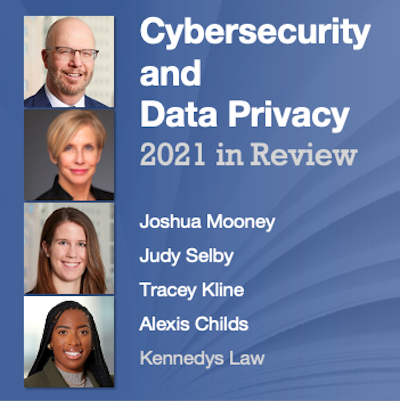
Cybersecurity and Data Privacy Year in Review 2021
The Authors The authors are all attorneys with the Kennedys law firm (kennedyslaw.com). Joshua Mooney (joshua.mooney@kennedyslaw) and Judy Selby (judy.selby@kennedyslaw.com) are partners. Tracey Kline (tracey.kline@kennedyslaw.com) and Alexis Childs (alexis.childs@kennedyslaw.com) are associates. Bridget Mead, associate, and Javier Vijil, senior associate, also contributed to this article. Judy Selby is also a member of the Editorial Board of Advisors for the Journal on Emerging Issues in Litigation. Cybersecurity and Data Privacy 2021 in Review By Joshua Mooney, Judy Selby, Tracey Kline, and Alexis Childs Abstract: As the world emerged from lockdown, it should come as no surprise that cybersecurity and data privacy remained dominant topics in the media and legal industry. Some of 2021 was much like 2020—ransomware attacks continued to fill the headlines, and in the aggregate, constituted significant loss paid under cyber insurance policies. OFAC reminded victim companies and incident response firms (and cyber carriers) that it remains unlawful to pay ransom payments to designated organizations. Comprehensive federal legislation addressing cyber defenses and notification requirements never materialized. Yet in 2021, we saw new and significant developments. U.S. law continued its drift toward comprehensive privacy regulation with two new significant pieces of privacy legislation and California’s enforcement of the California Consumer Privacy Act. In the absence of federal legislation, federal agencies either stepped up enforcement actions or signaled that they intend to do so within their realms of governance. Litigation under the Illinois Biometric Information Privacy Act continued its surge while the Illinois high courts rendered two impactful decisions and a circuit court punted to Illinois’s highest court. This review provides a brief synopsis of many events and developments that made the authors' list. Perhaps one of the most significant developments in U.S. privacy law for 2021 was the [...]

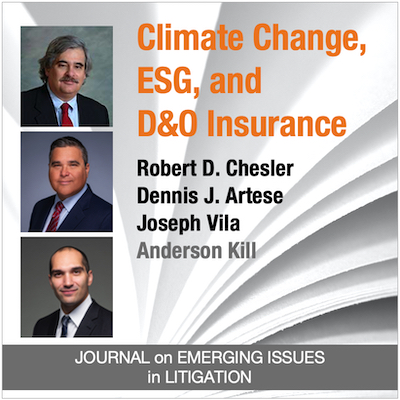
Climate Change, ESG, and D&O Insurance: Collision or Cooperation?
The Authors Robert D. Chesler (rchesler@andersonkill.com) is a shareholder in Anderson Kill’s New Jersey office and is a member of the firm’s Cyber Insurance Recovery Group. Bob represents policyholders in a broad variety of coverage claims against their insurers and advises companies with respect to their insurance programs. Dennis J. Artese (dartese@andersonkill.com) is a shareholder in Anderson Kill’s New York office and chairs the firm’s Climate Change and Disaster Recovery Group. Joseph Vila (jvila@andersonkill.com) is an insurance recovery attorney in Anderson Kill’s New Jersey office. Climate Change, ESG, and D&O Insurance: Collision or Cooperation? By Robert D. Chesler, Dennis J. Artese, and Joseph Villa Abstract: Climate change has been tied to the recent increase in catastrophic weather events. Insurance coverage for often billions of dollars in damage becomes a source of argument between insurers, who want to limit their exposure, and policyholders, who want the coverage they argue the carriers are contractually obligated to pay. The authors discuss the nature of the underlying suits and the potential coverage issues; the types of policies implicated; cases that have addressed these issues; the rising societal concern over climate change that have played a role in the new corporate emphasis on environmental, social, and governance, or ESG, and the insurance industry’s response to this trend. Excerpts: Directors and Officers (D&O) policies [are] directly affected by climate change. Two types of suits are already happening. First, there are at least 1,375 climate change–related suits pending in the United States, about two dozen of which have been filed by local municipalities and states seeking damages because of climate change. For example, the attorneys general of New York, Massachusetts, and the U.S. Virgin Islands launched investigations to determine whether Exxon Mobil Corporation misrepresented to investors [...]


The Impact of Sanctions on Russia on Global Financial Markets with Brad Rustin
The Impact on Global Financial Systems of U.S. Sanctions on Russia with Brad Rustin But what risks do American corporations and financial institutions face in light of these measures? What difficult reverberations will companies feel across the world? What should global businesses and FinTechs be doing right now to avoid, among other things, violating the restrictions imposed by the U.S. Treasury Department’s Office of Foreign Assets Control (OFAC)? What role will cryptocurrency play in all of this? Also, do institutions whose data are stored in Russia and Ukraine face an additional risk as a parallel (albeit less horrific) battle rages on in cyberspace? Listen to my interview with Brad Rustin, a partner with Nelson Mullins Riley & Scarborough LLP and chair of the firm’s Financial Services Regulatory Practice. Brad is a highly regarded FinTech law and industry expert. This will be apparent when you listen. Brad is also on the Editorial Advisory Board of the Journal on Emerging Issues in Litigation. This is a special rapid-release episode given we feel the insights Brad shares are insights business and FinTech’s -- and their attorneys -- urgently need to hear. This podcast is the audio companion to the Journal on Emerging Issues in Litigation, a collaborative project between HB Litigation Conferences and the Fastcase legal research family, which includes Full Court Press, Law Street Media, and Docket Alarm. The podcast itself is a joint effort between HB and our friends at Law Street Media. If you have comments or wish to participate in one our projects, or want to tell me how much you learned from Brad, please drop me a note at Editor@LitigationConferences.com. Tom Hagy Host and Litigation Enthusiast P.S. We did not get to discuss Russia’s retaliatory sanctions against President Biden, his son, Hunter, and Hillary Clinton. No word on sanctions against the Biden dogs. Oh! This just in [...]



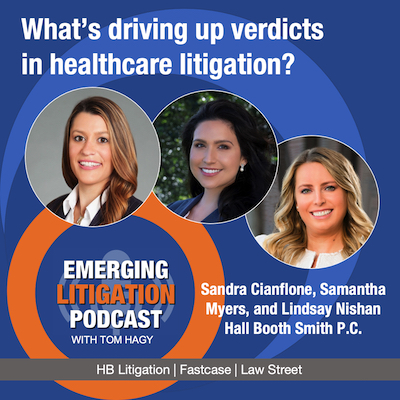
Social Inflation’s Impact on Jury Verdicts
Social Inflation's Impact on Jury Verdicts in Healthcare Litigation Our guests wrote in the Journal on Emerging Issues in Litigation: “These outsize awards are often driven by myriad factors including sympathetic jurors, societal conceptions about income and wealth of corporations, the use of emotion-driven ‘Reptile Theory’ tactics by plaintiff attorneys, the media spotlight on ‘bad apple’ physicians, and numerous other social factors. A new factor that influences elevated jury verdicts is the increasing volume of information—whether true or false—that is exchanged on social media platforms.” Listen to my interview with Hall Booth Smith P.C. attorneys Sandra Cianflone, Samantha Myers, and Lindsay Nishan, each of whom represents members of the healthcare industry, as they discuss what drives large verdict and what attorneys should consider in mitigating the effects of this phenomenon. In keeping with tradition, we may have strayed a bit from the topic. One guest’s Aunt Lulu made an appearance. It turns out Covid lockdowns may have produced more enthusiastic jurors. And I added another reason why writing and podcasting, and not the practice of law, was a better career path for me. (Apparently lawyers aren’t supposed to laugh in people’s faces. Noted.) This podcast is the audio companion to the Journal on Emerging Issues in Litigation, a collaborative project between HB Litigation Conferences and the Fastcase legal research family, which includes Full Court Press, Law Street Media, and Docket Alarm. The podcast itself is a joint effort between HB and our friends at Law Street Media. If you have comments or wish to participate in one our projects, or want to tell me how much you learned from Sandie, Sam, Lindsay, or Aunt Lulu, please drop me a note at Editor@LitigationConferences.com. Tom Hagy Litigation Enthusiast Host of the Emerging Litigation Podcast Jurors' perceptions of big corporations, insurance companies, drug companies, physicians and other healthcare providers [...]
The Shifting Gun Liability Landscape: Plaintiffs Say Companies are Marketing Illegally, Insurers End Up Paying
The Author Charlie spent more than four decades with General Reinsurance, three-quarters of which as the company’s Emerging Issues Officer. One colleague described him as “one of the most prescient and gifted industry futurists I have met in my 36 year professional career within the insurance industry. Entertaining and insightful, his ability to digest and communicate complex issues, many before they are readily apparent, is both a gift and a talent.” Charlie is also a member of the Editorial Board of Advisors for the Journal on Emerging Issues in Litigation. The Shifting Gun Liability Landscape: Plaintiffs Say Companies are Marketing Illegally, Insurers End Up Paying By Charlie Kingdollar On Feb. 15, 2022, Remington Arms, manufacturer of the Bushmaster AR15-style rifle agreed to pay $73 million to settle a lawsuit filed by the families of nine of the victims of the Dec. 14, 2012, Sandy Hook Elementary School shooting. The $73 million will be paid by four of Remington’s insurers (and likely their reinsurers).[i] Why is this a big deal? Insurers and reinsurers providing liability coverage for gun manufacturers did so believing that federal law protected gun manufacturers from liability arising from shootings under the federal Protection of Lawful Commerce in Arms Act (PLCAA). It seems likely that policy terms and conditions as well as pricing of the risk reflected that perceived liability protection. Things have changed. The Connecticut plaintiffs filed their suit under the Connecticut Fair Trade Practices Act. The plaintiffs alleged that the Bushmaster was a combat weapon and that Remington improperly marketed it to civilians – particularly trying to reach young men. In 2019, the Connecticut Supreme Court ruled that the federal PLCAA did have some carve-outs for state laws and subsequently declined Remington’s request to dismiss the lawsuit. [...]
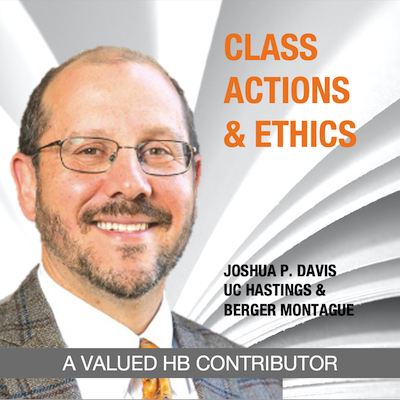
Robojudges: If Machines Could Make Judicial Decisions, Should They?
The Author A leading academic and practitioner, Joshua P. Davis (davisj@usfca.edu) is a nationally recognized expert on legal ethics and class actions, as well as on artificial intelligence in the law, antitrust, civil procedure, free speech, and jurisprudence. He has published more than 30 scholarly articles and book chapters on these subjects and is currently writing a book on AI titled Unnatural Law, which will be published by Cambridge University Press. He is Research Professor of Law at the University of California Hastings College of Law, and a Shareholder of the Berger Montague PC law firm and Manager of its new San Francisco Bay Area Office. Before taking these posts, for more than 20 years Davis was a tenured Professor of Law at University of San Francisco Law School, where he also served as the Director of the Center for Law and Ethics. Davis is also a member of the Editorial Board of Advisors for the Journal on Emerging Issues in Litigation, published by Fastcase Full Court Press. Tom Hagy, Editor in Chief. You can also listen to Josh on the Emerging Litigation Podcast! Robojudges: If Machines Could Make Judicial Decisions, Should They? By Joshua P. Davis Abstract: As artificial intelligence makes its way into every aspect of our daily lives—including the practice of law—humans have some decisions to make. Do we wish for AI to replace human judges? What are the risks and how might they be mitigated? What breakthroughs need to occur? How might robotic judges, or “robojudges,” perform better than human jurists? What surprises might be in store? Read on for the author’s perspectives on these important questions. After all, as he points out, AI is already being used by the judiciary, albeit to a limited [...]
Going Viral or Going Nuclear: Social Inflation’s Impact on Jury Verdicts …
The Authors All three authors are with the law firm of Hall Booth Smith, P.C., and concentrate on various aspects of healthcare defense. Lindsay A. Nishan (lnishan@hallboothsmith.com) is an Associate in the HBS Charleston office. Samantha Bowen Myers (smyers@hallboothsmith.com) is an Associate in their West Palm Beach, Florida, office. Sandra Mekita Cianflone (scianflone@hallboothsmith.com) is a Partner in the firm’s Atlanta office. She is also a member of the Editorial Board of Advisors for the Journal on Emerging Issues in Litigation, and a frequent contributor to the Emerging Litigation Podcast. Going Viral or Going Nuclear: Social Inflation’s Impact on Jury Verdicts and How to Safeguard Against It By Lindsay A. Nishan, Samantha B. Myers and Sandra M. Cianflone A juror’s perception of companies and healthcare providers is increasingly colored by TV and social media. The same is true for their understanding of the practice law or medicine, which may be as wrong as it is immovable. “Social inflation” refers to rising litigation costs and the resulting higher insurance payouts which drive up the cost of insurance. In this article the authors, each of whom represents parties in the healthcare industry, discuss the evolving social trends that lead jurors to render “nuclear verdicts,” and what attorneys should consider in mitigating the effects of this phenomenon. Social media feeds today are crammed with flashy advertisements from lawyers promising big-dollar settlements against “rich insurance companies.” The number of these commercials has spiked since the 1970s as the phenomenon known as "social inflation" has taken root in the legal system. Social inflation is a term of art that refers to rising litigation costs, the impact those costs have on insurance claim payouts, and how much the average policyholder is expected to pay for basic coverage. [...]

Persuasion Science for Trial Lawyers with John Blumberg
Persuasion Science for Trial Lawyers with John Blumberg John joins me to discuss his study of the science behind persuasion. He examines a number of important concepts for trial attorneys, such as how emotions overcome rational thought, and how mental fatigue interferes with how we receive information, leading us to take mental shortcuts rather than doing the hard work of critical thinking. He also writes about understanding the differences between liberal and conservative brains. In addition to being an author, John is a board-certified trial attorney based in Long Beach, California. He handles both legal and medical malpractice litigation and is on American Board of Trial Advocates. You will especially want to hear my contributions, such as what I know about the rule of threes. For example, a joke about a doctor, a lawyer, and a duck is much funnier than one about just a doctor and a lawyer. Unless, of course, at least one of them is a duck. This podcast is the audio companion to the Journal on Emerging Issues in Litigation, a collaborative project between HB Litigation Conferences and the Fastcase legal research family, which includes Full Court Press, Law Street Media, and Docket Alarm. The podcast itself is a joint effort between HB and Law Street Media. If you have comments or wish to participate in one our projects, or want to tell me how much you learned from John, please drop me a note at Editor@LitigationConferences.com. Tom Hagy Litigation Enthusiast and Host of the Emerging Litigation Podcast "Your proposition may be good, but let’s have one thing understood: Whatever it is, I’m against it. And even when you’ve changed it or condensed it—I’m against it!" —Professor Wagstaff (Groucho Marx) in the 1932 movie Horse Feathers Attorney John P. Blumberg’s new book, Persuasion Science for Trial [...]
 Can we rely on shareholders to compel corporations to meaningfully act on ESG issues? | By Rebecca Boon and John Rizio-Hamilton | Bernstein Litowitz Berger & Grossmann Gallery
Can we rely on shareholders to compel corporations to meaningfully act on ESG issues? | By Rebecca Boon and John Rizio-Hamilton | Bernstein Litowitz Berger & Grossmann
Can we rely on shareholders to compel corporations to meaningfully act on ESG issues? | By Rebecca Boon and John Rizio-Hamilton | Bernstein Litowitz Berger & Grossmann
The Authors Rebecca Boon has been litigating securities fraud and shareholder rights actions for over a decade, recovering more than $1.5 billion for the firm’s institutional investor clients. Her work at the firm expands beyond litigation. Rebecca has advanced equality in the workplace by co-founding the Beyond #MeToo working group and leading landmark recoveries that have resulted in hundreds of millions of dollars back to investors and important social change among industries. Contact: rebecca.Boon@blbglaw.com John Rizio-Hamilton is one of America’s top shareholder litigators. He works on the most complex and high-stakes securities class action cases, and has recovered billions of dollars on behalf of institutional investor clients. John led the trial team that recovered $240 million for investors in In re Signet Jewelers Limited Securities Litigation, a precedent-setting case that marks the first successful resolution of a securities fraud class action based on allegations of sexual harassment. Contact: johnr@blbglaw.com Can we rely on shareholders to compel corporations to meaningfully act on ESG issues? By Rebecca Boon and John Rizio-Hamilton This article was first published in the Responsible Investor, Aug., 10th, 2021. Posted with permission of the authors. Copyright 2021 by Rebecca Boon & John Rizio-Hamilton. All rights reserved. There is an ongoing debate about the role that regulators should take regarding corporate obligations and accountability for ESG issues. Earlier this year, the Ontario Capital Markets Modernization Taskforce weighed in with its long-anticipated recommendation on diversity quotas for corporate boards. After receiving significant industry feedback, the Ontario Taskforce changed its initial recommendation from a requirement that public companies meet specific diversity targets, to allowing companies to set their own targets, report them, and develop a timeline for implementation. This ‘market-based’ framework for diversity would rely on investors to push corporations and hold them accountable. [...]

PFAS Science with Jaana Pietari and Jim Fenstermacher and Litigation with Bob Chesler
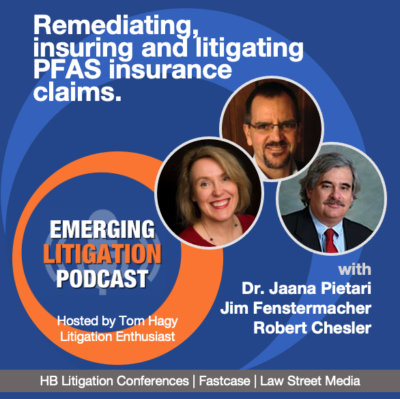
PFAS Science with Jaana Pietari and Jim Fenstermacher and Litigation with Bob Chesler In Part 1 of the episode, we discussed the PFAS from the scientific and environmental engineering perspective. And to do that I was fortunate to have Jim Fenstermacher and Dr. Jaana Pietari from the global engineering firm Ramboll. Jim and Jaana have deep experience in environmental remediation involving a variety of contaminants, including PFAS. In Part 2, I am joined by Robert Chesler of Anderson Kill. Bob is a long-time expert on insurance coverage for long-tail and other claims. He's considered a guru in the field, and has represented policyholders in disputes over coverage with insurers for as long as I've known him. It's a serious subject and these are seriously qualified folks. I did my part to make a mockery of scientific terms as I struggled to say the name of this family of chemicals. Fortunately for you my guests were much more linguistically nimble and it is their voices you will hear more of. This podcast is the audio companion to the Journal on Emerging Issues in Litigation, a collaborative project between HB Litigation Conferences and the Fastcase legal research family, which includes Full Court Press, Law Street Media, and Docket Alarm. The podcast itself is a joint effort between HB and Law Street Media. If you have comments or wish to participate in one our projects, or want to tell me how much you learned from Jaana, Jim and Bob, please drop me a note at Editor@LitigationConferences.com. Tom Hagy Litigation Enthusiast and Host of the Emerging Litigation Podcast p.s. Here's a bonus for you. Write to me and I will send you the latest issue of the Journal on Emerging Issues in Litigation with my compliments. That's some serious value right there. In our first two-part episode, we dive into the troubling existence of a group [...]

The Humble Beginnings and Wild Evolution of the TCPA with Joe Apatov
The Humble Beginnings and Wild Evolution of the TCPA with Joe Apatov Only $32 million! I mean, why bother even getting out of bed? Joining me to discuss the evolution of the TCPA is Joseph A. Apatov (japatov@mcglinchey.com), a member of the McGlinchey Stafford law firm’s Consumer Financial Services Litigation practice group. Based in their Fort Lauderdale office, Joe litigates on behalf of financial services clients in both state and federal courts, with an emphasis on defending banks, mortgage lenders and servicers, private-label card issuers, and automobile finance companies. Apologies for my trip down memory lane. Bear with me as I regale you with stories from the newsroom at Mealey’s Litigation Reports and the team’s anxious reliance on the "latest" technology: the facsimile machine. This podcast is the audio companion to the Journal on Emerging Issues in Litigation, a collaborative project between HB Litigation Conferences and the Fastcase legal research family, which includes Full Court Press, Law Street Media, and Docket Alarm. The podcast itself is a joint effort between HB and Law Street Media. If you have comments or wish to participate in one our projects, or want to tell me how much Joe enlightened you, please drop me a note at Editor@LitigationConferences.com. Tom Hagy Litigation Enthusiast and Host of the Emerging Litigation Podcast “The Telephone Consumer Protection Act had humble beginnings,” our guest writes, “with the bill’s sponsor explaining that the statute would permit consumers to bring small claims cases ‘without an attorney,’ and provides for an ‘amount of damages … fair to both the consumer and the telemarketer.’ Twenty-eight years after its enactment in 1991, the Eighth Circuit Court of Appeals affirmed a District Court’s decision to reduce a $1.6 billion jury award in a TCPA class action to only $32 million because the former was ‘shockingly large’ and ‘oppressive,’ in [...]


Where’s Your Head? Managing the Mind in Mediation with Jeff Trueman
Where's Your Head? Managing the Mind in Mediation with Jeff Trueman Joining me to discuss this is Jeff Trueman, an experienced, full-time mediator and arbitrator. Jeff helps parties resolve a wide variety of litigated and pre-suit disputes and interpersonal problems concerning catastrophic injuries, professional malpractice, wrongful death, employment, family business dissolution, real property, estate, and domestic relations. He is a panel mediator for the American Arbitration Association; a panel arbitrator for the Financial Industry Regulatory Authority; a Distinguished Fellow of the International Academy of Mediators; a recipient of the Paul A. Dorf Alternative Dispute Resolution Memorial Award by the Bar Association of Baltimore City; and will soon hold an LLM from the Straus Institute for Dispute Resolution at the prestigious Pepperdine School of Law. Finally, did I really suggest that having a mediator with a bad hip could help achieve a faster resolution? Did I really give a review of the HBO original movie Oslo, which I consider a must-see for anyone interested in conflict resolution? Did I really compare married couples during Covid-19 lockdowns to angry bees in a jar? Listen and find out. Spoiler alert: Yes. Yes I did. This podcast is the audio companion to the Journal on Emerging Issues in Litigation, a collaborative project between HB Litigation Conferences and the Fastcase legal research family, which includes Full Court Press, Law Street Media, and Docket Alarm. The podcast itself is a joint effort between HB and Law Street Media. If you have comments or wish to participate in one our projects, or want to tell me how Jeff really got you thinking, please drop me a note at Editor@LitigationConferences.com. Tom Hagy Litigation Enthusiast and Host of the Emerging Litigation Podcast "Attorneys possess many of the same characteristics as their human cousins." Someone said that. Probably me. They often bring to their jobs [...]
7th Circuit: Is Each Transmission of Biometric Data a BIPA Violation? | By Jennifer M. Oliver | MoginRubin LLP
7th Circuit: Is Each Transmission of Biometric Data a BIPA Violation? By Jennifer M. Oliver The outcome of this case will have a dramatic impact on statutory damages. The Seventh Circuit U.S. Court of Appeals has certified a question to the Illinois Supreme Court over the accrual of claims under the Illinois Biometric Information Privacy Act (BIPA). The question, posed by the court in Cothron v. White Castle Systems, Inc., reads: “Do section 15(b) and 15(d) claims accrue each time a private entity scans a person’s biometric identifier and each time a private entity transmits such a scan to a third party, respectively, or only upon the first scan and first transmission?” The case was brought by an employee of the White Castle hamburger chain, which requires fingerprint scans for employees to access computer systems. The plaintiff charged that sharing her fingerprints with a third party vendor violated the law. Cothron v. White Castle Sys., No. 20-3202, 2021 U.S. App. LEXIS 37593 (7th Cir. Dec. 20, 2021). An accrual rule based on each collection, opponents to such a finding argue, would pose potentially existential damages — especially in the class action context — since BIPA provides for statutory damages of $1,000 or $5,000 per violation. Parties disagree on whether BIPA damages are mandatory or discretionary, however. Should the court determine that the first scan is the only scan that starts the statute of limitations clock ticking, opponents to that interpretation say, anyone bringing a claim after five years would be out of luck, even if their private biometric data continued to be transmitted more than five years after the first occurrence. Preceding the federal court’s certification of this question by just five days, an Illinois appellate court ruled that, yes, claims under sections 15(a) and [...]
- The New Lloyd’s Market Association War, Cyber War and Cyber Operation Exclusions for Cyber Insurance Policies | By Vincent J. Vitkowsky | Gfeller Laurie LLP Gallery
The New Lloyd’s Market Association War, Cyber War and Cyber Operation Exclusions for Cyber Insurance Policies | By Vincent J. Vitkowsky | Gfeller Laurie LLP
The New Lloyd’s Market Association War, Cyber War and Cyber Operation Exclusions for Cyber Insurance Policies | By Vincent J. Vitkowsky | Gfeller Laurie LLP
The Author Vince Vitkowsky is a partner in Gfeller Laurie LLP, resident in New York. He focuses on cyber risks, liabilities, insurance, and litigation. Vince assists insurers and reinsurers in product development, and in all aspects of coverage evaluation and dispute resolution in many lines of business, including cyber, CGL, property, and professional liability. He also assists in complex claim evaluations, and if necessary, the defense of insureds in complex matters. Vince is also a member of the Editorial Advisory Board for the Journal on Emerging Issues in Litigation. Contact: vvitkowsky@gllawgroup.com More from Vince and his colleagues. The New LMA War, Cyber War and Cyber Operation Exclusions for Cyber Insurance Policies By Vincent J. Vitkowsky On November 25, 2021, the Lloyd’s Market Association released four War, Cyber War and Cyber Operation Exclusions (“Exclusions”). The LMA Cyber Business Panel spent well over two years drafting the Exclusions, which are models for use in standalone cyber insurance policies. Lloyd’s has agreed that they meet the requirement that all insurance and reinsurance policies written at Lloyd’s must, except in very limited circumstances, contain a clause which excludes all losses caused by war. The Exclusions address some difficult issues troubling the cyber insurance market for several years, following cyberattacks by nation-states (“states”) and threat actors associated with them. They attempt to reduce uncertainty for both insurers and policyholders. Five interrelated issues. The treatment of collateral damage (borrowing a concept from the traditional Law of Armed Conflict). Some state-sponsored attacks had significant effects on many entities that were not the intended targets. How attribution is to be determined, and whether the insurers have an obligation to make payments while attribution is being determined. The extent to which attacks by non-state actors associated with a state [...]

The Rise of Robojudges with Josh Davis
The Rise of Robojudges with Joshua Davis The good news for all of us, not the least of which are the robe and wig industries, is that we still have time. Artificial intelligence is advancing rapidly, but it's still not able to think like a learned jurist. We can say it will have flaws, but so do our human deciders. So it will be a tradeoff, right? What are the risks? What are the upsides? Will robojudges be able to absorb infinitely more information quickly? Will they hand down decisions free from the influence of bias? Wouldn't it be great to eliminate conflicts of interest? Joining me to discuss this not-so-out-there concept is Joshua P. Davis, a nationally recognized expert on legal ethics, class actions, and artificial intelligence in the law. He is Research Professor of Law at the University of California Hastings College of Law, and Shareholder and Manager of Berger & Montague, P.C.'s new San Francisco Bay Area Office. For more than 20 years Josh was a tenured Professor of Law at the University of San Francisco Law School, where he also served as the Director of the Center for Law and Ethics. Josh is authoring two books, one titled Unnatural Law, dealing with AI and the law, and a second on the important issue of class action ethics. Finally, remind me never to assume anything when I ask Josh a question. I said something like, "Surely we're not talking about sci-fi robots here," to which he basically said, "Not so fast." This happened more than once. When will I learn? This podcast is the audio companion to the Journal on Emerging Issues in Litigation, a collaborative project between HB Litigation Conferences and the Fastcase legal research family, which includes Full Court Press, Law Street Media, Docket Alarm and, most recently, Judicata. If you have comments [...]

Broken Privilege and IoT with Kathryn Rattigan
Broken Privilege and IoT with Kathryn Rattigan Joining me to discuss this emerging area of law is Kathryn M. Rattigan, a member of the Business Litigation Group, the Data Privacy + Cybersecurity Team, and the Drone Compliance Team in the Rhode Island office of Robinson Cole. Kathryn provides clients guidance regarding privacy and data protection in connection with mobile devices, data storage technologies, mobile apps, and location-based services. She assists with the development of website and mobile app privacy policies and terms and conditions. Kathryn is a frequent contributor to the excellent Robinson Cole Data Privacy + Cybersecurity Insider blog. She holds a J.D. from the Roger Williams University School of Law and a B.A. (magna cum laude) from Stonehill College. This podcast is the audio companion to the Journal on Emerging Issues in Litigation, a collaborative project between HB Litigation Conferences and the Fastcase legal research family, which includes Full Court Press, Law Street Media, Docket Alarm and, most recently, Judicata. If you have comments or wish to participate in one our projects, or want to tell me how insightful and informative Kathryn is, please drop me a note at Editor@LitigationConferences.com. Finally, yes, "skeevy" is a word. And the law is not settled as to whether Shiloh has privacy rights. Tom Hagy Host of the Emerging Litigation Podcast There are now billions and billions of interconnected devices in the world with more coming online every day. Smart cars. Smart cities. Smart agriculture and so much more. Even our pets are connected. And you have to look no further than the Colonial Pipeline ransomware attack to see the real-world consequences of what criminals can pull off by connecting with things large and small. Worried about your privacy? Well. There is plenty to worry about. Fortunately we also have a lot of people fighting back [...]

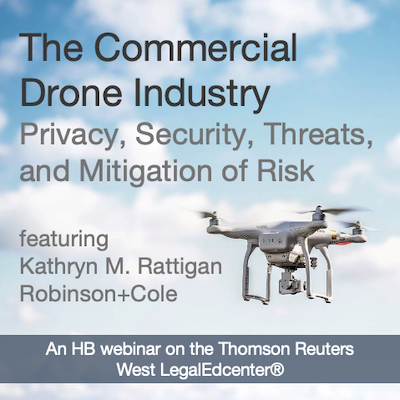
The Commercial Drone Industry: Privacy, Security, Threats, and Mitigation of Risk
HB presents a CLE-eligible webinar Now on-demand at the West LegalEdcenter THE COMMERCIAL DRONE INDUSTRY Privacy, Security, Threats, and Mitigation of Risk Drones have become an increasingly valuable tool for businesses of all types and sizes. Drones are already being used in many applications, but more will certainly arise as the technology advances. This means that certain risks, like cyber threats, will also continue to present themselves. Protecting the transmission and storage of data collected through drones is critical. Unfortunately, security usually comes as an afterthought. The drone industry is part of the aviation industry, which, based on its knowledge, keeps safety as a number one concern. Part of that safety is having proper protection for your systems, including security as a fundamental design principle. Take this webinar to gain insights on the topics listed below, and shared by an attorney who practices on the cutting-edge of this evolving technology. Topics: Defining drones. Current and future applications. FAA Modernization and Reform Act of 2012. FAA Part 107 Regulations and waivers. Resources, e.g. the FAA Drone Zone and LAANC Portal. Penalties for violations. Privacy implications. Drones as weapons. Vulnerability to cyber attacks. Take it now! What you get: 1+ CLE credits (subject to bar rules). Insights from an experienced professional who specializes in this area of the law. The complete PowerPoint presentation. Continued access to the complete recording for later use. Answers to your questions. Fee: No additional charge to subscribers to the West LegalEdcenter. Non-subscribers may take the course for $170. Meet the Speaker Kathryn Rattigan Robinson & Cole LLP Kathryn Rattigan is a member of the firm's Business Litigation Group and Data Privacy [...]
The Cyber Insurance Market Has Problems: A Conversation With Tom Johansmeyer
The Cyber Insurance Market Has Problems: A Conversation With Tom Johansmeyer The author of the piece is my guest on our latest episode. He is Tom Johansmeyer, ARM, is head of PCS, a Verisk business. PCS investigates and provide, independent loss estimates on catastrophes and large individual losses to the benefit of the global risk and capital supply chain. Tom has focused on the broad and rapid expansion of PCS, leading the team into Japan, New Zealand, and other APAC regions in 2019 – as well as Mexico. Tom is the architect of the PCS entry into global specialty lines, most recently adding large risk loss reporting to the group’s portfolio. Previously, Tom held insurance industry roles at Guy Carpenter (where he launched the first corporate blog in the reinsurance sector) and Deloitte. Personally, I like his LinkedIn description: "Aspiring cyclist and distance swimmer, former soldier. Leading the global charge at PCS. Haven't driven anything with a motor since 2007." Excellent. This podcast is the audio companion to the Journal on Emerging Issues in Litigation, a collaborative project between HB Litigation Conferences and the legal news folks at Law Street Media, and the Fastcase legal research family, which includes Docket Alarm and Judicata. If you have comments or wish to participate in one our projects, or want to tell me how insightful our guests are, please drop me a note at Editor@LitigationConferences.com. You might notice that I misused a commonly used term, one specifically common in the world of insurance, or maybe you weren't paying that much attention. That would make two of us. Also, Tom J. was just a fun interview and I hope to get him back! I like the way he explained his candor at the end. He suffers from an infliction that I wish were a pandemic. I hope you enjoy it. Tom [...]
Public Justice Shares Inside Look at Roundup Trial and Appeal in First Episode of “Justice Pod”
Public Justice Discusses Hardeman v. Monsanto in First Episode of Justice Pod That is according to a post written by Leslie Brueckner, Senior Attorney with Public Justice following the May 2021 Ninth Circuit U.S. Court of Appeals ruling against Monsanto, and for Edwin Hardeman, a California resident who developed non-Hodgkin’s lymphoma after decades of exposure to Roundup. The jury awarded Hardeman $5,267.634.10 in compensatory damages, and $75 million in punitive damages. The district court reduced the punitive damages award to $20 million. In this inaugural episode of Justice Pod: Conversations with Public Justice Change Makers, Leslie, is joined by David J. Wool, an attorney with the Wagstaff Law Firm. Wool and Jennifer A. Moore of the Moore Law Group, were on the trial team led by highly-regarded mass tort plaintiff attorney Aimee Wagstaff. Public Justice’s Brueckner served as co-lead appellate counsel along with Wool before the Ninth Circuit. Listen to what they felt inspired the jury to return such a substantial award, how Monsanto attempted to defend its actions, what the evidence revealed, and what it was like in the courtroom with the Hardeman family when the foreman read the verdict. I hope you find the episode inspiring and informative! Susan Gombert Host of Justice Pod: Conversations with Public Justice Change Makers Listen Now! Monsanto Co. has “stopped at nothing to deny the overwhelming scientific evidence” that its widely used and extremely profitable weed killer, Roundup, is a “deadly product that causes cancer and ruins lives and families.”

Putting an AI App to Work to Protect IP with Jan-Diederik Lindemans and Judith Bussé
Putting an AI App to Work to Protect IP with Jan-Diederik Lindemans and Judith Bussé They are Crowell & Moring partner Jan-Diederik Lindemans and Judith Bussé, both part of the firm’s Technology & Intellectual Property Department in Brussels. And, working with Neotalogic, they developed an interactive app that takes you through a set of attorney-crafted questions that, depending on your answers, take you to other questions. The app applies a layer of artificial intelligence to enhance the information gathering process. Listen to what these innovators had to say about the Crowell & Moring IP Check-Up application, and take it for a test drive yourself. Or, here is a quick video of someone using the app. This podcast is the audio companion to the Journal on Emerging Issues in Litigation*, a collaborative project between HB Litigation Conferences and the legal news folks at Law Street Media, and the Fastcase legal research family, which includes Docket Alarm and Judicata. If you have comments or wish to participate in one our projects, or want to tell me how insightful our guests are, please drop me a note at Editor@LitigationConferences.com. Tom Hagy Host of the Emerging Litigation Podcast * Highly regarded insurance and reinsurance industry attorney Laura Foggan of Crowell & Moring's Washington, DC, office is on the Editorial Advisory Board. Thanks to Laura for connecting me with J.D. and Judith. An organization’s intellectual property is often its most valuable asset. Whether it’s a patent or a trademark, a graphic design or proprietary market information, or just the unique way they do what they do, organizations must protect their innovations or risk significant damage to their future prospects. Assessing the vulnerabilities of such valuable inventory is as important as it is time-consuming. But a portfolio protection and process review involves answering the same long set of questions posed to any organization, no matter what [...]
Strategies for Maximizing Insurance Recovery for Climate Change–Related Loss and Damage
Strategies for Maximizing Insurance Recovery for Climate Change–Related Loss and Damage Abstract Losses from natural catastrophes are costing many tens of billions as year, from hurricanes and tornadoes to record-breaking rainfall and floods. Whether the insurance industry will or can provide coverage for all of the devastating effects of climate change (or, as some might put it, a new and calamitous phase in our earth’s existence) only time will tell. In the meantime, policyholders must cross their Ts if they expect coverage. In this article the author shares insights on the complex but essential task of documenting and valuing post-storm losses. Author Dennis J. Artese (dartese@andersonkill.com) is a shareholder in the New York office of Anderson Kill P.C. His practice concentrates on insurance recovery litigation, with an emphasis on securing insurance coverage for first-party property losses, construction accidents, and third-party liability claims. About The Journal on Emerging Issues in Litigation is a co-production of HB, Fastcase, and Law Street Media. You can also hear the complementary (and complimentary) Emerging Litigation Podcast wherever podcasts appear. For questions, contact Tom Hagy, Editor in Chief, at Editor@LitigationConferences.com.



Biotech Patent Wars: If at First You Don’t Succeed . . . University of California v. The Broad Institute
Biotech Patent Wars: If at First You Don’t Succeed . . . University of California v. The Broad Institute Abstract This case discussed in this article is about two methods of editing DNA: one that has infinitely more lucrative applications because it can edit human DNA (plus all animals and plants), another that works in cell-free environments. Whether inventions are separate or part of the same innovation is an important factor in patent interference disputes; if there are two patentably distinct inventions there cannot be interference. One party in this case lost its argument that there was only one invention at issue, but returned with a second interference claim, arguing that it was the first inventor to constructively reduce to practice the animal and plant DNA editor. In this article, the author examines the nuances and intricacies of the patent process in the world of biology, and how patent lawyers must possess a level of knowledge in disciplines related to the inventions they seek to protect. This is necessary, for example, in understanding whether an invention is a significant improvement over prior innovations. The author also shares the importance of confidentiality especially when potentially groundbreaking (and lucrative) inventions are in development. Author Adrienne B. Naumann (adriennebnaumann@uchicago.edu) practices intellectual property law at the Law Office of Adrienne B. Naumann in Skokie, Illinois. She has held leadership positions relating to patents, science, and technology law with the Chicago Bar Association and the Converging Technologies Association. She currently serves as Secretary on the Board of the University of Chicago Women’s Alliance. Ms. Naumann has also written numerous articles on intellectual 56 Journal of Emerging Issues in Litigation property law and her book United States Federal Intellectual Property Developments includes discussion of decisions under the Defend Trade Secrets Act as well [...]